Natalie Wexler delivers a jarring reminder that the very tools we celebrate for saving time may be eroding the mental muscle required to think. While the conversation around generative artificial intelligence often fixates on cheating or copyright, Wexler pivots to a more insidious danger: the atrophy of our internal knowledge base. She argues that without the friction of memorization, the brain loses its ability to process new information critically.
The GPS of the Mind
Wexler opens with a personal anecdote about her son dismissing GPS as a "crutch," a label she initially rejected until a new paper by Barbara Oakley forced a reevaluation. The core of Oakley's argument, as Wexler presents it, is that cognitive offloading prevents the formation of mental models. "When you read a map, you have to exert some mental effort to figure out how to reach your destination," Wexler notes, contrasting this with the passive nature of turn-by-turn navigation. The danger is not just getting lost when the battery dies; it is the inability to ever develop a spatial understanding of the world in the first place.
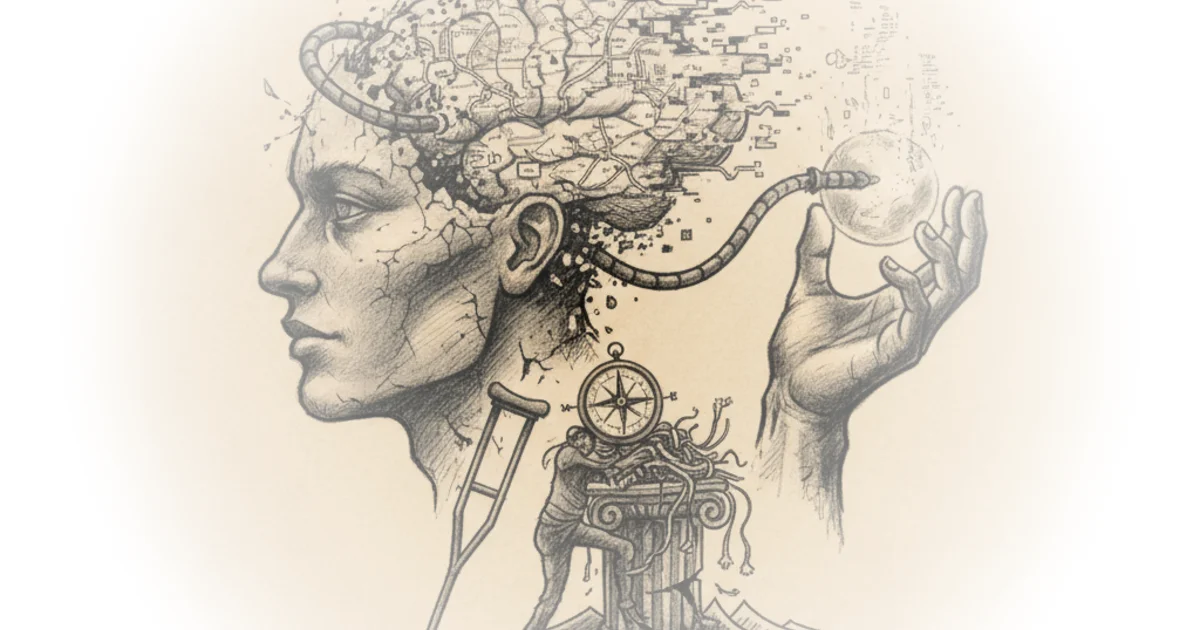
This framing is effective because it moves the debate from moral panic to cognitive science. Wexler writes, "The 'memory paradox' that gives the paper its title is that 'in an age saturated with external information, genuine insight still depends on robust internal knowledge.'" This is the piece's most vital insight. It challenges the modern educational dogma that dismisses memorization as "rote" and instead elevates it as the necessary foundation for higher-order thinking. As Wexler puts it, "It's impossible to think critically about a subject you know nothing about."
Critics might argue that in an era of instant information retrieval, the ability to memorize facts is a diminishing return. However, Wexler counters this by highlighting the speed of human intuition. She cites Oakley's chilling example of two nurses: one who memorized math facts and one who did not. When the calculator displays an erroneous "500" for five times ten, the nurse with internalized knowledge immediately recognizes the error, while the other proceeds to overdose a patient. "The schema—the mental model—to immediately recognize that something is wrong," Wexler explains, is a safety mechanism that no external tool can replicate in real-time.
The Decline of the Flynn Effect
The stakes of this cognitive shift are quantifiable. Wexler draws on the "Flynn Effect," the historical trend of rising IQ scores, which has reversed in wealthier nations since the mid-1970s. She links this decline directly to the dual forces of anti-memorization curricula and the proliferation of devices that spare us cognitive effort. "We can only imagine what the cognitive effects of generative AI tools like ChatGPT will be in the future," she warns, noting that the decline is already visible in higher education.
Professors report that students using AI to summarize texts feel prepared but crumble when asked to interpret passages independently. One professor described the phenomenon as "like going to the gym and asking a robot to lift weights for you." This analogy lands hard because it exposes the illusion of competence. The student receives the output without the struggle that builds the capacity for analysis. Wexler observes that students are becoming "metacognitively lazy," a state where they believe they understand a topic simply because an algorithm has articulated it for them.
Genuine insight still depends on robust internal knowledge, even in an age saturated with external information.
The Classroom Dilemma
Wexler acknowledges the inevitability of AI, noting that even Oakley's team used artificial intelligence to refine their manuscript. The solution, she argues, is not to ban the technology but to fundamentally restructure how we value knowledge. "Schools and teachers will need to somehow put guardrails in place," she writes, but the deeper fix requires a cultural shift within the K-12 system. We must stop viewing factual knowledge as "rote trivia" and start seeing it as "the glue for high-level thinking."
She highlights a promising, albeit hesitant, shift in some schools where curricula are moving away from abstract skills like "making inferences" toward building substantive knowledge. Yet, even here, the stigma of "memorization" persists. One teacher is quoted saying, "When students see their learning linking to the real world, they're not memorizing: They're weaving new knowledge into their lives." Wexler dismisses the semantic gymnastics, arguing that as long as the information is stored in long-term memory, the label doesn't matter.
However, the application of these findings is not without friction. Wexler points out the difficulty of translating Oakley's research into the humanities. Oakley suggests students should only grapple with problems once they have achieved 85% accuracy in practice. In math, this is measurable; in literature or philosophy, determining that "sweet spot" is far more subjective. "As always with research findings, though, it may not be a simple matter to transfer them to the classroom," Wexler concedes. This is a crucial counterpoint: the cognitive science is clear, but the pedagogical implementation in complex subjects remains an open challenge.
Writing as the Final Frontier
The commentary concludes by applying the declarative-to-procedural knowledge framework to writing. Wexler argues that while spelling and grammar can become automatic, the act of constructing arguments and analyzing texts requires constant, deliberate effort. She posits that if schools provided explicit instruction and guided practice in writing, they could "muffle the siren song of ChatGPT." The goal is to make the cognitive work of writing less overwhelming, thereby reducing the temptation to outsource it.
Wexler's final verdict is stark: "Placing guardrails on ChatGPT and banning phones from classrooms are common-sense measures. But they're unlikely to be enough." The only way to preserve deep reading and critical thought is to embrace the hard work of building content knowledge. As she writes, "Our education system also needs to embrace building students' content knowledge—and, I would add, teaching them to write about what they're learning."
Bottom Line
Wexler's strongest argument is the reframing of memorization not as a relic of the past, but as the essential infrastructure for future intelligence. Her biggest vulnerability lies in the practical difficulty of implementing this shift in a system designed for efficiency and abstract skill acquisition. The reader should watch for how schools navigate the tension between AI integration and the deliberate cultivation of internal knowledge, as this will define the cognitive capabilities of the next generation.