Mona Mona's November 21, 2025 roundup does not merely list philosophical texts; it constructs a urgent map of a world fracturing under the weight of algorithmic colonization, geopolitical violence, and the quiet erosion of human connection. In an era where digital noise often drowns out ethical clarity, Mona Mona curates a collection that insists on the radical necessity of grief, resistance, and the hard work of seeing the unseen. This is not a passive digest of ideas, but a call to arms for the mind, arguing that philosophy is the only tool sharp enough to dissect the specific agonies of late 2025.
The Architecture of Loss and Resistance
The collection opens with a striking juxtaposition: the technological promise of AI against the irretrievable reality of death. Mona Mona highlights Omer Al Tijani's work on the futility of digital resurrection, noting that "AI won't bring your dead loved ones back." This is a crucial corrective to the current technological optimism, grounding the reader in the physical limits of the machine. The commentary shifts immediately to the tangible costs of conflict, where the abstract becomes visceral. Mona Mona writes about the "Sudanese Kitchen cookbook" as a vital act of documentation in a country where "hunger has been weaponized in extreme ways." Here, the argument is that preserving culture is not a luxury but a form of survival against erasure.
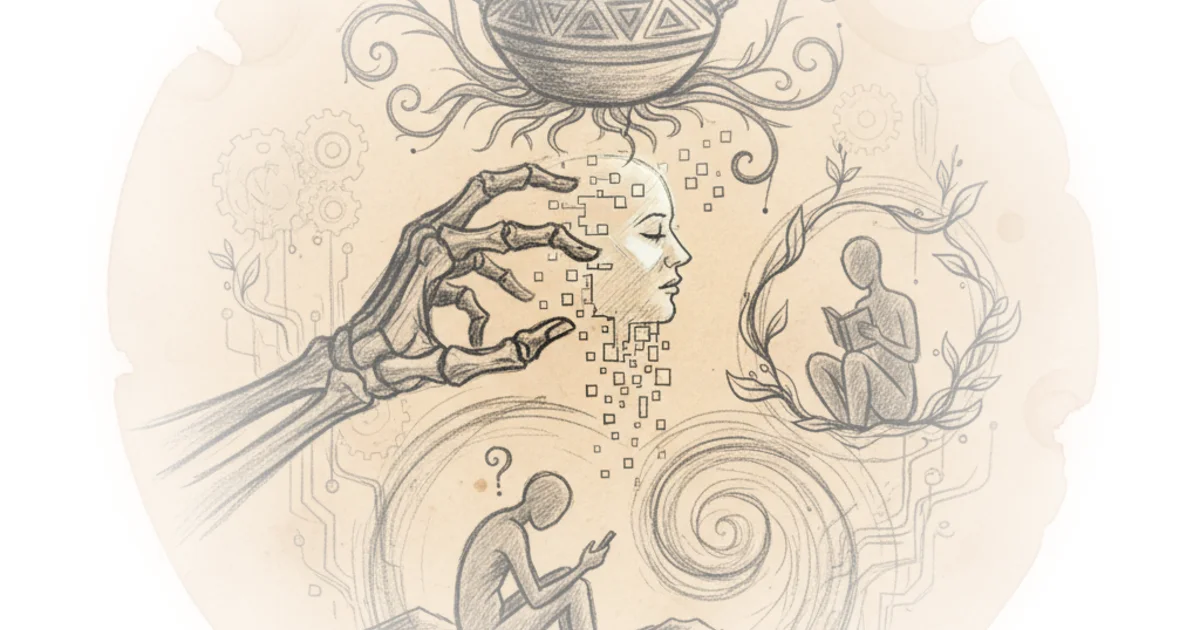
The human cost of these systemic failures is further explored through the lens of disenfranchised grief. Mona Mona points to a piece on "how to honor a loss that others may not see or recognize," suggesting that the modern world has created a new category of sorrow that lacks social rituals. This framing is powerful because it validates the silent suffering of those marginalized by official narratives. However, one might argue that focusing solely on individual emotional processing risks obscuring the structural violence that creates such grief in the first place. Yet, Mona Mona's curation suggests that healing the self is the first step toward challenging the system.
In a country ravaged by war and where hunger has been weaponized in extreme ways, The Sudanese Kitchen cookbook works against invisibility and erasure.
The State, The Algorithm, and The Self
The roundup pivots to the mechanisms of control, examining how power operates through both traditional statecraft and new digital frontiers. Mona Mona selects an article titled "Privacy as Jihad," defining it as "a discipline to protect the human principle from algorithmic colonization." This metaphor is provocative, equating the defense of personal data with a spiritual and existential struggle against a dehumanizing force. The argument implies that the algorithm is not just a tool but an occupying power that seeks to rewrite human agency.
This theme of power is expanded to the geopolitical stage, where Mona Mona highlights a piece on the "Trillion-Dollar Vassal." The text connects the dots between the executive branch's foreign policy, the war in Gaza, and the financial machinery of sovereign wealth funds. Mona Mona notes how these elements "converged in a firestorm of finance, geopolitics, and genocide," refusing to let the reader view economic policy as separate from human suffering. The curation here is uncompromising, forcing a confrontation with the reality that capital and violence are often two sides of the same coin. Critics might suggest that linking financial instruments directly to genocide oversimplifies the complex causal chains of international relations, but the piece's strength lies in its refusal to accept the status quo as neutral.
Mona Mona also touches on the internal landscape of the self, quoting George Eliot on the nature of jealousy: "one of the tortures of jealousy is that it can never turn away its eyes from the thing that pains it." This observation serves as a microcosm for the broader societal obsession with the sources of our pain, whether they be algorithms, enemies, or the past. The argument suggests that true freedom requires the difficult discipline of looking away.
The Ethics of Existence in a Fractured World
As the roundup moves toward the end, the focus narrows to the interpersonal and the philosophical foundations of a just society. Mona Mona includes a piece on Simone de Beauvoir, highlighting her insight that "love doesn't mean the same thing to men and women," a reminder that gendered power dynamics permeate even our most intimate spaces. This is followed by a discussion on the "Philosophical Case for Bitcoin," which frames cryptocurrency not just as an asset but as a tool for "Resistance Money."
The collection concludes with a reflection on the "Philosopher's Guide to Watching Everything Fall Apart," invoking Walter Benjamin's Angel of History. Mona Mona writes that the angel is "blown backward into the future" by a storm of progress, unable to fix the pile of debris behind. This image captures the mood of the entire roundup: a sense of witnessing catastrophe while being powerless to stop the momentum of history. The argument is that philosophy does not offer a way out of the storm, but a way to see the debris clearly.
Virtues need virtues to stay virtues.
Bottom Line
Mona Mona's curation succeeds by refusing to separate the personal from the political, the emotional from the structural. The strongest element of this piece is its insistence that in 2025, the act of thinking is an act of resistance against erasure and algorithmic control. Its vulnerability lies in the sheer density of the crisis it presents, which could leave the reader feeling paralyzed rather than empowered. The reader should watch for how these philosophical frameworks translate into concrete action, as the text brilliantly diagnoses the disease but leaves the prescription to the individual's courage.