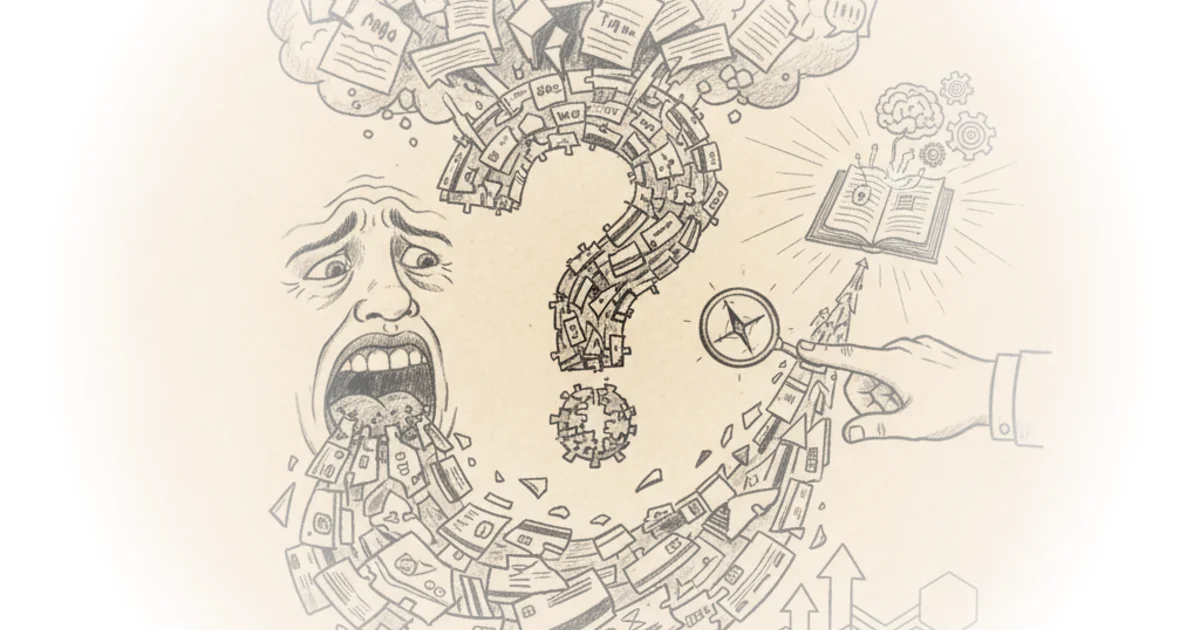
In an era where a single headline can trigger global panic, Hank Green of Crash Course offers a startlingly practical antidote: the problem isn't just bad science, but the systematic distortion of nuance as information moves from the lab to the living room. He argues that we are not drowning in lies, but rather suffocating in a filtered reality where the most alarming data points are amplified while the context is stripped away. This is not a plea for blind skepticism, but a masterclass in digital literacy that reveals how even well-intentioned organizations can inadvertently weaponize uncertainty.
The Iceberg of Information
Green begins by dismantling the viral claim that humans consume a credit card's worth of plastic weekly. He notes that while the statement is technically possible, it represents a deliberate narrowing of a much broader scientific range. "That CNN article isn't the whole story," Green writes. "It's just the part we see as consumers of science news. That science news tastes bad. Think of it like the tip of the iceberg. There's a lot more going on below the surface." This metaphor is effective because it shifts the blame from the reader's gullibility to the structural mechanics of news production. The original study from the University of Newcastle presented a range from 0.1 grams to 5 grams, yet the advocacy group, the Worldwide Fund for Nature (WWF), highlighted only the upper limit to sound an alarm.
The commentary here is sharp: Green identifies that different actors have different goals. The WWF, as an advocacy group, aims to mobilize support for nature preservation, which incentivizes emphasizing the worst-case scenario. "Considering an outlet's goals gives us as consumers more information to consider," Green explains. "It gives us a broader context than just the story would alone." This reframing is crucial. It moves the conversation from "is this true?" to "why is this being presented this way?" Critics might argue that highlighting the worst-case scenario is a necessary strategy for advocacy in the face of climate and environmental crises, but Green's point remains valid: without the range, the public cannot assess the actual magnitude of the risk.
News organizations, by the way, also have goals that we should take into consideration. like the goal to get a lot of people to click on an article and a headline that says you might eat between a tenth of a gram and five grams of microplastics every week is not going to get the clicks.
This observation about the economic incentives of media is the piece's most uncomfortable truth. A headline featuring a range of uncertainty is boring; a headline featuring a credit card is terrifying. Green traces the distortion through the chain of custody: from the primary source (the scientists), to the secondary source (the WWF report), to the tertiary source (the news article). He notes that "sometimes when science gets reported, it can also get distorted. Sometimes it's an honest mistake. Someone somewhere along the way got their facts mixed up. We call that misinformation." Yet, he quickly pivots to the more insidious threat: disinformation. "But because, as the kids say, we live in a society, we also have to worry about disinformation, information that is intentionally misleading or false." The distinction is vital, as it prevents the reader from dismissing all advocacy or news as malicious, while still demanding rigor.
The SIFT Method: A Toolkit for the Busy Mind
For the busy professional, Green offers a specific, actionable framework known as SIFT, developed by digital literacy expert Mike Caulfield. This is not a call to become a full-time fact-checker, but a set of heuristics to apply in seconds. "That's the key, Hank. You don't dig, you sift," Green says, introducing the acronym. The first step, Stop, is a pause button for emotional reactions. "Stop when you see something that triggers a strong emotional response," he advises. This is particularly relevant given the historical tendency of science journalism to amplify fear, a phenomenon well-documented in the coverage of microplastics and other emerging threats where the "scary" narrative often overshadows the data.
The second step, Investigate the source, requires looking beyond the domain name. Green demonstrates this by checking a media bias chart, noting that while CNN is reputable, its specific article might still suffer from the structural issues of the industry. "We call this strategy lateral reading," Green explains. "Checking other websites, newspapers, and media guides like this one to make sure that the source you're getting the original information from is on the up and up." This approach is far more efficient than reading the entire article before questioning its validity. It aligns with the broader lesson from the companion deep dive on science journalism: the medium often shapes the message as much as the content itself.
Then, you won't be surprised to hear the T. T is for trace claims to their original context. This is a big one. Often when we see quotes or images online, they're taken out of context. So tracing them back to their origin can help us figure out if we're seeing the whole story.
Green's application of this step to the plastic story is the ultimate proof of concept. By tracing the claim back to the Newcastle study, the "credit card" narrative collapses into a nuanced range of 0.1 to 5 grams. "The high end of this range which was in the original report is actually 50 times greater than the low end of the range," Green points out. "That's a lot." This single sentence encapsulates the entire problem of modern information consumption: the loss of the middle ground. The SIFT method forces the reader to recover that middle ground.
The Limits of Trust and the Rise of AI
The commentary concludes with a necessary warning about the changing landscape of information. Green explicitly states that generative AI tools do not pass the SIFT test. "Chat GPT and other generative AI tools do not pass the SIFT test. They are not trustworthy as primary sources." This is a critical distinction for a generation increasingly reliant on AI for summaries. While AI can synthesize information, it cannot verify the chain of custody or the intent behind a claim. "Reliability isn't [a personal choice]," Green asserts. "Some sources are just more reliable and more trustworthy than others. And our personal biases don't change that."
He acknowledges that even the best tools have limits. "But it's not foolproof. Even the SIFT method will let us down sometimes." This humility strengthens the argument, as it admits that critical thinking is a practice, not a perfect shield. The reference to the "tide of mistruths" suggests that the environment is hostile, but that "tools like lateral reading are some of the best shields we have." The argument is bolstered by the historical context of how science communication has evolved; just as the cherry-picking of data has long been a tactic in policy debates, the speed of digital dissemination has only accelerated the distortion.
Thinking critically about the sources we're getting our news from is one of the best ways to make sure we aren't consuming a credit card's worth of bad information every week.
Bottom Line
Crash Course's strongest move is reframing the problem of misinformation not as a failure of individual intelligence, but as a failure of information architecture that rewards extremity over accuracy. The argument's greatest vulnerability is the assumption that busy readers have the time or patience to consistently trace claims to their primary sources, even with a streamlined method like SIFT. However, the verdict is clear: in a world where the "credit card" headline is designed to bypass our critical filters, the only defense is to stop, investigate, and trace the story back to its origin before sharing it. The most reliable path forward is not to distrust everything, but to understand exactly who is speaking, why they are speaking, and what they are leaving out.