Matt Stoller delivers a blistering autopsy of Spirit Airlines that refuses to accept the convenient narrative that a single regulatory decision killed the carrier. Instead, he argues that the airline's collapse is the inevitable result of decades of unchecked consolidation, predatory pricing by legacy carriers, and a financial system that prioritizes asset stripping over operational continuity. For busy listeners tracking the fragility of the modern economy, this piece cuts through the noise to reveal how the "Spirit effect"—the very mechanism that kept airfares low for millions—was systematically dismantled by the industry's largest players.
The War Narrative and the Real Culprits
Stoller immediately challenges the administration's attempt to pin Spirit's liquidation on the Iran conflict and soaring jet fuel costs. While acknowledging that fuel prices have doubled, he points out that this is a global shock that should have triggered a unified industry response, not a targeted liquidation. "Legacy airlines don't really compete with each other," Stoller quotes JetBlue CEO Robin Hayes, a statement that sets the stage for his argument that the industry is a cartel rather than a competitive market. The author notes that while the low-cost sector requested $2.5 billion in relief, the administration's failure to negotiate a bailout was less about fiscal prudence and more about political maneuvering.
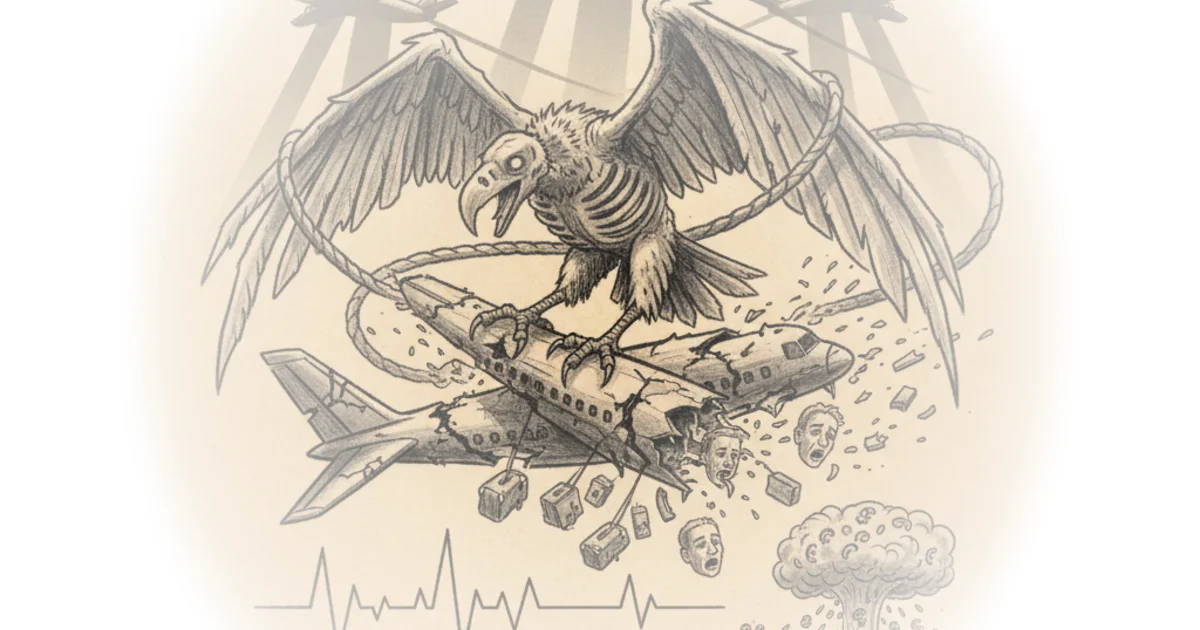
The commentary highlights a disturbing detail: the legacy carriers actively lobbied against saving Spirit. "They promised the Trump administration they'd certainly hire Spirit's employees, arguing that Spirit should be allowed to fail," Stoller writes. This hypocrisy is stark when contrasted with their behavior during previous crises. The author suggests that the vulture investors behind Spirit's debt—firms like Citadel and Ares—calculated that liquidating the airline's assets, such as airport gates and slots, would yield more profit than keeping it flying. "They'd recover more money liquidating Spirit's gates and airport slots and firing the 17,000 workers," Stoller notes, attributing the human cost of 17,000 job losses directly to financial engineering.
The motive for Wall Street to blame the antitrust enforcers under Biden is clear. They don't like any constraints on their behavior.
Critics might argue that the administration's refusal to intervene was a necessary market correction, but Stoller's evidence regarding the coordinated lobbying efforts suggests a deliberate strategy to eliminate a competitor rather than a genuine market failure.
The JetBlue Factor and the Illusion of Merger
A significant portion of the piece dismantles the narrative that blocking the JetBlue-Spirit merger was the death knell for the low-cost carrier. Stoller points out the absurdity of blaming antitrust enforcers when the merger itself would have eliminated Spirit as an independent entity. He cites Transportation Secretary Sean Duffy's claim that blocking the deal was a "MASSIVE MISTAKE," only to counter it with the reality that the deal was legally flawed from the start. "Spirit's own executives thought it was an illegal deal and publicly said so," Stoller emphasizes, reminding readers that the airline's board warned shareholders against the bid.
The author describes the proposed merger as a dangerous gamble for both parties. "Putting together JetBlue and Spirit was a bit like having two drunks holding each other up," he writes, illustrating the financial fragility of both carriers. Had the merger proceeded, the resulting entity would have been saddled with a debt-to-capital ratio of 110%, a precarious position that likely would have led to the liquidation of both airlines. Stoller argues that the narrative blaming the Biden administration is a distraction from the fact that JetBlue's strategy was to "rip out seats from Spirit's planes and raise prices, by up to 40%."
The Big Four and the Death of Competition
Stoller's most compelling argument lies in his analysis of the "Big Four" legacy carriers—American, Delta, Southwest, and United—and their systematic destruction of low-cost competition. He references the work of analyst Bill McGee to show how the industry has bifurcated into profitable giants and struggling smaller airlines. The author details a sophisticated strategy of predatory pricing, where legacy carriers would strategically discount a small number of seats on routes competing with Spirit to render the flight unprofitable. "Consumers of low fare airlines tend to book a few weeks before their trip," Stoller explains, describing how a 9% revenue loss on a single flight could push Spirit into the red.
This behavior is not new; Stoller traces it back to the deregulation era of 1978, noting how Laker Airlines was driven out of business in the early 1980s through similar tactics. He argues that the legal doctrine of predatory pricing was effectively neutered by court decisions in the 1980s and 1990s, allowing the majors to weaponize their balance sheets. "Intentionally losing money to destroy a competitor and then increase prices later is known as predatory pricing," Stoller writes, framing it as a fundamental violation of capitalist principles. The author connects this to the massive consolidation wave between 2008 and 2013, which reduced the number of major network carriers from eight to four.
The airline industry is an oligopoly that has become more concentrated due to a series of mergers in the first decades of the twenty-first century, with a small group of firms in control of the vast majority of the market.
This quote from Judge William Young, cited by Stoller, underscores the structural reality that antitrust enforcers have been fighting an uphill battle against an entrenched oligopoly. The author suggests that the failure to prevent these earlier mergers created the conditions for Spirit's demise, making the current liquidation a symptom of a much deeper systemic rot.
Bottom Line
Matt Stoller's analysis is a powerful indictment of an airline industry that has abandoned competition for monopoly power, using financial engineering and predatory tactics to crush the very carriers that kept fares affordable. While the argument places significant weight on the legacy carriers' strategies, it effectively reframes Spirit's collapse not as a failure of the low-cost model, but as a victory for an unregulated oligopoly. The strongest part of this piece is its exposure of the coordinated effort to liquidate Spirit's assets rather than save its operations, a move that prioritizes short-term Wall Street gains over long-term industry health and worker stability.