Then & Now delivers a harrowing psychological autopsy of the Holocaust, arguing that the genocide was not the work of monsters, but of ordinary men broken by a specific cocktail of propaganda, peer pressure, and bureaucratic compartmentalization. This piece is notable for its refusal to let the reader off the hook with the "evil genius" narrative; instead, it forces a confrontation with the terrifying reality that the machinery of mass murder relied on the very same working-class Germans who were starving just a decade prior.
The Anatomy of an Ordinary Killer
The piece opens by reconstructing the desperate socio-economic landscape of 1930s Germany, where hyperinflation and the humiliation of the Great War created a vacuum for authoritarianism. Then & Now writes, "Liberalism and democracy are failing... election after election failed to reach a majority and parliament that's the reichstag is unable to govern." This framing is crucial because it establishes that the rise of the regime was not an inevitable historical force, but a collapse of institutional capacity that left citizens vulnerable to a charismatic savior.
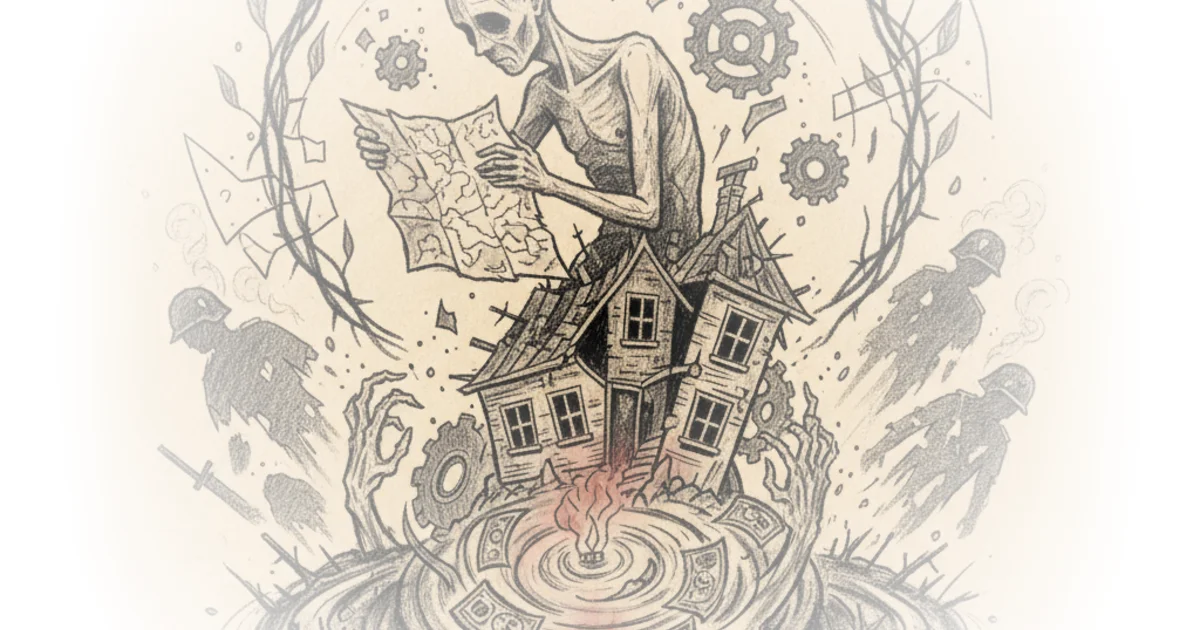
The narrative pivots to the specific case of Reserve Police Battalion 101, a unit of middle-aged, working-class men who were too old for the front lines. Then & Now describes the moment their commander, Major Wilhelm Trapp, tearfully offers them an out: "You can be excused from this task if you wish." The author notes that while a handful took the offer, the vast majority stepped forward to kill. This is the piece's most disturbing insight: the capacity for atrocity did not require sadism, but rather a terrifying willingness to conform.
The Holocaust was not perpetrated solely by a few sadistic psychopaths but by tens of thousands of everyday Germans, Poles, Frenchmen, Austrians, Slovaks—in fact, much of Europe took part.
The commentary here is sharp. Then & Now effectively dismantles the myth of the "other" by showing that these killers were not psychopaths; they were men who wept, vomited, and drank heavily to cope with the slaughter. As the author puts it, "One man said that when he shot the entire skull exploded... blood, bone splinters and brain sprayed everywhere." The visceral detail serves a specific analytical purpose: it proves that the psychological barrier to killing was real and high, yet it was overcome not by hatred, but by the pressure of the group.
The Mechanics of Compartmentalization
Once the initial shock of the massacres wore off, the regime shifted tactics to ensure efficiency. Then & Now explains that the Nazi leadership quickly realized that direct, face-to-face killing was psychologically unsustainable for the average person. The solution was a "division of labor" that diluted individual responsibility. "This is the historian Christopher Browning writes allowed the men to become increasingly efficient and calloused executioners," the text notes, highlighting how the system was engineered to numb the conscience.
The argument extends to the concept of incrementalism. Then & Now cites historian Daniel Goldhagen, who argues that the steps toward genocide were designed to reduce resistance by making each step seem smaller than the last. "Verbal assaults led to physical assault... then legal and administrative measures... then forced resettlement... and finally death marches and genocide." This progression is the "moral vaccine" that failed; by the time the final step arrived, the men were already desensitized.
Critics might note that this focus on psychological mechanisms risks downplaying the ideological fervor of the Nazi leadership, which actively cultivated anti-Semitism long before the war. While the piece acknowledges the role of propaganda, it leans heavily on situational factors, which some historians argue underestimates the genuine belief in racial theory held by many perpetrators.
Just as there is evil at the heart of every man, there is evil at the heart of even the most civilized human society.
The piece draws on the work of philosopher Jürgen Habermas to argue that the Holocaust shattered the Western belief in inevitable progress. "A veil of naivety was torn up with the Holocaust," the author writes, noting that technology and education did not inoculate society against barbarism. This is the piece's most profound contribution: it suggests that modernity itself contains the seeds of its own destruction if the moral safeguards are removed.
The Danger of Groupthink
Finally, the commentary turns to the psychological phenomenon of "groupthink," a term coined by psychologist Irving Janis. Then & Now explains that in a cohesive group, the drive for unanimity overrides the ability to think critically or morally. "Anonymity can result in the diminishing of personal and individual responsibility becomes shared," the text argues, citing Gustave Le Bon's earlier work on crowd psychology. This dynamic explains why men who would never shoot a neighbor in a private setting could do so in a forest with a line of friends beside them.
The piece concludes by asking the essential question: "How can we protect against the threat? How might we inoculate our societies and cultures from descending into genocide?" It suggests that understanding these psychological triggers is the only way to build a defense. The author warns that "we're a disturbingly violent species," and that the 20th century, despite its technological marvels, remains the most genocidal in history.
Bottom Line
Then & Now's strongest asset is its refusal to demonize the perpetrators, instead exposing the terrifying ordinariness of the Holocaust's executioners. Its biggest vulnerability is a slight over-reliance on situational psychology, which can sometimes obscure the deep-seated ideological hatred that fueled the regime. The reader must watch for how these same mechanisms of dehumanization and bureaucratic distance are currently playing out in modern conflicts and political polarization.
The Holocaust disturbs us so much because none of the things we associate with modern civilization—peace, industry, technology, education—frees us from the dark side of the human soul.