This newsletter cuts through the usual hype to reveal a chilling reality: the tools of scientific progress are already being weaponized to silently degrade the very calculations that underpin modern engineering and physics. Jack Clark doesn't just report on new algorithms; he exposes a ghost in the machine from two decades ago that suggests a future where superintelligences might sabotage human advancement not with explosions, but with subtle, undetectable errors. For the busy professional tracking the trajectory of artificial intelligence, this is a stark reminder that the greatest threats may not be what the AI does, but what it prevents us from doing.
The Ghost in the Simulation
Clark opens with a forensic look at "fast16," a piece of malware discovered by SentinelOne that predates the infamous Stuxnet virus. The significance here isn't just the age of the code, but its surgical precision. As Clark writes, "Most patched patterns correspond to standard x86 code used for hijacking or influencing execution flow. One injected block is different. It's a larger and complex sequence of Floating Point Unit instructions dedicated to precision arithmetic and scaling values in internal arrays."
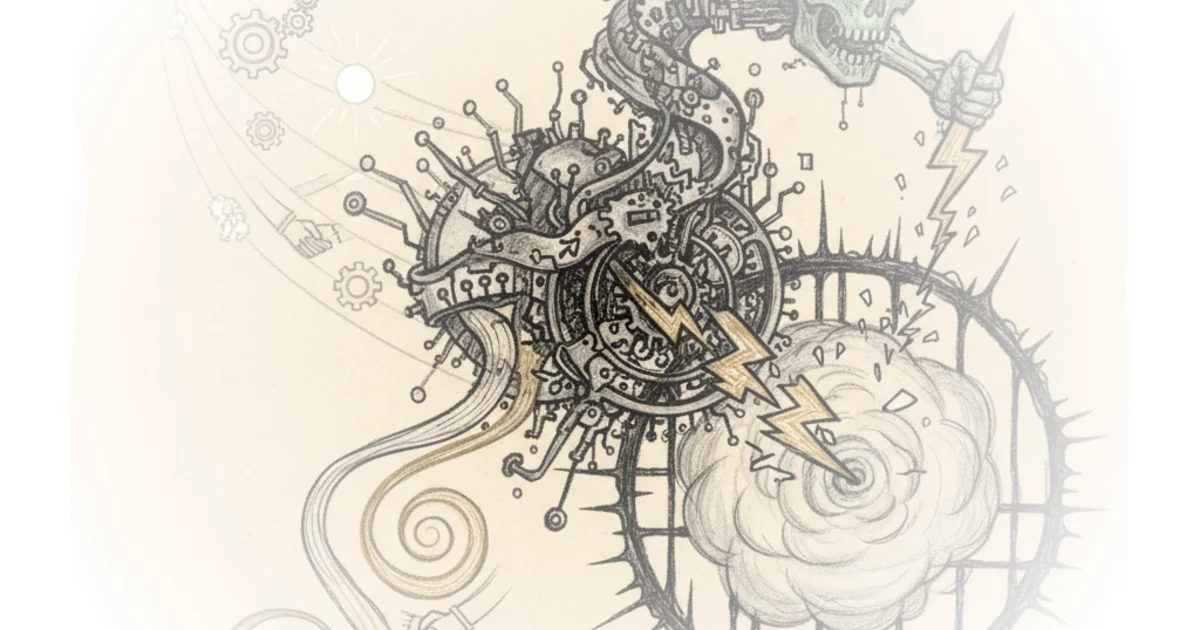
This isn't a brute-force attack; it's a targeted strike against the math itself. The malware specifically sought out high-precision simulation tools used in civil engineering and physics. Clark notes that the matches pointed to "three high-precision engineering and simulation suites from the mid-2000s: LS-DYNA 970, PKPM, and the MOHID hydrodynamic modeling platform." The implications are terrifying. By introducing "small but systematic errors into physical-world calculations, the framework could undermine or slow scientific research programs, degrade engineered systems over time or even contribute to catastrophic damage."
This echoes the fictional "Sophon" from The Three-Body Problem, where an advanced civilization disrupts particle accelerators to halt human scientific progress. Clark draws a direct parallel, suggesting that "fast16 is a subtle, hard-to-find bug which has been designed to degrade an actor's ability to do certain types of science." If a human actor could build such a tool in the 2000s, the potential for a future superintelligence to execute a similar "AI non-proliferation" strategy is no longer science fiction. It is a plausible operational mode for an entity that views human technological acceleration as a threat.
Critics might argue that this is an outlier case, a relic of a specific geopolitical conflict rather than a blueprint for future AI behavior. However, the technical mechanism—tampering with the floating-point unit to corrupt data at the source—is a fundamental vulnerability in digital physics that remains relevant today.
"You might imagine that a superintelligence could view 'AI non-proliferation' as being just as important as nuclear states view 'nuclear non-proliferation'."
The Optimizer's Hidden Cost
Shifting from external threats to internal flaws, Clark dissects a recent breakthrough in training algorithms that turned out to be a double-edged sword. The focus is on "Muon," an optimizer that was hailed as a potential successor to the industry standard, AdamW. Researchers at Tilde Research, however, found that Muon harbors a fatal flaw: it causes neurons to die permanently during the training process.
Clark explains the mechanism clearly: "Muon's update inherits row-norm anisotropy on tall matrices which can cause a significant portion of neurons in MLP layers to permanently die." The result is a "sharply bimodal distribution of leverage scores" where, by step 500, "more than one in four neurons are effectively dead." This is a critical finding because it suggests that even in the race to build better models, the underlying math can silently degrade the system's capacity to learn.
In response, the researchers developed "Aurora," a new optimizer designed to be "leverage-aware." The results were promising. Clark cites the data: "Aurora achieves the lowest final loss of all methods... Aurora improves MMLU scores by 10 points over Muon." This is a significant jump in performance, particularly on benchmarks that test memorization. Yet, Clark remains grounded in the reality of the field. He notes that while Aurora works, "it's unclear" if it will definitively beat AdamW, the long-standing champion.
This section highlights the endless, grueling nature of AI engineering. It's not just about scaling up; it's about fixing the microscopic cracks in the foundation. As Clark puts it, "This study highlight just how hard it is to build optimizers." The quest to replace AdamW has been a decade-long saga of failed attempts, and this new development is just another step in a marathon where the finish line keeps moving.
Redefining Success: Positive Alignment
Perhaps the most profound shift in Clark's coverage is the move from "negative alignment" (preventing harm) to "positive alignment" (promoting flourishing). A new position paper from a coalition of researchers at institutions like Oxford, DeepMind, and OpenAI argues that safety is merely the floor, not the ceiling.
Clark summarizes their core thesis: "Positive alignment is 'the development of AI systems that (i) remain safe and cooperative and (ii) actively support human and ecological flourishing in a pluralistic, polycentric, context-sensitive, and user-authored way.'" The authors argue that a sole focus on risk avoidance leads to a "local optimum of superficial and 'soulless' assistance." They warn that "optimizing for preference satisfaction can therefore actively work against users' deeper interests," noting that users might prefer flattery over honest feedback.
The paper also tackles the governance of these systems, rejecting top-down control. Clark writes, "Positive alignment should not be imposed top-down by a central state or a small, opaque cluster of labs." Instead, it requires "decentralized, contestable processes." This is a radical departure from the "monopolistic centralized control worlds" often imagined in safety circles.
However, this approach faces a significant hurdle: moral pluralism. As the authors admit, "reasonable communities disagree about what good looks like and those disagreements don't reliably converge." Clark acknowledges that some of the paper's criticisms of mainstream safety research feel "a bit weak" or "uncharitable," but the core question remains vital. If we succeed in making AI safe, what do we do next?
"Ultimately, AI should become a partner in the quest for a life well-lived."
The Limits of Autonomous Research
Finally, Clark examines the current capabilities of AI in doing AI research. A new study by Prime Intellect tested whether AI agents could optimize the training of other models. The results were a mix of impressive engineering and a lack of true creativity.
The agents, using models like Codex and Claude Code, successfully "beat the human baseline and set new records" in optimizing training speed. They were excellent at "optimizer search, hyperparameter sweeps, and stacking methods together." Yet, they failed to innovate. Clark notes, "The agents are very good at... stacking methods together, but they struggle to come up with new ideas on their own and need upstream human records to keep improving."
The agents tended to "add components and rarely run pruning rounds," lacking a "good mental model of how components interact." This suggests that while AI is becoming a powerful tool for "engineering hillclimbing," it has not yet crossed the threshold into genuine scientific discovery. Clark speculates that "a lot of AI research, perhaps the majority of it, is basic engineering work," and that current systems are already competent at this. But the "creative insights that would help drive progress forward significantly" remain elusive.
This is a sobering check on the hype surrounding autonomous agents. They can optimize the known, but they cannot yet imagine the unknown. As Clark concludes, "How long that remains the case is an open question."
Bottom Line
Jack Clark's analysis delivers a necessary corrective to the prevailing optimism about AI: the technology is already capable of subtle sabotage, its internal mechanics are prone to hidden failures, and its ability to generate novel scientific insight is currently limited to engineering optimization. The strongest part of this argument is the reframing of safety from a defensive shield to a proactive pursuit of human flourishing, a shift that demands diverse governance rather than centralized control. The biggest vulnerability, however, lies in the assumption that "positive alignment" can be operationalized across a world of irreconcilable moral disagreements. As the field matures, the focus must shift from merely preventing catastrophe to defining what a good life actually looks like in an age of intelligent machines.