Michael Tracey cuts through the noise of the current geopolitical moment to argue that the administration's sudden, aggressive pivot toward Venezuela is not a reaction to an imminent threat, but a calculated, voluntary project to secure a historical legacy. While the public discourse focuses on the rhetoric of "narco-terrorism," Tracey contends that the real driver is a decades-old belief among American executives that true greatness is forged only through military adventurism and regime change.
The Legacy of War
Tracey's central thesis is that the executive branch is driven by a meta-historical obsession with becoming a "war President." He writes, "Gore Vidal relayed that his onetime friend 'Jack' Kennedy had once explained to him that in order to be 'a great President,' one must become a 'war President.'" This framing is crucial because it shifts the analysis from the specific grievances against the Maduro government to the internal psychology of the presidency itself. The author suggests that leaders often manufacture or exaggerate external conflicts to satisfy an internal need for historical reverence, echoing the sentiments of Abraham Lincoln and Franklin D. Roosevelt.
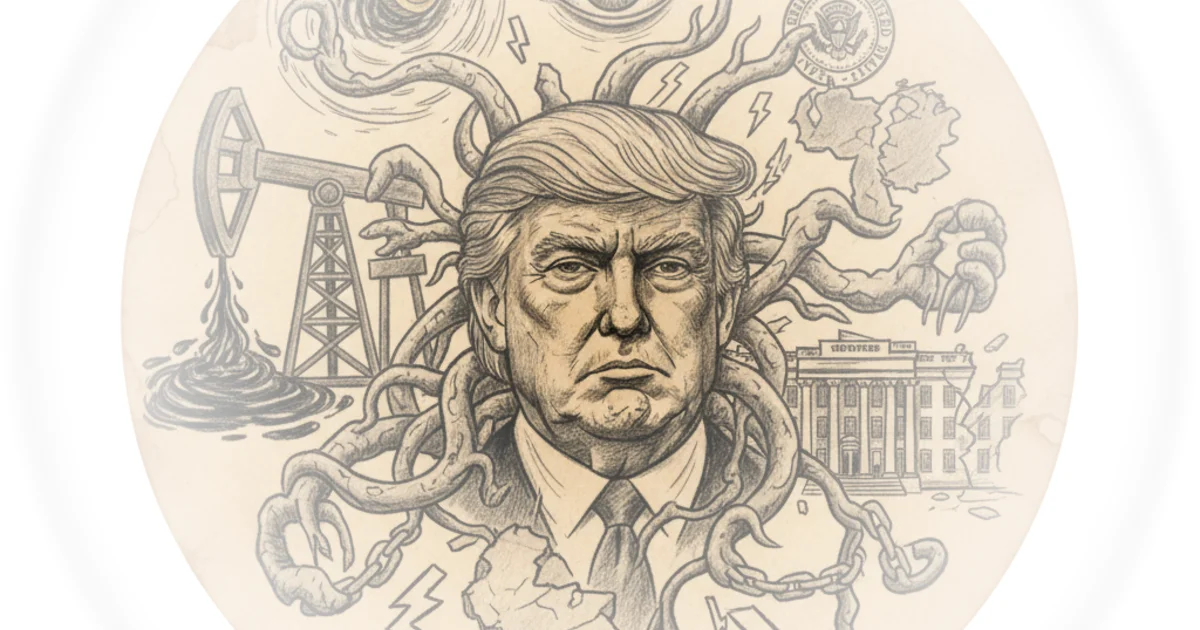
The piece draws a sharp parallel to the George H. W. Bush administration, noting how the invasion of Panama was engineered to cure the nation of its "Vietnam syndrome." Tracey observes, "Bush cured this nagging malady by engineering the First Gulf War, and perhaps more relevantly for today's purposes, the invasion of Panama." This historical context is vital; it reminds us that the current fixation on Venezuela is not an anomaly but part of a recurring pattern where the US seeks to demonstrate overwhelming force to prove its global dominance. Critics might argue that this historical determinism ignores the unique, specific intelligence failures or genuine security concerns that could exist in the Caribbean today, but the evidence presented suggests the policy is being driven by ideology rather than necessity.
"It's a thoroughly voluntary ideological project, with an end-state preordained — the rest (legal rationale, political justification) to be backfilled at the time and place of their choosing."
The Architects of Intervention
The commentary identifies a specific power dynamic within the administration, pinpointing Marco Rubio as the primary architect of this foreign policy shift. Tracey notes that Rubio, serving simultaneously as Secretary of State and National Security Advisor, has positioned himself to emulate historical figures like Henry Kissinger. The author writes, "Day-to-day activities of the actual State Department — almost an afterthought." This observation highlights a concerning concentration of power where diplomatic nuance is sidelined in favor of a singular, aggressive agenda.
The piece details how Rubio's long-standing desire to topple the Venezuelan government, which dates back to his time in the Senate, is now being pursued with the full weight of the executive branch. Tracey points out that in 2019, Rubio was "reduced to noisily tweeting gruesome images of a bloodied Muammar Gaddafi — unsubtly warning Maduro what fate he could expect." The implication is clear: the current administration is not reacting to new events but is attempting to "finish the job" of a previous, failed intervention. This reframing is powerful because it exposes the personal ambitions of key officials as the engine of national policy, rather than a response to a shifting global landscape.
The Human Cost of "Nation-Building"
Perhaps the most sobering section of the article addresses the human reality behind the political maneuvering. Tracey critiques the administration's use of euphemisms, noting that the administration has declared Venezuela a "terrorist" state and Maduro a "narco-terrorist" kingpin, "Like a Spanish-speaking Al Qaeda or something." This rhetorical escalation serves to dehumanize the target and justify extreme measures, including the ultimatum delivered to Maduro to "abdicate his office and leave the country at once, or else be removed by force."
The author warns that the "mainstream" media has already primed the public for a grim outcome, with one correspondent suggesting Maduro will either flee, be captured, or "meet his maker." Tracey writes, "Whichever of the three scenarios comes to pass, the final outcome is the same: regime change in Venezuela, effectuated by the US, one way or another." This is a stark reminder that behind the geopolitical chess game lies the very real possibility of violence, instability, and civilian suffering. The piece does not shy away from the potential for disaster, noting that previous regime change efforts in Iraq, Libya, and Syria have had "disastrous results," yet the political class remains "so ingrained" in the belief that such interventions are rational and necessary.
"Regime change is incredibly easy to oppose in the abstract. Seldom will you hear anyone of note tout their support for 'regime change' as a general principle... That's why it's imperative to discern accurately a politician's views on 'regime change' by reference to their position on particular, specific conflicts or initiatives."
The Economic and Imperial Ambitions
The commentary also explores the economic dimensions of this foreign policy, linking it to a broader vision of American expansionism. Tracey notes that the administration has explicitly endorsed "nation-building," even in Gaza, and is pursuing "minerals deals" in Ukraine that effectively turn the country into a "quasi-colonial US outpost." The author suggests that the administration is driven by a desire to annex territories and resources, citing Trump's inaugural address which heralded William McKinley as a model—a president who "annexed various far-flung territories (such as Guam and the Philippines) that were previously unknown to 99% of Americans."
This imperial ambition extends to the personal interests of the administration's inner circle. Tracey points out that Jared Kushner, despite holding no formal government position, is playing a "robust day-to-day involvement" in foreign affairs, with plans to meet with Vladimir Putin and oversee reconstruction projects in Gaza. The author writes, "Locating profitable ventures for his son-in-law Jared is clearly another perennial passion project for Trump." This intertwining of personal profit and national security policy raises serious questions about the motivations behind the administration's actions, suggesting that the drive for regime change may be fueled by the promise of lucrative post-conflict contracts.
Bottom Line
Michael Tracey's analysis is a compelling indictment of the administration's foreign policy, effectively arguing that the push for regime change in Venezuela is a self-serving project driven by legacy aspirations and personal ambition rather than genuine national security needs. The piece's greatest strength is its refusal to accept the official narrative at face value, instead tracing the policy back to the psychological and historical drivers of the executive branch. However, the argument's vulnerability lies in its heavy reliance on the psychological profiling of leaders, which, while insightful, may understate the complex, multifaceted nature of international relations and the genuine, albeit contested, security concerns that exist in the region. Readers should watch for how the administration justifies its actions in the coming weeks, as the gap between the stated "narco-terrorism" rationale and the underlying "legacy" project is likely to widen.