Karim Zidan exposes a jarring collision between global sport and domestic authoritarianism, arguing that the 2026 World Cup has ceased to be a neutral tournament and has instead become a vehicle for an "America First" political spectacle. This is not a standard preview of logistics or venues; it is a forensic look at how the executive branch is actively repurposing international cooperation to enforce a vision of exclusion, turning the pitch into a stage for immigration enforcement and nationalist posturing.
The Stagecraft of Power
Zidan opens with a scene that reads less like a sports celebration and more like a political takeover. He describes the 2025 Club World Cup final in Chelsea, where the trophy ceremony devolved into an awkward tableau. "Chelsea may have stolen the show on the pitch, but Trump had found a way to remain the centre of attention," Zidan writes, highlighting how the President lingered on stage long after the official presentation, forcing players to wait for his exit. The visual dissonance was palpable; as Zidan notes, "the president of the United States standing directly at the center of the shot, as though he too were part of the team's triumph."
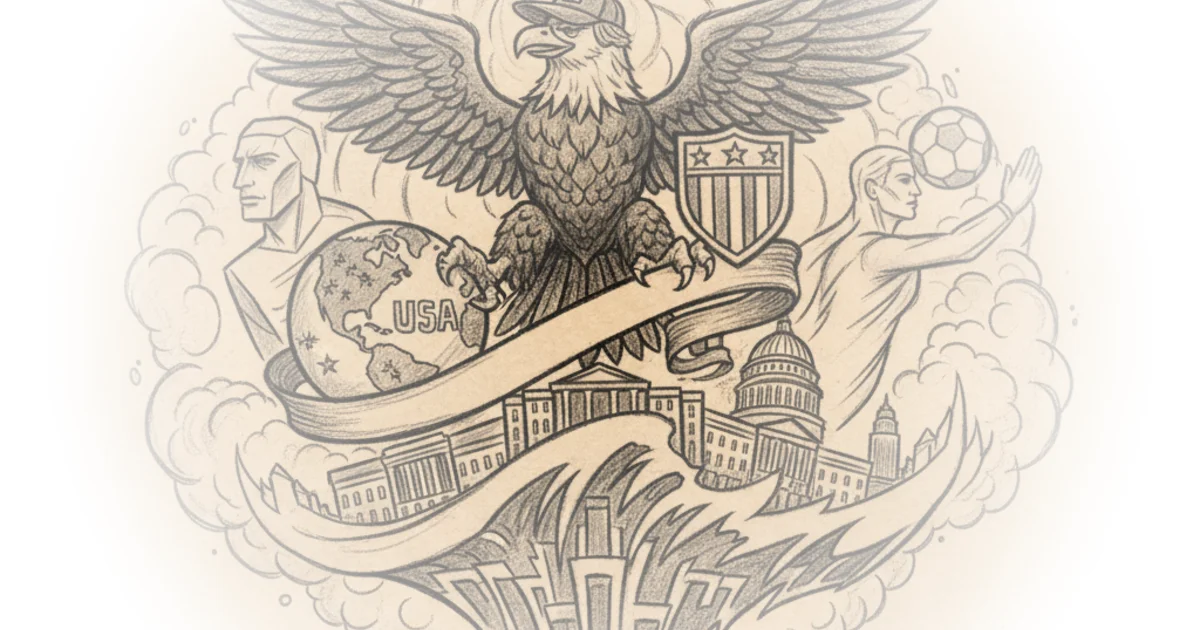
This framing is effective because it moves beyond abstract policy to the visceral reality of the event. The author details how even the championship trophy was a replica, one that the President insisted on keeping in the Oval Office, while a winner's medal was pocketed by the administration. The presence of Homeland Security Secretary Kristi Noem and Attorney General Pam Bondi at a sporting event further blurs the line between celebration and state power. Zidan argues that the event revealed itself as "a MAGA-tinged spectacle, blending politics, entertainment, and cultural symbolism in a way that feels more like an unabashed display of American exceptionalism than a sporting event." This observation lands hard: it suggests the administration views the World Cup not as a shared human experience, but as a proprietary asset to be branded.
From Policing to Partnership
The piece then pivots to a historical analysis that is crucial for understanding the current dynamic. Zidan contrasts the 2015 FBI-led crackdown on FIFA corruption with the current administration's cozy relationship with the organization's leadership. In 2015, the Department of Justice treated FIFA as a "criminal enterprise," raiding hotels and arresting officials for racketeering and money laundering. "The probe centred on claims that FIFA executives accepted millions of dollars in kickbacks," Zidan writes, reminding readers of the era when the U.S. positioned itself as the global policeman of football integrity.
That stance has been entirely inverted. Zidan traces the parallel rise of the President and FIFA President Gianni Infantino, noting how both leveraged populist appeal to consolidate power. "Where the FBI investigation had framed FIFA as a case study in transnational crime... Trump's administration had other plans. Instead of isolating FIFA, his administration would soon seek to work with its leadership," he explains. This shift is underscored by the administration's rapid pivot to championing the 2026 bid, despite earlier conflicts over the "Muslim ban" (Executive Order 13769). Zidan points out that while UEFA's Aleksander Čeferin warned that "If players cannot come because of political decisions... then the World Cup cannot be played there," the administration eventually secured the bid through back-channel diplomacy, notably involving Jared Kushner's late-night negotiations in Saudi Arabia.
The relationship between the U.S. and FIFA is entirely different than it was a decade ago, trading the role of global enforcer for that of a strategic partner in a nationalist project.
Critics might argue that the administration's ability to secure the bid despite the travel ban controversy proves the resilience of American soft power and the importance of the North American market. However, Zidan's evidence suggests the cost of that success was the normalization of a political climate that previously threatened the tournament's very existence.
The Shadow of Deportation
The most chilling section of the commentary addresses the 2025 establishment of the White House Task Force on the 2026 World Cup. Zidan details how the task force, chaired by the President and including Vice President J.D. Vance, explicitly linked the tournament to the administration's aggressive immigration crackdown. The author quotes Vice President Vance's stark warning to potential visitors: "We want them to come. We want them to celebrate. We want them to watch the game. But, when the time is up, they have to go home. Otherwise, they'll have to talk to [DHS] Secretary Noem."
This is a profound reframing of hospitality. Zidan connects these words to the reality of mass deportations, noting that ICE agents were present at the Club World Cup to "help ensure the safety and security of the event." The author highlights the dissonance of an event billed as a unifying global festival occurring alongside raids on places of worship and the use of the 1798 Alien Enemies Act to deport individuals with limited due process. "The Trump administration's anti-immigrant crackdown even extended to football," Zidan writes, painting a picture where the safety of the tournament is inextricably linked to the threat of detention for millions.
Furthermore, the piece notes the structural fragility of this approach. The U.S. Travel Association has warned that the air travel system is ill-equipped for the surge of visitors, yet the administration is simultaneously gutting federal institutions and engaging in trade wars with co-hosts Canada and Mexico. Zidan observes that this trade war "goes against the spirit of an event that has long been propagated as a unifying force," potentially creating security obstacles that the administration's rhetoric ignores.
The Alliance of Autocrats
Zidan concludes by examining the ideological convergence between the President and Infantino. The author notes that FIFPro, the global players' union, criticized Infantino's exclusion of player welfare discussions, calling for "responsible leadership, not emperors." Yet, Infantino has doubled down, aligning himself with the President's vision. "Infantino's ambitions now extend far beyond football's internal politics. His most audacious gamble, the 2026 World Cup, has bound him to Donald Trump, for whom football is not just sport but a political instrument," Zidan argues.
The final image Zidan leaves us with is of a President who views the tournament as an extension of his own legacy, stating, "I'm going to have to extend it for a couple of years... I hope you're going to remember me in 2026." This personalization of a global event is the core of the author's critique: the World Cup is no longer about the world; it is about the host's political narrative.
Bottom Line
Zidan's strongest argument is the compelling evidence that the 2026 World Cup has been weaponized as a tool for domestic political theater, sacrificing the event's inclusive spirit for a display of executive power. The piece's vulnerability lies in its reliance on the assumption that this political framing will not alienate the international community enough to derail the tournament's success, a risk that remains to be seen. Readers should watch for how the administration balances its rhetoric of "safety" and "deportation" with the practical necessity of welcoming millions of global fans in the coming months.