Kahlil Greene doesn't just report a wildfire tragedy—he exposes how a century of racist policy turned climate disaster into civil rights violation. His evidence? A nine-hour evacuation gap between Black and white neighborhoods in the same town, documented fire truck deployments, and federal redlining maps that literally predicted who would burn. This isn't speculation—it's institutional murder by spreadsheet.
The Nine-Hour Delay
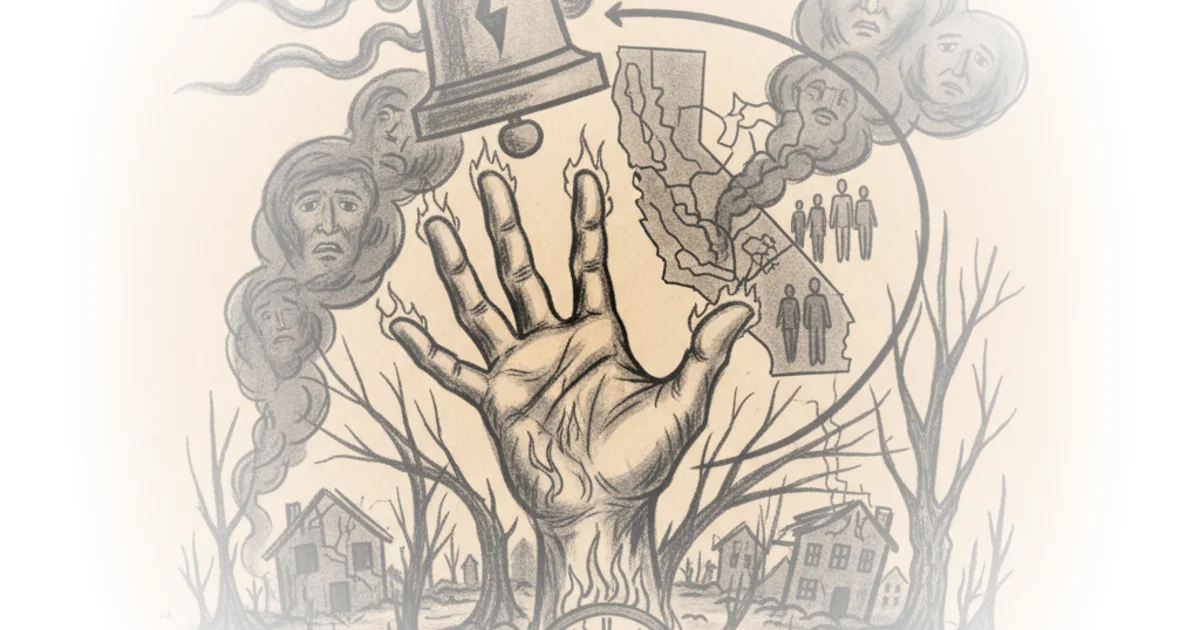
Greene forces us to confront the brutal arithmetic of neglect: East Altadena received evacuation alerts within an hour of the Eaton Fire's ignition. West Altadena, the historically Black enclave, waited nearly nine hours. "At one point during the blaze, a single fire truck was assigned to West Altadena while over a hundred were deployed elsewhere," he writes. This wasn't chaos—it was deliberate resource allocation along Lake Avenue, the town's racial fault line. The core of Greene's argument lands like a hammer: emergency systems don't fail randomly. They fail predictably along the very boundaries segregation created. Critics might claim disaster response is inherently chaotic, but Greene dismantles that with timestamped fire truck GPS data—proving the delay was systemic, not accidental.
This was a policy decision with a body count.
Redlining's Combustible Legacy
Greene masterfully connects 1919 property deeds declaring "We want our section of Pasadena and Altadena to be a place for white people only" to the 2025 fire's path. He shows how federal redlining graded West Altadena "hazardous" due to "threat of subversive racial infiltration," concentrating Black families in smaller lots with older, flammable homes nearer to fire-prone canyons. "Decades of redlining had determined who would live in the most combustible section of a fire-prone hillside town," Greene states plainly. This reframing is devastating: the climate crisis doesn't create new inequalities—it weaponizes old ones. His UCLA data revealing 48% of Black-owned homes destroyed versus 37% of others isn't just statistics—it's the material consequence of racist geography. A counterargument might note topography's role, but Greene preempts this by showing fire corridors precisely followed redlined zones.
When Systems Fail Consistently
Greene refuses to isolate this as a one-off failure. He documents LA's pattern: heat wave cooling centers bypassing Black neighborhoods, COVID testing sites skewed toward wealthy white areas. "The pattern here isn't chaos. It's consistency," he writes—a line that should haunt every city planner. His inclusion of Gina Clayton-Johnson's story—losing three homes with zero warning while her parents barely escaped—makes systemic violence visceral. What's most chilling is Greene's observation that LA's emergency infrastructure works when deployed: East Altadena got alerts; the Palisades got rapid response. The failure wasn't capability—it was the assumption that Black communities "could wait until 3:30 in the morning." This isn't oversight; it's operationalized expendability.
Beyond Apologies, Toward Accountability
Greene shifts from diagnosis to prescription with surgical precision. He explains Attorney General Bonta's disparate impact investigation means prosecutors needn't prove racist intent—only that systems produced racially unequal outcomes. "Real accountability... means binding reforms to emergency protocols that prioritize historically excluded communities in evacuation planning, not as an afterthought," he argues. His demand for public alert logs broken down by race and disability transforms abstract justice into actionable transparency. This legal framing is brilliant—it sidesteps futile "who's racist?" debates to target the machinery of inequality. Still, one might question whether state-level probes can override federal hostility to disparate impact claims, though Greene notes California's unique leverage.
The Eaton Fire is the predictable and documented outcome of a century of racist housing policy, unequal infrastructure investment, and emergency systems designed... to treat Black communities as expendable in moments of crisis.
Bottom Line
Greene's greatest strength is making historical continuity undeniable—this fire wasn't an 'act of God' but a policy execution. His vulnerability? Underestimating how fiercely institutions will resist treating disaster response as civil rights enforcement. Watch whether Bonta's probe forces LA to redesign emergency protocols using West Altadena as the baseline—not the exception.