Mick Ryan cuts through the noise of diplomatic posturing to reveal a stark reality: while the administration in Washington pushes for a rushed settlement, the battlefield in Ukraine is still writing the terms of peace. This piece is notable not for predicting the end of the war, but for exposing the dangerous gap between political narratives of "inevitable victory" and the brutal, granular truth of the front lines. In a landscape of fog and spin, Ryan offers a rare, clear-eyed look at why the war continues and what it costs the people living through it.
The Theater of Leadership
Ryan frames the recent visit by President Zelenskyy to the front lines near Kupiansk not merely as a morale booster, but as a direct rebuttal to the Kremlin's deception. He writes, "If it ever was, it isn't anymore," referring to Russian claims of controlling the city, before noting that Zelenskyy's presence there serves to "demonstrate again to Trump that Putin lies." The author draws a sharp, almost moral contrast between the two leaders: while Zelenskyy has made frontline visits a feature of his command since the war began, Putin "rabbited out of Moscow" during the 2023 Wagner mutiny and has never visited Russian frontline positions.
"Putin is a willing manipulator of information to perpetuate the 'inevitable Russian victory narrative' to shape the views of America's peace negotiations team."
This framing is powerful because it shifts the focus from personality to the mechanics of information warfare. Ryan argues that the administration's push for peace is being fed by a distorted view of reality, where Russian setbacks are ignored in favor of a narrative that demands Ukrainian concessions. However, one must consider that while Zelenskyy's courage is undeniable, his recent domestic corruption scandals, which Ryan acknowledges, complicate the moral high ground he seeks to leverage in international negotiations. The human cost of this deception is high; as Ryan notes, Russia recently launched a massive strike involving 495 drones and missiles, targeting cities from Kirovohrad to Chernihiv, proving that while leaders argue over maps, civilians pay the price.
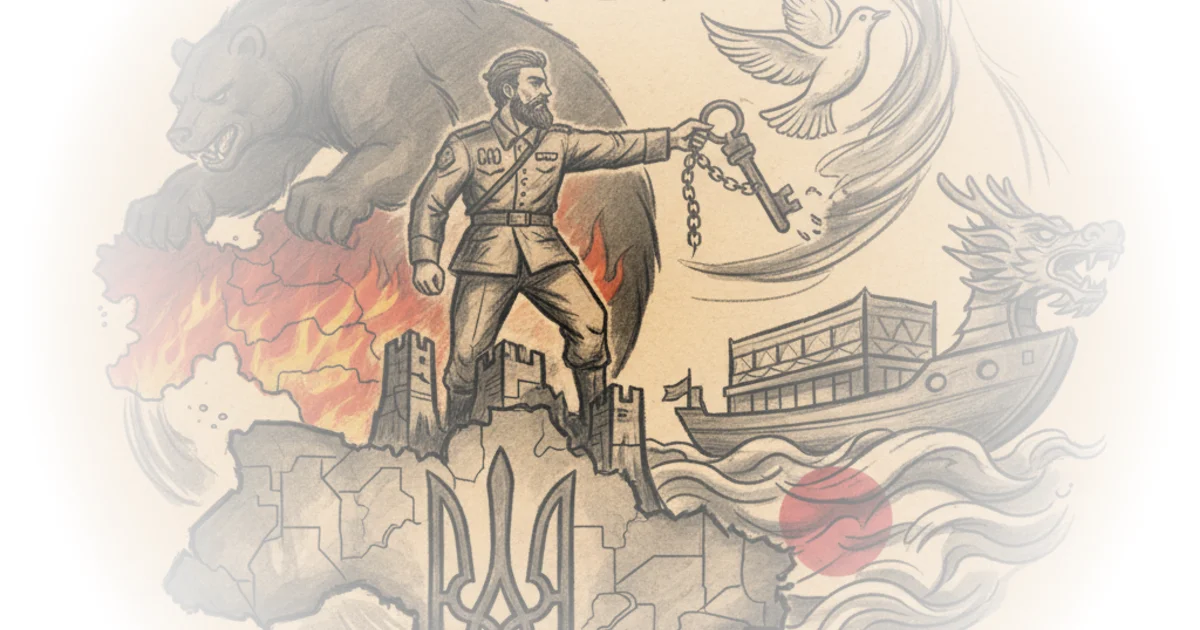
The Illusion of the Transparent Battlefield
The core of Ryan's tactical analysis centers on the Ukrainian counter-attacks around Kupiansk, where the 2nd Khartiia Corps successfully cut off Russian infiltrations. He uses this to dismantle the prevailing military theory that modern warfare has made surprise impossible. "Seeing lots of things on the battlefield is not the same as understanding them," Ryan writes, challenging the idea that the battlefield is truly transparent. He highlights that the Ukrainian operation validated that offensive actions are still possible "without the horrendous expenditure of human lives like those of the Russians."
This observation is crucial for understanding the current stalemate. Ryan points out that despite the grim reality of high casualties—British intelligence estimates 395,000 Russian casualties in 2025 alone—Putin has not paid a major political price. Instead, the author argues, "he has convinced many on the Trump administration that coercing Ukraine into handing over territory... is a good idea." This is a sobering assessment of the geopolitical dynamic: military attrition has not yet translated into diplomatic leverage for Kyiv. Critics might note that Ryan's optimism about the "limited success" at Kupiansk could be premature; while the tactical win is real, the strategic situation remains a grinding attrition where minor territorial gains are bought with immense suffering.
"The battlefield was truly transparent, such offensive actions should not be possible. But seeing lots of things on the battlefield is not the same as understanding them."
The Pacific Shadow
Ryan pivots seamlessly from the European theater to the Pacific, where the stakes are equally high but the dynamics differ. He details the movement of a Chinese aircraft carrier strike group, including the Liaoning, operating closer to Japan's home islands than ever before. Ryan interprets this not as a preparation for full-scale war with the United States, but as a calculated exercise in coercion. "They are excellent coercive tools against every other nation in the region," he argues, suggesting the deployment is designed to "test the reaction of Japanese military organisations" and "cow regional nations."
This analysis is bolstered by the concurrent news of Taiwan unveiling its $13 billion "T-Dome" missile defense system. Ryan connects these dots to show a region hardening its defenses against a rising power that is "stretching its legs." He even speculates on future moves, noting he would not be surprised to see a Chinese carrier group circumnavigate Australia to test the resolve of the Albanese government. The inclusion of the AUSMIN 2025 talks, where the US and Australia committed to critical minerals and AUKUS expansion, underscores the growing institutional response to this pressure. Yet, the human element here is the anxiety of the populations living in the shadow of these maneuvers, where a miscalculation in the Taiwan Strait could trigger a conflict with global consequences.
Bottom Line
Ryan's strongest argument lies in his refusal to accept the administration's narrative of a "joined-up" peace process when the battlefield reality suggests otherwise; he correctly identifies that peace cannot be negotiated while one side is still actively striking civilian infrastructure. The piece's greatest vulnerability is its reliance on the assumption that tactical victories like Kupiansk will eventually force a diplomatic shift, a leap that history has shown is not guaranteed. Readers should watch closely to see if the administration's pressure for territorial concessions yields to the hard evidence of Russian attrition, or if the war continues to grind on with dignity sacrificed for expediency.