Most economic analysis treats insurance as a passive safety net, a quiet background utility that simply pays out when disaster strikes. Economics Explained upends this assumption with a startling thesis: insurance is not merely protection, but the very mechanism that grants "economic permission" for modern civilization to function. By reframing the industry as the active underwriter of housing, agriculture, and global trade, the author reveals a systemic fragility that threatens to unravel the global economy from the bottom up.
The Architecture of Risk
The piece begins by dismantling the historical stability of the insurance model. For decades, the industry relied on a simple mathematical premise: risks were local, infrequent, and independent. "Storms happened, but not everywhere at once," the author notes, allowing premiums to be pooled and losses to be smoothed over time. This logic held for most of the 20th century, but the author argues that the foundational assumptions have collapsed. The evidence is stark: in 2023 alone, the US suffered 28 billion-dollar climate disasters, a figure that dwarfs the four-decade average of fewer than nine per year.
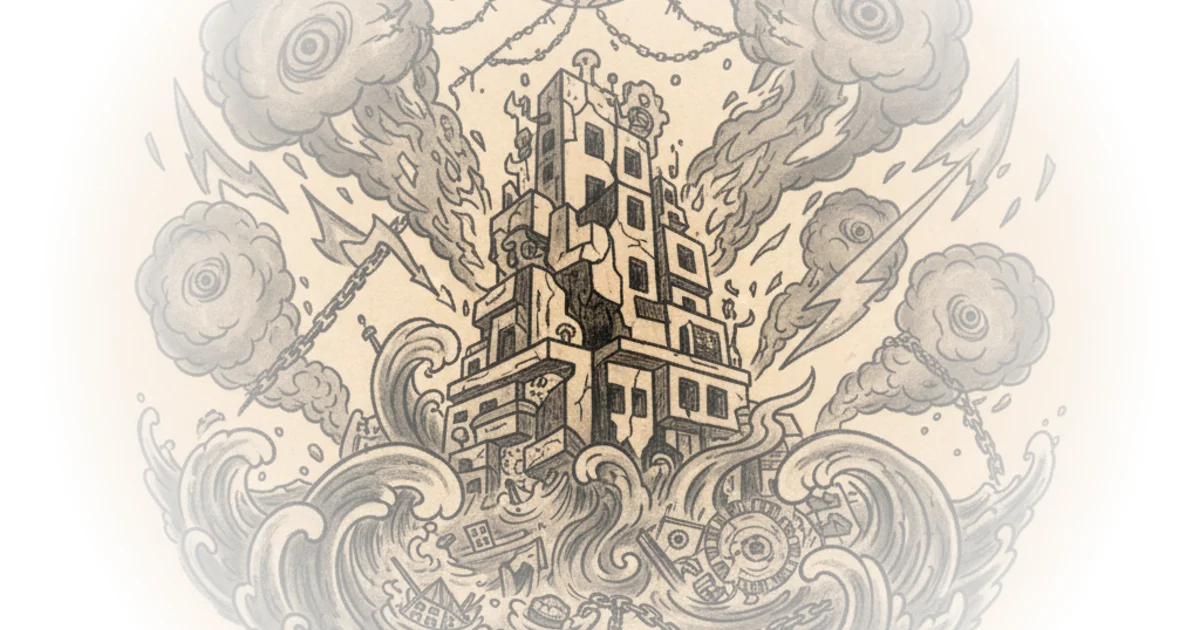
This shift is not just about frequency; it is about the breakdown of predictability. As Economics Explained writes, "The future will look enough like the past that those prices will still make sense" was the industry's working hypothesis, but it "no longer describes the world insurers are dealing with today." The author effectively illustrates how this failure of prediction is creating a feedback loop. When insurers cannot price risk, they retreat. This retreat is not a business failure but a rational response to a broken model. The consequence, however, is catastrophic for the broader economy. "If something can't be insured, banks won't lend against it. Investors won't fund it, and regulators often won't allow it to operate."
Insurance isn't just protection, it's economic permission.
The commentary here is particularly sharp in its connection between insurance and credit. The author points out that mortgage lending is legally tethered to insurance coverage. When insurers pull back, as seen in California and Florida, credit dries up, property values decline, and economic activity stalls. This is a crucial insight that moves the conversation beyond individual hardship to systemic paralysis. Critics might note that the article focuses heavily on property and health, potentially underplaying the role of government-backed flood insurance or state-run reinsurance pools that attempt to fill these gaps. However, the core argument—that the private market is retreating at a pace the public sector cannot match—remains compelling.
The Squeeze on Capital
The analysis deepens by examining the financial mechanics of the insurance industry itself. The author correctly identifies that insurers are not just risk managers but massive asset managers. "Premiums are collected upfront long before most claims are paid out. That creates enormous pools of capital sitting on insurers balance sheets for months or years at a time." In the US, property casualty insurers hold over $1.4 trillion, capital that has historically financed government projects and corporate debt. When this capital pool shrinks or becomes volatile, the entire economy feels the pinch.
Economics Explained highlights a perfect storm of pressures converging on these balance sheets. First, the cost of reinsurance—the insurance that insurers buy to protect themselves—has skyrocketed. "Between 2017 and 2024, global insured losses from natural catastrophes regularly exceeded $100 billion in all but one year." This has forced reinsurers to raise prices and tighten terms, passing the pain down to primary insurers. Second, inflation has driven reconstruction costs up by more than 40% since the pandemic, meaning every claim is more expensive to settle. Third, while higher interest rates have increased investment yields, they have also introduced market volatility that threatens the value of existing bond portfolios.
The author draws a powerful parallel to the concept of "moral hazard" often discussed in catastrophe bond markets, noting that the system was designed for independent, isolated events, not the "stacking" of risks we see today. A heat wave drives wildfires, which disrupt housing markets, which strains credit, all while inflation inflates the cost of the claims. "Together, this turns what used to be manageable risks into systemwide stress that insurance was never designed to absorb all at once." This synthesis of climate science, financial markets, and macroeconomics is the piece's strongest asset, moving beyond siloed analysis to show the interconnectedness of the crisis.
The Human Cost and the Health Crisis
The commentary extends beyond property to the human sphere, specifically healthcare. The author argues that the same pricing breakdown is occurring in health insurance, driven by aging populations and breakthrough treatments that are incredibly expensive. "Between 2000 and 2023, average family health insurance premiums in the US more than quadrupled, even though overall inflation rose by roughly 80% over the same period." The introduction of new gene therapies, some costing over $2 million per patient, creates a mismatch that the current pooling model cannot easily absorb.
As coverage becomes unaffordable, the risk shifts from the collective to the individual. "When insurance starts to fail, the risk simply gets pushed down the chain." The author provides a chilling statistic: in more than 150 US zip codes, at least one in ten homeowners lost coverage in 2022 simply because they could no longer afford the premiums. This is not a voluntary exit; it is a forced abandonment of assets. The result is a two-tiered economy where large corporations can absorb costs, but small businesses and individuals are left exposed.
Remove it and houses, farms, factories, and ships don't disappear overnight, but their economic usefulness slowly erodes.
This metaphor of insurance as a complementary good—like petrol for a car—is a masterstroke of economic explanation. It clarifies why the absence of insurance doesn't just mean higher costs, but the total devaluation of assets. The author's observation that "shippers reroute because insurers decide a stretch of ocean can no longer be priced cheaply enough" underscores how insurance dictates the flow of global trade, not just the safety of the cargo.
Bottom Line
Economics Explained delivers a rigorous and alarming diagnosis of a system in structural failure, successfully arguing that the collapse of insurability is a leading indicator of broader economic contraction. The strongest element of the piece is its ability to connect the abstract mathematics of risk pooling to the tangible reality of frozen mortgages and halted construction projects. Its primary vulnerability lies in the lack of a clear policy roadmap; while the diagnosis is precise, the article stops short of exploring whether government intervention can or should replace the private market's retreat. Readers should watch for how central banks and regulators respond to this growing gap between risk and coverage, as the next phase of this crisis will likely be defined by the political struggle over who bears the cost of an uninsurable world.