In an era where digital media chases algorithmic validation through performative outrage, Justin E. H. Smith offers a startling counter-narrative: the most intellectually mature audience is often the quietest. This piece reframes the crisis of independent publishing not as a failure of content quality, but as a collision between human-scale intellectualism and the brutal mechanics of attention economies.
The Paradox of Silent Readership
Smith opens by challenging the assumption that high engagement metrics equate to cultural relevance. He notes the publication's strange position: "We are at once a high-readership and a low-engagement operation," attributing this silence to the maturity of their readers who prefer private assent over public effusion. This is a sharp observation on the current state of digital discourse, where the loudest voices often drown out the most thoughtful ones.
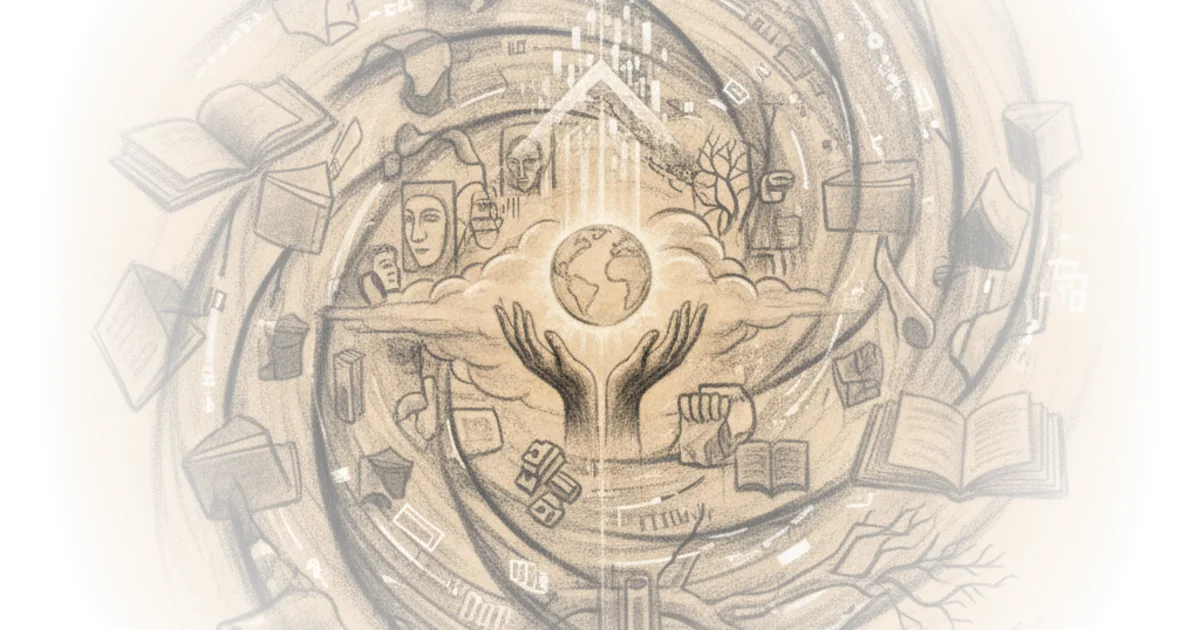
The author leans into historical self-awareness to contextualize this dynamic. He writes, "We are not quite so paranoid as to worry that we've been subject to what Sam Kriss calls 'heavenbanning'," referencing a scenario where bots simulate an audience for empty bleachers. Yet, he admits the vanity of seeking validation from "five or six neighbours," echoing Blaise Pascal's warning on human pride. By invoking the "Port-Royal aphorist," Smith subtly connects his struggle to the 17th-century Jansenist logicians who also grappled with the tension between public perception and private truth, suggesting that the desire for recognition is an ancient, perhaps futile, human constant.
The core of the argument rests on the invisibility of the true audience. Smith describes these silent readers as "something like the dark matter of the Hinternet universe in that our ability to tell as much is only by theoretical inference from the available data." This metaphor is particularly potent when considered against recent deep dives into cosmology; just as astronomers infer the existence of dark matter through its gravitational effects on visible galaxies, editors must infer the presence of their most dedicated readers through subtle shifts in reputation rather than click-through rates. The argument holds up because it acknowledges a reality most platforms ignore: value does not always equal visibility.
"In this economy?! It's so easy to get more or less everything we want from the unpaywalled parts of the Substack operations we like; Everything seems as if cheapened when it's made to share space with the great glut of AI slop that did not exist six years ago."
The Economics of Survival
Smith does not shy away from the grim financial realities facing independent thought. He outlines a stark choice: secure direct support or pivot to a model reliant on "big-league mécènes" and corporate sponsorship. The tone shifts from philosophical musing to urgent pragmatism as he warns that if subscription churn continues, they will be forced to "pack up and move on." This is not a threat but a diagnosis of the structural fragility of niche intellectual projects in a market flooded with free, automated content.
The author's willingness to imagine absurd compromises highlights the desperation of the situation. He jokes about potentially wearing "tutus while twirling sparklers" or inserting jingles for canned soup into treatises on natural theology. This hyperbolic imagery serves a serious purpose: it illustrates how market forces can pervert artistic integrity until the medium becomes indistinguishable from the message. The fear is that without direct patronage, the publication will be forced to "formalize the terms" of its own degradation.
Critics might argue that Smith's reliance on the "human-scale" model is nostalgic and ignores the potential for new, decentralized funding mechanisms beyond traditional subscriptions or grants. However, his point remains valid: current platforms are structurally designed to prioritize volume over depth, making the "quiet" reader a financial liability in the eyes of algorithms.
Intellectual Lineage and Political Persecution
The piece takes a somber turn as Smith honors two recently deceased intellectual giants, Carlo Ginzburg and Robert Thurman. He connects his own work to their legacies, noting how Ginzburg's The Night Battles inspires stories about "peasants riding stalks of fennel through the night sky," moving from microhistory to vast speculative reconstruction. This connection underscores the publication's commitment to deep, historical inquiry that resists the flattening effect of modern media.
However, the most urgent section addresses the house arrest of Russian Aristotle scholar Svetlana Mesyats. Smith reframes her persecution not merely as a bureaucratic dispute over funds, but as an ideological attack on "imported" intellectual traditions in favor of nationalist purity. He traces this conflict back to 1685 and the establishment of the Moscow Slavic-Greek-Latin Academy, noting how the tension between foreign influence and native tradition has persisted for centuries.
The author argues that the current crackdown is a symptom of a "longue-durée" pattern where periods of nationalist fervor in Russia inevitably reject cosmopolitan scholarship. He writes, "the distinction between 'imported' and 'native'... inevitably rebounds, and can extend beyond such everyday matters as consumer spending habits all the way to millennia-old intellectual traditions." This historical framing is crucial; it suggests that the suppression of Mesyants is not an isolated incident but a recurring feature of Russian political culture.
"It seems that in periods of rebounding nationalist fervor in Russia, the distinction between 'imported' and 'native', between things that are импортные and things that are наши , inevitably rebounds."
While Smith's historical analysis is compelling, one might question whether emphasizing the deep roots of this conflict risks normalizing it as an inevitable cultural trait rather than a political choice by current authorities. Nevertheless, his call to amplify Mesyants' distress signal remains a vital intervention.
Bottom Line
Smith's commentary succeeds in exposing the fragile ecosystem of independent intellectualism, arguing that true cultural impact often exists in the silence between metrics. The strongest part of the argument is its refusal to accept algorithmic validation as the sole measure of success, even while admitting the economic necessity of such metrics for survival. Its biggest vulnerability lies in the assumption that a "worldly" audience will eventually step up to fund their own preservation, despite the overwhelming incentives provided by free, AI-generated alternatives. Readers should watch whether this publication can navigate the transition from a subscription model to a foundation-backed entity without losing its distinctive voice.