Most analyses of higher education focus on the rising cost of tuition or the perceived value of a degree, but PolyMatter identifies a far more existential threat: a demographic cliff that has been 18 years in the making. The piece argues that the closure of institutions like Birmingham Southern College is not an anomaly but the inevitable result of a collision between falling birth rates and a funding model that has shifted the burden entirely onto students. This is a structural crisis that no amount of marketing or administrative bloat can fix.
The Demographic Time Bomb
PolyMatter begins by dismantling the assumption that a college diploma is a guaranteed asset. "We take for granted that someone will always be around to store our transcripts and that the name on our diplomas will hold if not gain in value but this is not nearly as safe an assumption as you might imagine." The author supports this with stark data: between 1996 and 2023, nearly a third of for-profit community colleges closed, and even 7% of four-year nonprofits vanished. This is not just about schools failing; it is about the disruption of hundreds of thousands of lives, with only 32% of affected students ever having their debt forgiven.
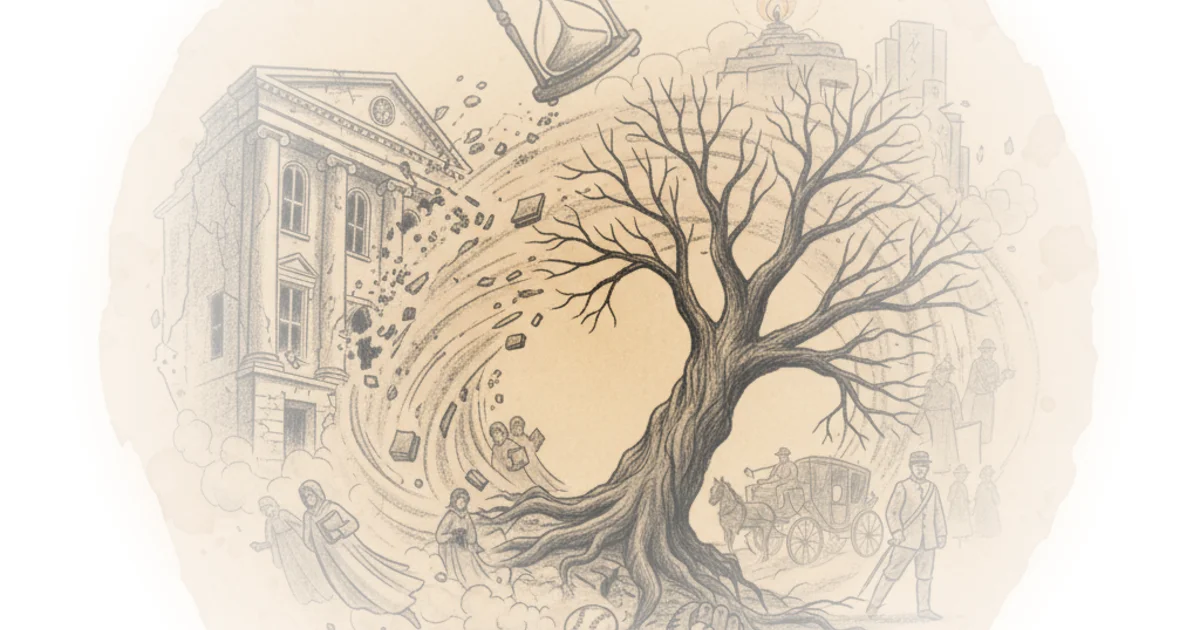
The core of the argument rests on a simple, terrifying timeline. PolyMatter notes that for nearly two decades after 1990, family sizes hovered around two children, but the Great Recession triggered a permanent decline. "It's now been 17 years since the Great Recession and it takes about 18 years to produce a college freshman which means were one school year away from this smaller cohort of babies born in 2008 enrolling in college this year." The author reframes the narrative from "students don't want college" to "there are simply fewer students to go around." By 2037, the number of high school graduates is projected to drop from 4 million to 3.5 million. This is a supply-side shock that the system is ill-equipped to handle.
College hasn't gone out of fashion but having children has and that spells trouble for the institutions that depend on them.
Critics might argue that international students or older learners could fill the gap left by the decline in traditional 18-year-olds. While true for elite institutions, PolyMatter correctly points out that this strategy relies on a fragile pipeline of full-price payers that cannot sustain the entire sector.
The Shift from Public Good to Private Burden
The commentary then pivots to the financial mechanics that made this crisis so dangerous. PolyMatter explains that during economic downturns, state and local governments, squeezed by rising social needs and falling tax revenues, cut funding to higher education. Between 2008 and 2013, state appropriations fell by over $13 billion. The response from universities was predictable and damaging: they raised tuition. "The burden of paying for college has moved in Only One Direction each session permanently shifts more of the cost from the public at large to individual families."
The author illustrates this with the University of Washington, where state funding per student has remained flat in inflation-adjusted terms for 30 years, yet the state's share of the cost plummeted from 80% to 38%. This has transformed public universities into "hyper capitalist quasi corporate Enterprises" that rely heavily on out-of-state and international students to balance their books. PolyMatter writes, "when that fails it means outof State students who typically pay two or three times as much for the same education and when even those run out it means International students who are often treated like cash cows."
This framing is effective because it exposes the fragility of the current model. Universities have become dependent on tuition revenue at the exact moment the demographic pool is shrinking. "Schools didn't just become extremely dependent on tuition Revenue they did so at the exact moment birth rates fell to 2008 laying the foundations for a demographic Time Bomb 18 years later and today it's finally about to explode." The author argues that universities, due to their rigid structures and tenured faculty, cannot easily cut costs, leaving tuition hikes as the only lever they can pull.
The Great Divide: Sellers vs. Buyers
Perhaps the most insightful part of PolyMatter's analysis is the distinction between "sellers" and "buyers" in the higher education market. "Some schools will be just fine these your Colombia's and your John's Hopkins are what author Jeffrey selingo calls sellers their prestigious names draw students from around the country they receive far more qualified applic ations than they have seats in each class and this allows them to name practically any price." These elite institutions, with massive endowments, are insulated from the crisis.
However, the vast majority of schools are "buyers." PolyMatter explains, "The vast majority of schools 67% except virtually everyone who applies they have to these are your buyers since buyers don't have nationally recognized brand name they recruit almost exclusively from their surrounding region state or even Town." These schools are small, local, and incredibly vulnerable. "75% of all colleges have fewer than 5,000 students and a third have fewer than 1,000 in other words nearly a th000 universities across the country enroll fewer than 250 new students a year therefore if just 25 fewer students enroll next year that class will generate at least 10% less Revenue."
The author concludes that a painful reckoning is inevitable. "University of Pennsylvania professor of Education Robert zimsky estimates that about 20% of all schools face substantial Financial Risk likewise one consulting company estimates that 560 public and nonprofit 4 year universities are at serious risk of potential closure." The piece ends with a sobering warning for prospective students: "those at Birmingham Southern College surely wish they had will this school still be around by the time I graduate." This shifts the focus from the prestige of the school to the solvency of the institution.
A few dozen students here or there can make or break an entire University.
A counterargument worth considering is that market consolidation could lead to stronger, more efficient institutions rather than closures. Mergers and acquisitions are already happening, potentially saving some schools by combining resources. However, PolyMatter's data suggests the scale of the demographic decline may outpace the ability of the sector to consolidate effectively.
Bottom Line
PolyMatter's strongest contribution is reframing the college crisis not as a cultural rejection of higher education, but as a mathematical inevitability driven by demographics and a broken funding model. The argument's biggest vulnerability is its assumption that universities will continue to raise tuition rather than fundamentally restructure their cost bases, but the historical evidence strongly supports this pessimistic view. Readers should watch for the wave of closures expected in the next five years, particularly among small, regional, non-elite institutions that lack the endowment buffer of their elite counterparts.