Chris Chappell's on-the-ground reporting from Hong Kong captures a pivotal, chaotic moment where a massive, festive rally fractures into a violent siege of the Legislative Council. What makes this coverage distinct is not just the footage of the breach, but the nuanced observation of a movement struggling with its own identity as it shifts from peaceful demonstration to tactical escalation. For observers tracking the trajectory of civil unrest, Chappell's live account offers a rare, unfiltered look at the internal tensions that define a leaderless movement when the government refuses to engage.
The Fracture in the Movement
Chappell opens by highlighting a jarring dichotomy within the crowd: "there was part of the protest where you know there's like you know old guys doing a drum circle a couple blocks away but then if he went to the Legislative Council you had the young guys who were trying to bash their way into the Legislative Council." This observation is crucial because it challenges the monolithic narrative often presented by state media, revealing a complex ecosystem of dissent where generational and tactical divides are widening. The author notes that while the atmosphere near the rally was "festive," the mood shifted drastically as protesters approached the government buildings, describing an "air of frustration that even after the protests the big rally ended a lot of people ended up in front of the police had just yelling at the police again."
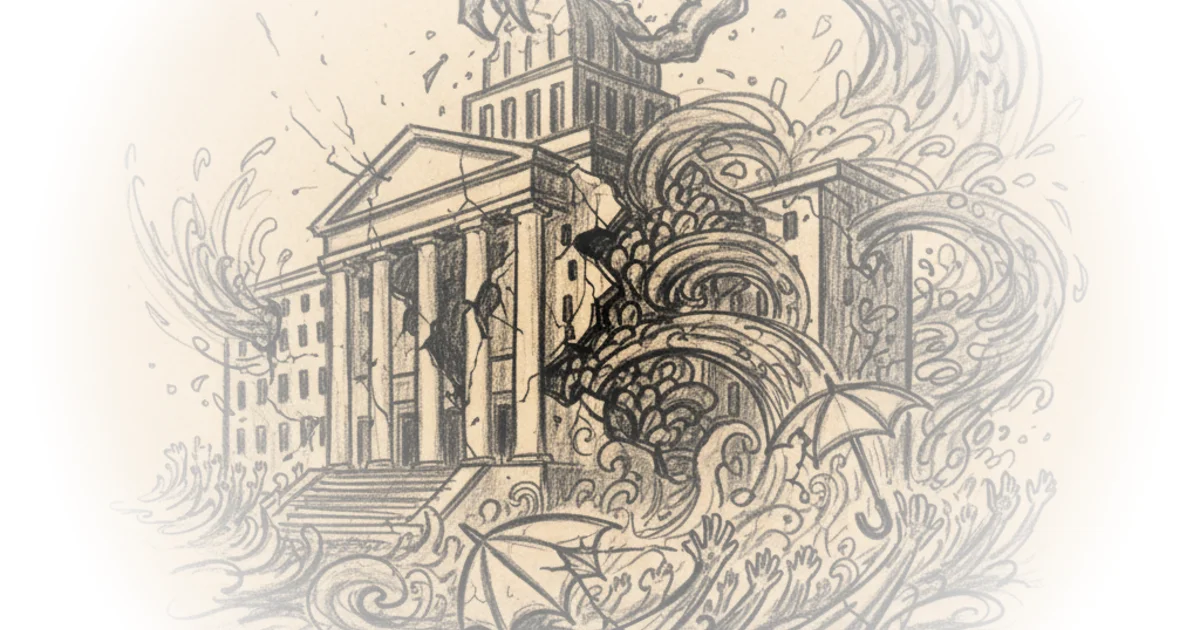
The commentary effectively captures the psychological turning point. Chappell argues that the government's decision to stall and then pretend the issue was resolved was the catalyst for this escalation. He notes, "this is I mean like some of the footage we have like it's definitely would be gold for like people's daily... this thing not this particular protest but in this whole week has been like suicide and like these things it's definitely the PR could turn on the protesters." This is a sharp analysis of the strategic risk protesters now face; by storming the building, they risk losing the broad public sympathy that the earlier two-million-person march secured. Critics might note that Chappell's focus on the potential loss of public sympathy overlooks the fact that for many participants, the government's inaction had already eroded faith in peaceful protest as a viable tool.
"This is definitely an escalation and I think sadly the government did kind of indicate before after the 612 protest that's one where people were tear gassed... and then the government was like okay we're gonna postpone the bill so in a way they've indicated that the more dramatic intense confrontations are what's going to get an answer out of them which is also unfortunate."
The Paradox of Violence and Care
One of the most compelling aspects of Chappell's reporting is his documentation of the strange, contradictory behavior of the protesters. He describes a scene where some individuals actively tried to block his camera to protect identities, while others were "still being the very considerate polite you know protesters that we've seen this whole time polite ones and the ones who are pissed and ready to break stuff." He recounts how, even as the front line was storming the barricades, "there were still people trying to give us goggles and safety gear like trying to make sure that we were safe and stuff like that."
This paradox highlights the unique nature of a leaderless movement. Chappell explains the difficulty of coordination: "the thing about a leaderless movement is it's hard for the people to convince the pissed ones not to do what they want to do." The author's observation that protesters were using umbrellas to shield each other and even constructing barricades from pedestrian barriers demonstrates a high degree of organization amidst the chaos. However, the footage of "red stains" on the broken glass and the tearing of doors off their hinges serves as a grim reminder of the physical toll. The author notes, "I don't know what the ultimate goal is but that's what they're doing," underscoring the uncertainty of the movement's endgame as it moves beyond symbolic protest.
The Government's Calculated Silence
Chappell frames the escalation not merely as a spontaneous outburst of rage, but as a reaction to the administration's strategic silence. He points out that pro-democracy legislators tried to convince the crowd not to breach the building, but "they just failed." The frustration is palpable, driven by the perception that the executive branch has decided to "move on" and "pretend that everything's okay now." Chappell suggests a cynical dynamic at play: "there is a possibility that they are hoping something like this could happen something that the protesters could kind of go over the edge and then public opinion would turn against them."
This analysis cuts to the heart of the institutional deadlock. The author argues that the protesters have learned a dangerous lesson: "maybe we have to tear and tear away into the Legislative Council this is definitely an escalation." The coverage suggests that the government's refusal to withdraw the bill or engage in meaningful dialogue has inadvertently validated the most radical tactics. While Chappell acknowledges the risk of backlash, he also notes that "there's still no looting there's no destruction of private property," distinguishing the target of the violence as the seat of power rather than the general public. This distinction is vital for understanding the protesters' intent, even if the methods are destructive.
Bottom Line
Chappell's reporting succeeds in humanizing a chaotic event, capturing the tragic irony of a movement that is both highly organized and dangerously unmoored. The strongest part of the argument is the identification of the government's silence as the primary driver of escalation, suggesting that the administration's strategy of waiting out the protests may have backfired by radicalizing the crowd. The biggest vulnerability remains the movement's lack of a unified strategy, leaving it vulnerable to the very public relations disaster Chappell predicts. Readers should watch closely to see if the administration capitalizes on this breach to reframe the narrative, or if the sheer scale of the protest continues to force a political resolution.