Sixty years after the May 16 Notification unleashed chaos across China, a startling historical irony emerges: Western anarchists once viewed the architect of one of history's deadliest totalitarian regimes as a fellow traveler. This piece from Reason does not merely recount a strange footnote of the 1960s; it dissects how a fog of distance and ideological projection allowed intellectuals to mistake a brutal power struggle for a libertarian uprising. The article forces a reckoning with how easily the desire for decentralization can blind observers to the reality of mass murder, a lesson as urgent today as it was in the era of the Red Guards.
The Projection of Liberty
The core of the argument rests on the dangerous allure of the "imaginary Mao." Reason reports that during the Cultural Revolution, "some of them thought they were watching an anti-authoritarian leader instigating a revolt against bureaucracy." This was not a simple case of leftists supporting a socialist revolution; it was a specific, bizarre convergence where those "allergic to bureaucracies" and centralized organizations found a hero in a dictator. The piece notes that Paul Berman identified this group as "inconsistent libertarians" who kept "falling for the Third Worldist fantasies of the modern Marxists."
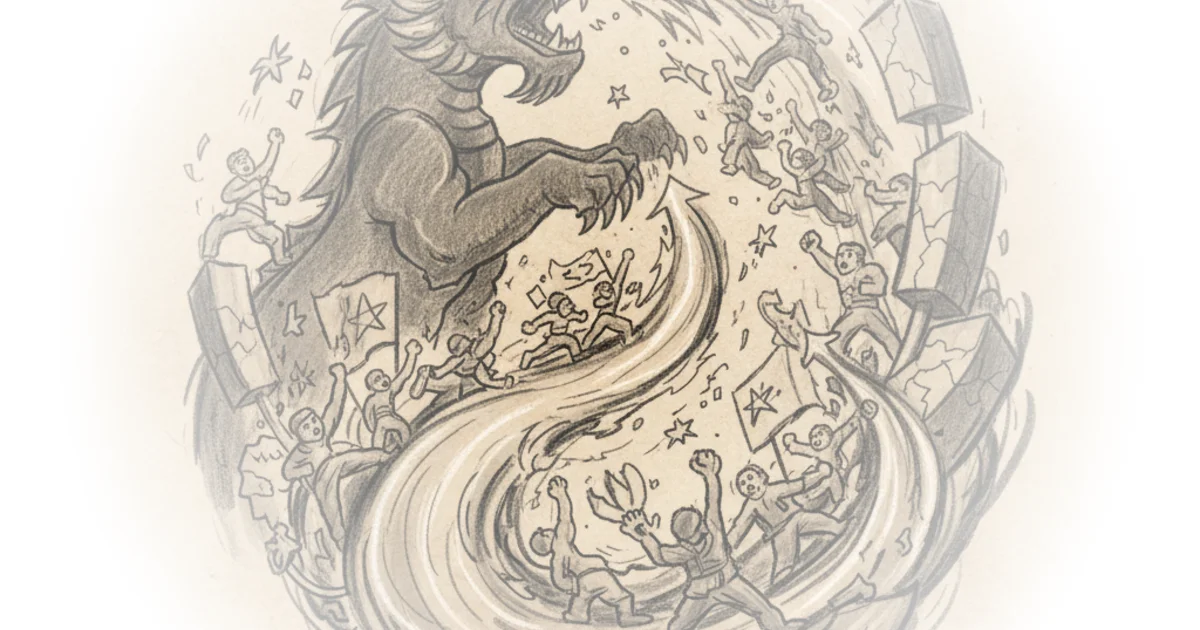
The evidence of this delusion is staggering in its variety. The article highlights how the Whole Earth Catalog, a counterculture bible with a strong libertarian streak, hailed Mao's China as "one of the great social and political experiments of all time." Even more jarring is the account of composer John Cage, who mixed futurism with a belief that Mao's admonition to the Red Guards that "it is right to rebel" signaled a genuine anarchist impulse. The editors note that this was a time when "most Westerners viewed this through a fog," projecting their own ideals onto a reality that was, in fact, a "mishmash of groups chaotically clashing" in a violent rebellion.
Critics might argue that the sheer volume of these misinterpretations suggests a deep flaw in the Western New Left's analytical framework rather than just a historical curiosity. The piece effectively demonstrates that the human cost was ignored in favor of a narrative; while "hundreds of thousands of people were killed—probably well over a million," the intellectual fascination continued unabated.
The Libertarian Detour
Perhaps the most fascinating section explores how free-market libertarians also fell into this trap, attempting to reconcile their philosophy with Maoist economics. The article details the work of Stephen Halbrook, who claimed that "all forms of coercion were taboo" during the Great Leap Forward—a flat-out inaccuracy that the piece exposes by showing how Halbrook cherry-picked quotes. Halbrook presented a 1934 report where Mao promised to promote the private sector, conveniently omitting the crucial qualifier: "so long as it does not transgress the legal limits set by our government."
Yet, the piece acknowledges that some serious thinkers were drawn in. Karl Hess, a former Goldwater speechwriter turned anarchist, took a more nuanced approach. He did not claim China was free, but argued that libertarians should watch for a "direction of political and social movement" away from command socialism. Hess suggested the country was "moving—at least moving—away from command socialism and toward a sort of participatory democracy." This framing allowed him to maintain a degree of distance from the regime while still engaging with the idea of a shift toward freedom.
"He may have landed there accidentally, but he got there all the same."
This observation is the piece's most insightful moment. Hess's vagueness about the hinterlands turned out to be prescient, even if his diagnosis of the cause was wrong. The article explains that the chaos of the Cultural Revolution did indeed decimate the party's grip, leading to a situation where "many villages really did enjoy a great deal of de facto autonomy." However, this was not the result of Maoist ideology, but rather the collapse of central authority.
The Irony of the Ultra-Left
The narrative takes a sharp turn when it examines the actual Maoists who rejected the state. The piece describes the Shengwulian movement, where a teenaged spokesman argued in 1968 that the party was a "privileged class" and the state should be replaced with a decentralized democracy modeled on the Paris Commune. The irony is palpable: this essay was "officially denounced and its author shipped to a prison camp." These ultra-left critics were not anarchists in the Western sense, but they were the only ones who correctly identified the totalitarian nature of the regime from within.
The article draws a striking parallel to the American right, noting that it was Ronald Reagan who read a radio script quoting these "new Chinese libertarians." The script, written by John McClaughry, featured Reagan approvingly quoting a manifesto that declared, "We oppose all dictatorships, all governments, all forms of statism, and all authority." The piece uses this to highlight the absurdity of the era's ideological cross-pollination, where a future president of the United States was amplifying the very critiques that the Chinese state was trying to erase.
Bottom Line
The strongest part of this coverage is its unflinching exposure of how ideology can warp reality, turning a genocide into a "libertarian experiment" in the eyes of the distant observer. Its biggest vulnerability lies in the sheer complexity of the Chinese context, which the article simplifies to make its point about Western projection, though it does so effectively to illuminate the danger of romanticizing foreign revolutions. Readers should watch for how this pattern of projecting domestic desires onto foreign chaos repeats in modern geopolitical analysis, where the human cost is often the first casualty of a good narrative.