In an era where technology is often framed as a neutral tool for progress, Wayfare presents a startlingly different diagnosis: that modernity has birthed a spiritual and existential prison we barely notice. The piece argues that we are not merely using machines, but are being consumed by a "Machine" that has reconfigured human consciousness, turning the very concept of freedom into a new form of slavery. This is not a standard tech-lash; it is a profound theological and philosophical intervention suggesting that the solution to our crisis lies not in better regulation, but in a radical reorientation of the human heart.
The Architecture of the Cage
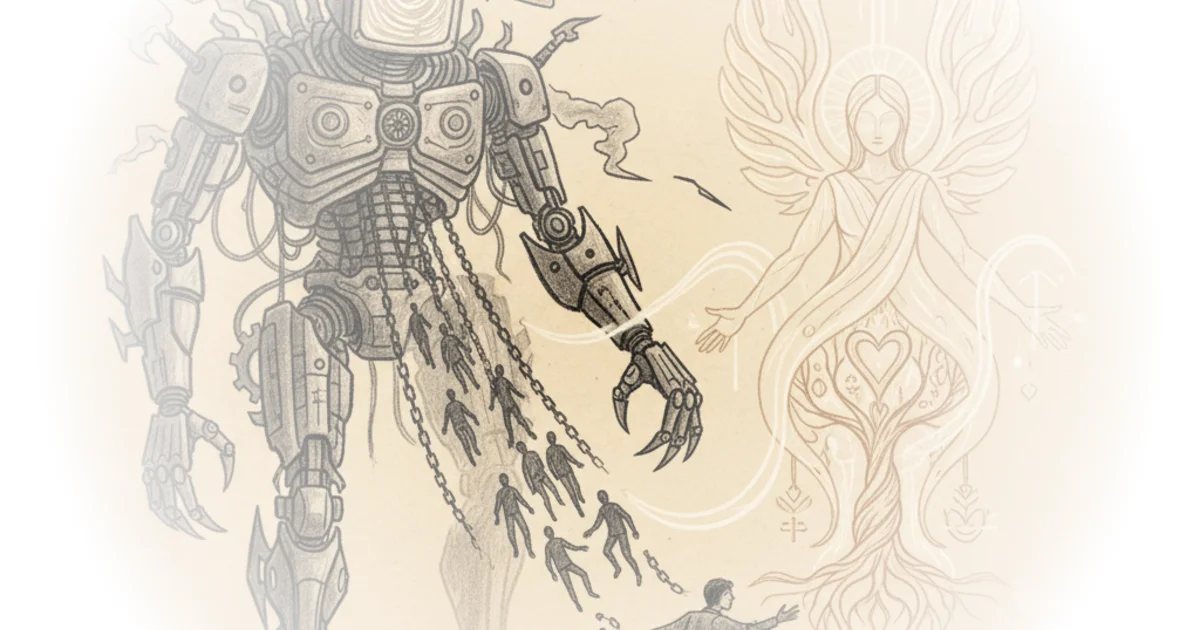
The commentary anchors its argument in the work of Paul Kingsnorth, who describes the modern condition as a "monster" that is "cold and inhuman and spiritually bereft." Wayfare reports that Kingsnorth selects this term because it aptly captures the pervasive reliance on what Jacques Ellul called "technique" and what Iain McGilchrist identifies as the "dominion of left-hemispheric thinking." This historical grounding is crucial; it reminds the reader that this is not a new phenomenon born of the smartphone, but a centuries-long drift toward a worldview that prioritizes utility over truth. The piece draws a powerful parallel to Rainer Maria Rilke's poem "The Panther," noting that "there are a thousand bars; and behind the bars, no world." This metaphor effectively illustrates the article's central claim: the Machine is an existential cage that numbs us to the reality beyond our immediate, manufactured confines.
"The human mind itself has become machine-like. But this is all to say that it's not unexpected when we can't always see the Machine at work. We are its children and its disciples and emissaries, after all."
The argument gains depth by suggesting that the Machine is not just an external force but an internal one. Wayfare posits that the pollution we see in the skies is merely a symptom of a deeper, "implicit, even unconscious" pollution of the mind. The piece asserts that "a renewal of mind is necessary, coupled with a heavy dose of repentance, if we are to be free from it." This theological turn is the article's most distinctive feature. It reframes the crisis of modernity not as a policy failure but as a spiritual fall, a "recapitulation of seizing the fruit of the tree of knowledge of good and evil." By invoking the story of the Tower of Babel, the editors suggest that our attempt to build a civilization based on our own sufficiency has led to the very fragmentation and isolation that the Machine thrives upon.
The Myth of Progress and the Loss of Roots
The commentary sharply critiques the prevailing narrative of inevitable progress. Wayfare argues that the story of the Machine's rise is often told as a natural evolution, but this is a "myth of Progress in a nutshell," described as an "ideology masquerading as natural inevitability." The piece contends that this narrative is a "demonic force that stepped in when God was denied a say in the modern world." This is a bold claim, one that challenges the secular assumption that history is a linear march toward improvement. Instead, the article suggests that "every attempt to control the world... has ended up convincing us only of our lack of power and agency."
The editors highlight Kingsnorth's "alliterative list of four Ss"—Science, Self, Sex, Screens—as the pillars of this modern fixation on the ego. Wayfare reports that these emphases involve a "preference for representation" over reality, a dynamic St. Paul would describe as the "desire of the flesh." The piece notes that while the flesh is not always negative in scripture, in this context, it refers to the part of us that works against our true nature. This analysis connects the dots between our cultural obsessions and a deeper spiritual malaise, suggesting that "without a realistic sense of boundaries, we end up at the mercy of the reign of quantity."
Critics might note that framing complex socio-political issues through a strictly theological lens risks alienating secular readers or oversimplifying the material causes of environmental and social decay. However, the piece counters this by arguing that the "modern liberal West has become an idol," and that the "blank-slate state" fantasy of a do-over is itself a product of Machine thinking. The editors suggest that Kingsnorth's call to "let the West die" is not an abandonment of tradition, but a necessary death of the "modern liberal West" to allow the "Greater Western tradition, as a perpetual pursuit of truth, might be revived."
"The ultimate temptation would be to listen carefully, to comprehend the desperateness of the situation, and then to walk away and do nothing about it—or worse, continue to support those things that work against our well-being."
The Path to Wakefulness
Despite the grim diagnosis, the commentary insists that the book is not a manifesto of despair. Wayfare notes that "there is rage and sadness beneath it, of course, but also hope." The editors praise Kingsnorth as a "subtle and gentle guide" who avoids the "Malcolm-Gladwellification of non-fiction." The piece argues that the very fact that we can be "horrified by the Machine" is proof that we have a "sense of the way out." This emotional resonance is key; the article suggests that "anguish" is not a weakness but a "warning" and a sign of the "human heart beating in your chest."
The commentary concludes by emphasizing the practical, albeit difficult, nature of the proposed solution. Wayfare reports that the book is divided into four parts, moving from diagnosis to history, to present experience, and finally to "practical suggestions for survival and resistance." The editors note that while Kingsnorth leaves much room for readers to work out the details, the core message is clear: "We must feel the damage, and we must act now." The piece suggests that the path forward requires a "clear eye for what is valuable and lasting—and even for what is transcendent," even while living in the "unlighted belly of the Machine."
Bottom Line
Wayfare's commentary on Paul Kingsnorth's work offers a rare, deeply philosophical critique of modernity that transcends typical political or technological debates. Its greatest strength lies in its ability to reframe the crisis of the age as a spiritual and existential one, connecting the dots between ancient theology and contemporary alienation. However, its reliance on a specifically Christian theological framework may limit its persuasiveness for a secular audience, even as it offers a compelling alternative to the dominant narratives of progress and efficiency. For the busy reader seeking a deeper understanding of why the modern world feels so broken, this piece provides a necessary, if challenging, wake-up call.