Adam Tooze cuts through the noise of 2026's economic anxiety with a startling thesis: the panic over global imbalances is a distraction from a far more dangerous reality. While the World Bank and IMF gather to discuss the usual suspects of trade deficits and currency flows, Tooze argues we are ignoring the fact that the "barbarians are already inside the house." This piece is essential listening because it reframes the current economic chaos not as a technical glitch in the global system, but as a symptom of a shattered political order in Washington and a structural trap in Beijing.
The Myth of the Stable Door
Tooze begins by dismantling the conventional wisdom that global imbalances are a new crisis. He notes that for decades, the US has run deficits while nations like China and Germany have run surpluses. "When we view the last decades of modern economic history, the striking thing is that imbalances are not just large but persistent," Tooze writes. He points out that standard economic theory promised these would self-correct via exchange rates, yet they haven't. The persistence of these flows is not new; the 2008 financial crisis reduced the scale slightly, but the fundamental architecture remained.
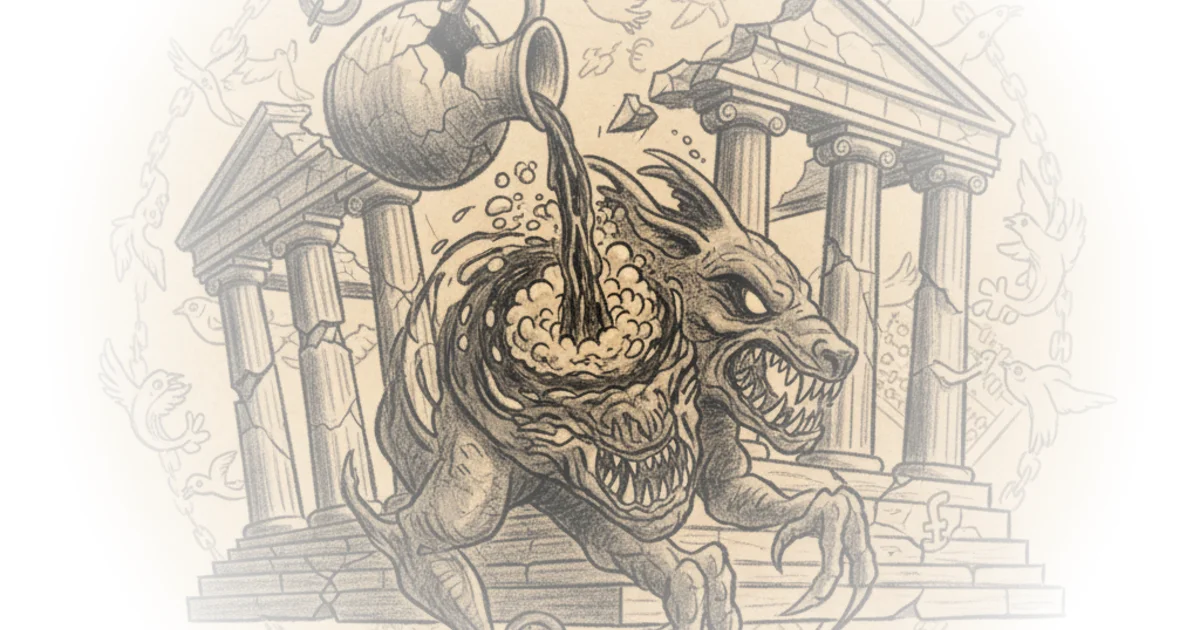
The author's most provocative move is to dismiss the current fear of protectionism as a trigger for these imbalances. He argues that worrying about future trade wars is futile when the damage is already done. "After Trump's utterly unprecedented trade policy rampage in 2025, worrying about global imbalances as a potential trigger for future protectionism is akin to making a labored argument for locking the stable door after the horse has not just bolted but smashed its way through the stable wall." This framing is powerful because it shifts the blame from abstract economic forces to concrete political actions. The "barbarians" aren't waiting at the gate; they are the ones who burned the gate down.
Critics might argue that focusing solely on the 2025 trade policies ignores the underlying economic grievances that fueled them. However, Tooze counters that the political rhetoric has little to do with sophisticated balance-of-payments analysis. He suggests that the disconnect between the administration's tariff demands and the actual pressures of the American political economy is a sign of deeper dysfunction. "To engage in conventional macroeconomic policy debate when the barbarians are inside the house is, in the best case, a form of escapism," he asserts.
The Fiscal Black Hole
The commentary then pivots to the financial side of the equation. The US is accumulating massive liabilities, nearing $30 trillion, which is roughly equivalent to its GDP. Yet, Tooze warns against the alarmist narrative of a dollar collapse. Citing Brad Setser, he notes that foreign investors remain hungry for US equities, particularly the mega-cap tech giants driving the AI boom. "There seems little reason, on the face of it, to worry about foreign claims on the US private sector," Tooze writes, highlighting that the real issue isn't a flight from the dollar, but the US government's own fiscal profligacy.
The core of the argument here is that the deficit is a political choice, not an economic inevitability. Tooze points out that the US is running historically large budget deficits despite full employment, a phenomenon driven not by spending but by a collapsed tax base. "What is anomalous is the atrophying of the American tax take," he explains, pinning the blame on a Congressional impasse where Republicans have refused to raise revenue. This analysis is crucial because it strips away the complexity of global finance to reveal a simple domestic failure: the US is borrowing to fund a political stalemate.
Your main focus should be on the manifest disintegration of coherent political decision-making in Washington D.C.
This focus on domestic political decay as the driver of global instability is the piece's strongest insight. It forces the reader to look inward rather than outward. While some might argue that global factors like the strength of the dollar or foreign demand play a larger role, Tooze convincingly argues that the primary engine of the crisis is the "atrophying" of the American state's ability to fund itself.
The China Shock 2.0 and the European Frontline
The narrative shifts to the surplus side, where the dynamics are equally distorted. Tooze highlights a surge in exports from Taiwan and South Korea driven by AI data center demand, but the real story is China. He suggests that official data from the IMF and other bodies significantly understate China's true trade surplus. "The stronger interpretation favored by the redoubtable Brad Setser is that the data systematically understate the level of Chinese trade surplus," Tooze writes. He argues that Beijing is manipulating the RMB and hiding reserve accumulation in the balance sheets of para-state banks to maintain growth in the face of a real estate recession.
This leads to the concept of "China Shock 2.0." Unlike the first wave in the 2000s, which hit the US manufacturing sector, Tooze argues the current surge is primarily targeting Europe. "This time the principal 'victim' of a surge in affordable, high quality imports from China is Europe, not the US," he notes. This explains why the debate has shifted to a trans-Atlantic conversation, with French economists and American liberals warning of the impact on the EU. The US, paralyzed by its own trade wars, has ceded the frontline to Europe.
Tooze draws on the work of the Centre for Economic Policy Research (CEPR) to suggest that the West must adjust to China's rise as a long-term trend, rather than viewing it as an anomaly. He critiques the 1990s "convergence ideology" that assumed China would simply "bolt on" to the Western system. "If history was not actually over, there was at least..." he trails off, implying that the illusion of a seamless global integration has finally shattered.
Critics might contend that focusing on the "China shock" narrative risks ignoring the internal demand issues within China that are driving these exports. However, Tooze's point is that the policy response is being shaped by the perception of a deliberate industrial strategy, regardless of the underlying data nuances. The IMF, once a defender of the old orthodoxy, has finally conceded that industrial policy can indeed shift macro balances.
Bottom Line
Adam Tooze's analysis is a masterclass in cutting through economic jargon to reveal the political rot beneath. The strongest part of his argument is the refusal to treat global imbalances as a technical problem solvable by better accounting; instead, he identifies them as the symptom of a broken American political system and a strategic trap in China. The biggest vulnerability of this view is that it offers little in the way of a solution beyond diagnosing the paralysis in Washington. Readers should watch for how Europe responds to the "China Shock 2.0," as it may become the new laboratory for trade policy in a world where the US has abdicated its leadership role.