Julia Belluz returns with a provocative challenge to the dominant narrative on obesity: the idea that we overeat because food is too pleasurable is fundamentally wrong. Instead, she presents a conversation with journalist Mark Schatzker arguing that ultra-processed foods exploit a neurological mismatch, creating a state of uncertainty that drives compulsive eating far more than simple "bliss points" ever could. For busy readers navigating a diet culture obsessed with calories and willpower, this reframing offers a startling explanation for why "just stopping" is biologically nearly impossible.
The Myth of the Bliss Point
Belluz opens by dismantling the popular theory, championed by authors like Michael Moss, that food engineers have perfected a "bliss point" of sugar, salt, and fat that hijacks our brains. She introduces Schatzker's counter-intuitive finding that the industry itself has moved away from this concept. "I think the idea that these foods are hitting bliss points is wrong," Schatzker tells Belluz. "Bliss is not an action, it's a state of mind. They used words like craveability or 'moreish.' They were searching for foods that made people want to eat."
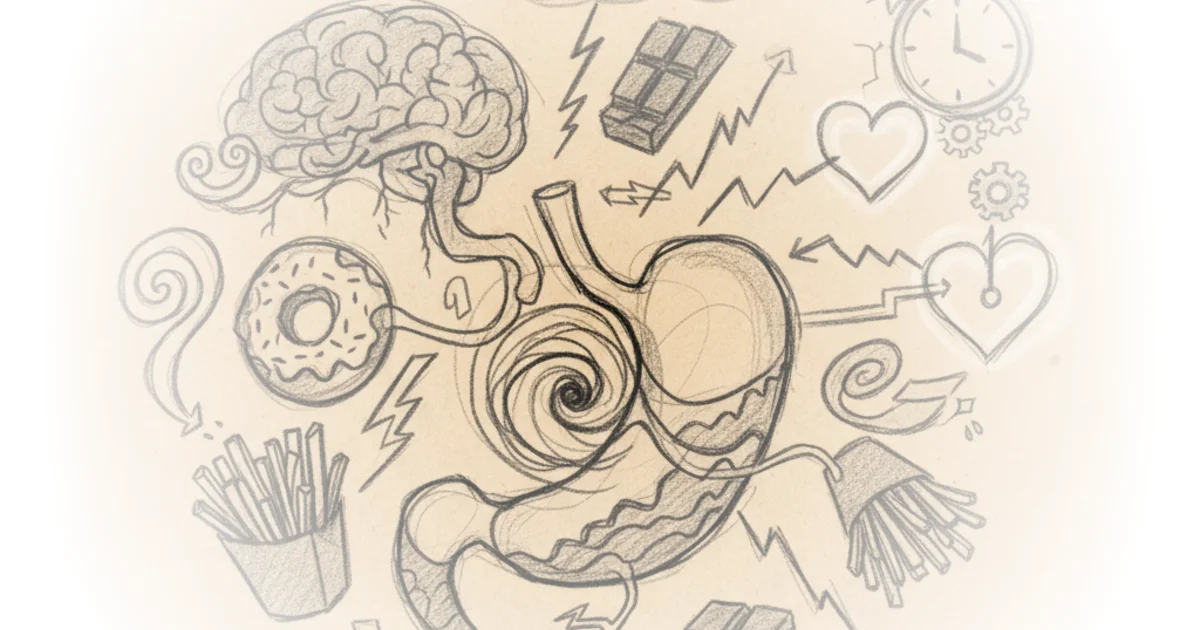
This distinction is crucial. The argument shifts from "we like it too much" to "we want it too much." Schatzker points to brain imaging that reveals a disconnect in people with obesity: a spike in wanting upon seeing food cues that is not matched by the actual liking or reward received upon consumption. Belluz synthesizes this well, noting that the stigma of obesity often blames a lack of self-control over pleasure, when the science suggests a warped appetite system. "The ultimate effect is that millions of brains have been goaded into seeking more calories than they need," Schatzker argues. This lands powerfully because it removes the moral judgment from the equation, replacing it with a mechanistic explanation of how modern food environments hijack evolutionary drives.
Critics might argue that this biological determinism downplays the role of individual agency or the sheer volume of calories consumed, but the neurological evidence regarding "reward prediction error" is difficult to ignore.
The Culture of Eating
Belluz then pivots to a dimension often missing from policy debates: culture. She contrasts the American relationship with food against that of France and Japan, where high-quality, calorie-dense foods are enjoyed slowly and socially. Schatzker notes, "The cultures that value and celebrate and revere deliciousness the most... they're super thin. They're markedly more thin than anyone else." He suggests that the problem isn't the food itself, but the context in which it is consumed. "One of the craziest stats I came across was that the French and Italians eat far fewer calories than Americans, and yet it takes them longer to eat a smaller amount of food," he tells Belluz.
The commentary here is sharp. Belluz highlights how the "food environment" includes social norms, not just the availability of products. Schatzker's observation that a chocolate croissant is a "terrible waste" if eaten mindlessly in a car underscores the loss of ritual. "We need to stop obsessing over nutrients and create a culture of appreciation," Schatzker concludes. This is a compelling policy angle, suggesting that education should focus on sensory literacy—understanding sauces, pickling, and terroir—rather than just macronutrient counting. However, one must consider whether this cultural approach is scalable in a food system driven by efficiency and low cost, where school lunches are often priced at a few dollars and quality is sacrificed.
We need to stop obsessing over nutrients and create a culture of appreciation.
The Disorder of Uncertainty
The piece's most sophisticated argument arrives in its final third, where Schatzker defines the modern food crisis as a "sensory mismatch." In nature, flavor signals nutrition; sweetness means energy, and fat means calories. Ultra-processed foods break this link. "The signals that we get from food don't match up with nutrition anymore," Schatzker explains. "Fooling the brain potentially becomes a very bad idea. Because then you're creating a situation where the brain is going, 'I thought I was getting calories, and I didn't get them.'"
This creates a "reward prediction error," a state of uncertainty that the brain interprets as a threat, triggering a drive to eat more to resolve the deficit. Belluz connects this biological mechanism to the social reality of poverty and food insecurity. "We know how the brain acts in uncertain situations. It responds with motivation," she writes, quoting Schatzker. The parallel is drawn between the uncertainty of a slot machine and the uncertainty of a modern diet where flavor no longer predicts energy. "Something has tweaked millions of people to go seek out calories," Schatzker says, noting that food names like "double down" or "triple stacker" promise a "calorie jackpot."
This framing is brilliant because it unites the biological and the socioeconomic. It explains why food insecurity often correlates with obesity: the brain's evolutionary response to uncertainty is to hoard calories. While some might argue that this ignores the role of sedentary lifestyles, the focus on the predictive failure of the food system provides a more robust explanation for the scale of the crisis than simple "gluttony" ever could.
Bottom Line
Belluz's interview with Schatzker successfully reframes the obesity epidemic from a failure of willpower to a failure of the food system's signal integrity. The strongest part of the argument is the concept of "sensory mismatch," which explains why ultra-processed foods are uniquely addictive without relying on the debunked "bliss point" theory. The biggest vulnerability lies in the policy implications; while cultivating a "culture of appreciation" is ideal, it offers little immediate relief to those trapped in food deserts or struggling with the economic realities of the modern diet. Readers should watch for how this "uncertainty" framework influences future regulations on flavor additives and food labeling.