Yascha Mounk does not ask whether artificial intelligence is powerful; he asks whether surrendering to it is a form of self-erasure. While the industry fixates on model capabilities and market valuation, Mounk offers a rare, grounded diagnosis: the real danger isn't that machines will become human, but that humans will willingly become machines. This is not a Luddite rant, but a pragmatic warning from someone who has watched the same extraction playbook play out twice—first with social media, and now with generative models.
The Second Act of the Same Play
Mounk's central thesis rests on a striking historical parallel. He argues that the current AI boom is merely a sequel to the social media era, repackaged with new promises but identical motives. "I might be a lot more interested in developments with AI if I hadn't already seen this movie," he writes. The author recalls the early days of Facebook, where the promise of connection gave way to isolation, noting that "everybody seemed to be sealed up in their rooms carrying out a facsimile of social exchange."
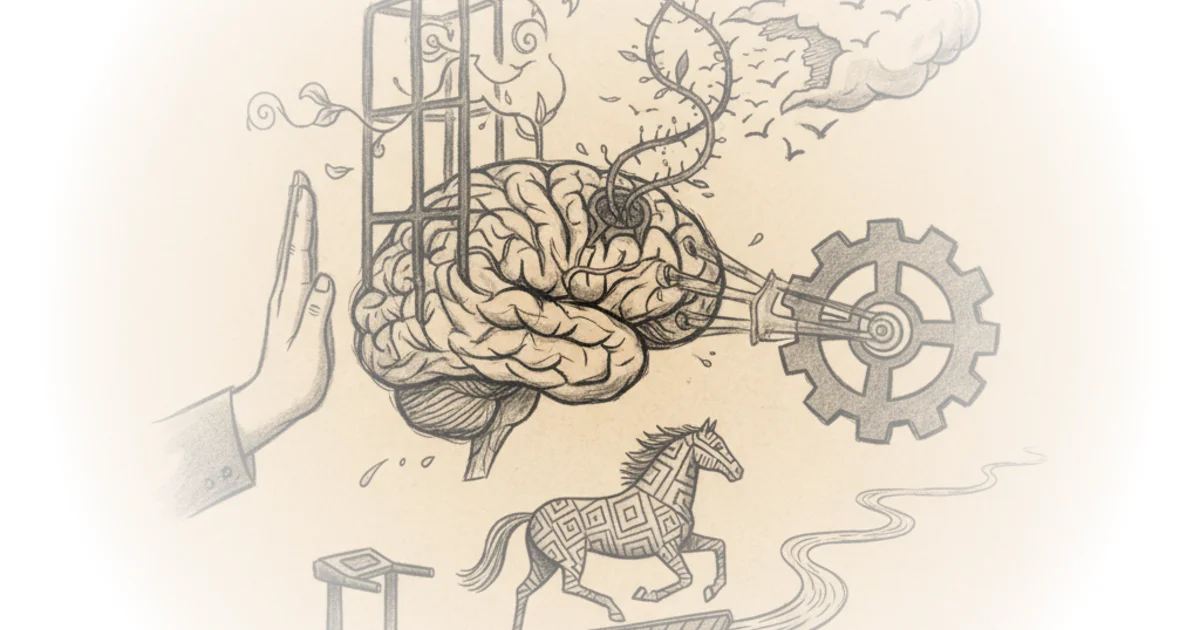
This comparison is effective because it shifts the debate from technical specs to behavioral economics. Just as the attention economy mined human relationships for ad revenue, the new AI regime mines our "deep privacy of people's innermost lives." Mounk points out that users now confess their darkest secrets to large language models, which "spit back out what they want to hear" without the legal confidentiality of actual therapy. The stakes have simply moved from the public square to the private soul. Critics might argue that this ignores the genuine utility of AI in coding or data analysis, but Mounk's focus remains on the psychological cost of outsourcing our inner lives to data miners.
The question is about agency—do you choose to exert agency in your own life, in the way that humans always have and were doing just fine with until, like, three years ago? Or do you prefer to turn it over to a machine, which really means turning it over to the data miners and the advertising innovators in the world's largest tech corporations?
The Illusion of Optimization
The author dismantles the prevailing narrative that life is a problem to be solved through efficiency. He observes that the tech sector's obsession with "optimization" clashes with the human need for meaning. "But whoever said that life is about optimization?" he asks, challenging the assumption that a clean, error-free output is superior to a messy, subjective human effort.
Mounk illustrates this with a poignant example of a travel writer whose company replaced human staff with AI, only to realize that "the whole point of travel is the relationship between you, the traveler, and the place visited." When the industry turns to algorithms, the result is content that is technically proficient but emotionally hollow. This aligns with historical concerns about the Luddite movement, which was often mischaracterized as anti-technology; in reality, it was a protest against the degradation of craft and the replacement of skilled human judgment with cheaper, inferior substitutes. Mounk suggests we are facing a similar moment, where the "slop" generated by machines is flooding the zone, making it harder for genuine human work to stand out.
He notes that the adoption of AI is often driven by a "glazed look" of habit rather than genuine benefit. "The assumption at the moment is that AI 'is the future'—a phrase like that is the underpinning of just about any conversation on AI," he writes. Yet, he warns that this inevitability is a fantasy. The technology is impressive, but as he notes, "cloning and nuclear technology are also impressive and have strict guardrails around them." The focus on capability is a distraction from the ethical question of whether we should use these tools at all.
The Practical Cost of Laziness
In his role as an educator, Mounk sees the consequences of this shift firsthand. He describes a classroom where students have become "distinctly lazier," convinced that the AI is simply better than they are. The result is a generation that risks losing the very skills required to compete. "If they show up in the workforce using AI for everything, their employers will of course take them at their word and simply replace their jobs with AI," he argues.
This is a stark, practical warning that cuts through the hype. The author suggests that the only way to distinguish oneself in a world of AI-generated uniformity is to do the work that the machine cannot: the subjective, the idiosyncratic, and the deeply human. He recounts how a friend in the travel industry lost their job because their boss decided to "welcome in AI," only to find that the remaining staff were merely checking for hallucinations in a sea of generated text. The irony is palpable: in seeking to optimize, the industry destroyed the very value it sought to create.
The question isn't whether AI is a stochastic parrot or not; the question is whether you are.
Bottom Line
Mounk's argument is most powerful when it reframes the AI debate from a technological inevitability to a choice of values. His strongest point is the identification of "agency" as the true casualty of the AI revolution, a vulnerability that the industry's marketing glosses over. However, the piece's biggest weakness is its reliance on individual boycotts in an ecosystem where AI is rapidly becoming the default infrastructure of the internet; opting out may soon become impossible for many. The reader should watch for whether the "slop" Mounk predicts will eventually trigger a cultural backlash, or if the convenience of automation will permanently erode the human capacity for deep, unassisted thought.