Andrew Henry doesn't just ask if Confucius has living descendants; he asks why a family line survived two millennia of political chaos, war, and ideological purges to become a state-sanctioned institution. While most genealogical claims dissolve under the weight of time, Henry presents a case where the lineage was not merely preserved but actively weaponized as a tool of political legitimacy and economic power.
The Architecture of a Sacred Lineage
Henry immediately dismantles the romantic notion of a passive family tree. He notes that while most Americans struggle to trace roots past the Civil War, the Kong family claims a continuous record stretching back to 500 B.C.E. "Tracing back more than 80 generations ago to around 500 B.C.E., which actually has earned them a Guinness World Record for the longest documented family line," Henry writes. This is not just a trivia fact; it is the foundation of a unique socio-political phenomenon. The author argues that the survival of this line was not accidental but engineered through the creation of the "Duke of Yen Chong" title in 1055 C.E. This was a masterstroke of soft power. As Henry puts it, "The Kong lineage with the Duke at its head basically acted like a centralized aristocratic government."
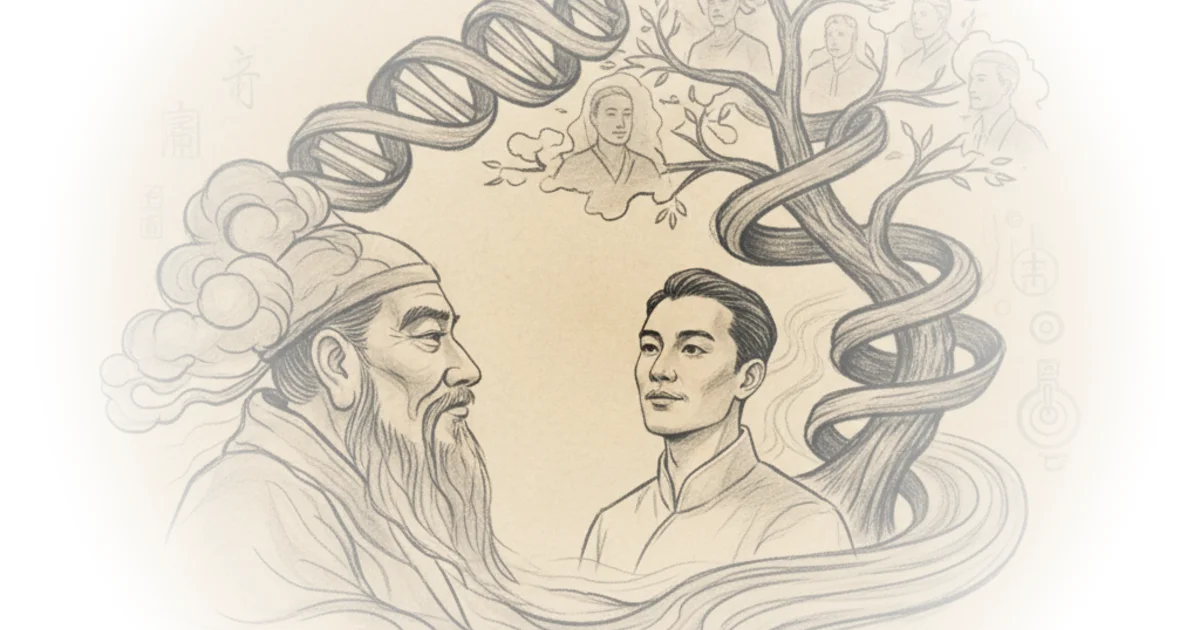
The brilliance of Henry's coverage lies in his refusal to treat the Kong Dukes as mere ceremonial figureheads. He details how the family managed vast estates, administered the temple, and even wielded military power. "They knew that the soft power of sacred prestige could be leveraged into hard power which they were able to do quite successfully for hundreds of years," he observes. This reframing is crucial. It shifts the narrative from a story of ancient bloodlines to one of institutional resilience. Critics might note that Henry glosses over the fact that this "centralized government" was entirely dependent on the goodwill of the ruling dynasty, making their power precarious rather than absolute. Yet, the sheer longevity of their influence remains undeniable.
The large gap in time is why scholars like Dr. Agnu only accept the genealogy going back to 1055.
The Fragility of Historical Memory
Henry is refreshingly honest about the gaps in the historical record. He acknowledges the 1,500-year chasm between Confucius's death and the formal appointment of the first Duke. "Just because someone claims to be descended from a famous figure doesn't mean the paperwork holds up," he admits. This skepticism grounds the piece in reality. He explains that the lineage was likely solidified during the Song Dynasty because the title came with tangible benefits: tax breaks and official status. "The family lineage needed to be regularly maintained to establish the rightful holder of the title as Duke of Yen, as well as who was eligible for those sweet, sweet tax breaks," Henry writes with a touch of wit.
The coverage shines when detailing the chaos that threatened to shatter this continuity. Henry describes the split during the Song Dynasty, where both the north and south claimed their own Duke, and the subsequent Mongol conquest that created a third claimant. "At one point you've got three different men, all claiming to be the one true descendant of Confucious," he notes. This highlights the absurdity and high stakes of the situation. The lineage survived not because of biological purity, but because every new regime needed the symbolic capital of Confucius to legitimize their rule. The Kongs were the gatekeepers of that capital, and they negotiated fiercely to keep it.
The Modern Assault and Revival
The most dramatic turn in Henry's narrative is the 20th-century collapse of the Kong family's status. He connects the decline of the family to the broader ideological war against tradition. The author cites the writer Lu Xun, who famously equated Confucianism to cannibalism. Henry explains how Lu Xun's story "Kong Yi" served as a "blunt metaphor" for the perceived obsolescence of the sage's teachings. "The fictional scholar shares a surname with Confucious himself, Kong. And Lou's supposed real life inspiration carries the surname Mang, as in Menus," Henry points out, showing how the attack on the family was also an attack on the philosophy itself.
The Cultural Revolution brought this conflict to a violent peak. Henry quotes a Red Guard leader, Tong Holan, who declared, "We want to establish the ultimate authority of Mao Zadong's thought and topple the Kong family shop to its foundations." The destruction of the family compound and the scattering of the lineage to Taiwan and mainland China marked the end of the hereditary dukedom. Yet, Henry's analysis doesn't end in tragedy. He traces the family's cautious re-emergence in the 1980s and their current role as cultural ambassadors. "Confucious has gone from being denounced as a symbol of feudal backwardness to being repurposed into a international ambassador of Chinese culture," he writes.
The modern iteration of this lineage is fascinatingly hybrid. Henry notes the existence of an "AI Confucius" that visitors can interact with, a stark contrast to the ancient rituals of the past. "The association has even officially endorsed an AI Confucius that visitors can interact with at Mount Ni, the traditional birthplace of Confucious," he observes. This juxtaposition of ancient lineage and artificial intelligence perfectly encapsulates the family's current struggle: maintaining relevance in a rapidly modernizing world.
Bottom Line
Andrew Henry's strongest asset is his ability to treat a genealogical curiosity as a lens for understanding Chinese political history. He effectively argues that the Kong family's survival was a result of institutional savvy rather than biological inevitability. The piece's biggest vulnerability is its reliance on the "official" narrative of the lineage, which, as Henry himself admits, has gaps that historians still debate. Readers should watch for how the Chinese state continues to co-opt Confucianism for nationalistic purposes, a trend that will likely define the Kong family's future role.
The ongoing work of defining, claiming, and sustaining descent from the sage generation after generation is the real story, not the DNA.