Yale University opens this lecture with a stark temporal contrast that reframes the last thirty years of global history not as a steady march toward liberal democracy, but as a volatile pendulum swing from euphoric optimism to deep institutional anxiety. The piece is notable because it refuses to treat the rise of far-right populism as an aberration, instead positioning it as the logical, terrifying sequel to the unipolar moment of the late 1980s. For a busy professional trying to make sense of today's fractured political landscape, this historical arc offers the context missing from daily headlines: the stability we took for granted was an anomaly, not the rule.
The Illusion of the End of History
Yale University sets the stage by defining the lecture's scope as the three decades since 1989, a period they describe as "incredibly tumultuous" and distinct from the relative stability of the post-World War II era. The author argues that while the Cold War produced proxy conflicts, it paradoxically ensured stability for citizens in Western democracies by containing violence abroad. "From the point of view of the citizens of the Western democracies... it was a far-off war that didn't have a great impact on the stability of people's lives," the lecture notes, contrasting this sharply with the domestic turbulence of the modern era.
The commentary pivots to the fall of the Berlin Wall, using it as the symbolic apex of a global wave of democratization. Yale University highlights the optimism of the time, noting that in 1989, "it seemed like democracy was on the March." This optimism was crystallized by Francis Fukuyama's famous thesis, which the author explains meant that "liberal democracy was sweeping the world." The argument suggests that the world reached a tipping point where, by the turn of the 21st century, "most countries in the world were not democracies" had flipped to a reality where "most countries were democracies."
This framing is powerful because it captures the genuine, almost naive confidence of the era. The author writes that there was "enormous confidence in democratic capitalism and enormous confidence in the idea that many people were going to be lifted out of poverty." This sentiment is crucial for understanding the shock of the present; the current political volatility feels so jarring precisely because it shattered a decades-long consensus that history had resolved itself in favor of liberal institutions.
"It's impossible to completely describe how deeply Germans feel about what's happened here... my feeling is that we are very close to an end of the artificial division of Berlin."
Critics might argue that this retrospective glosses over the immediate failures of the post-Cold War order, such as the wars in the Balkans or the stagnation in Russia, which were happening even as Fukuyama was writing. However, the lecture's point is about the perception of the time—the collective belief that the arc of history was bending toward a benign equilibrium. That belief, Yale University suggests, is what makes the subsequent collapse so disorienting.
The Fracture of the Establishment
The narrative then fast-forwards to 2017, specifically focusing on Germany as a microcosm of a global trend. Yale University details the rise of the Alternative for Germany (AfD), a far-right, anti-immigrant party that crossed the five percent threshold to enter parliament. The author describes the political paralysis that followed: the traditional grand coalition between the Social Democrats and the Christian Democrats collapsed, and attempts to form a new government failed because the AfD was "beyond the pale" and no other party would work with them.
The lecture effectively illustrates the dilemma of modern governance. As the author puts it, the establishment parties were "shrinking and becoming weaker and the parties on the fringes are growing and becoming stronger." This dynamic forced the Social Democrats back into a coalition they despised, terrified of the alternative: "another election in which the far-right would do even better." This is a critical insight for understanding why political gridlock feels so intractable today; the center is being squeezed from both sides, and the cost of stability has become the suppression of democratic choice.
Yale University draws a chilling parallel to the 1930s, noting that the current anxiety in Germany mirrors the pre-Hitler era. "If you want to go back to the 1930s you can see... it was a very unstable system," the author warns, pointing out that the Nazis became the biggest party in 1932 before Hitler came to power 18 months later. While the author acknowledges that the situation is not a perfect replay, the comparison serves to underscore the fragility of democratic norms when extremist parties gain legitimacy.
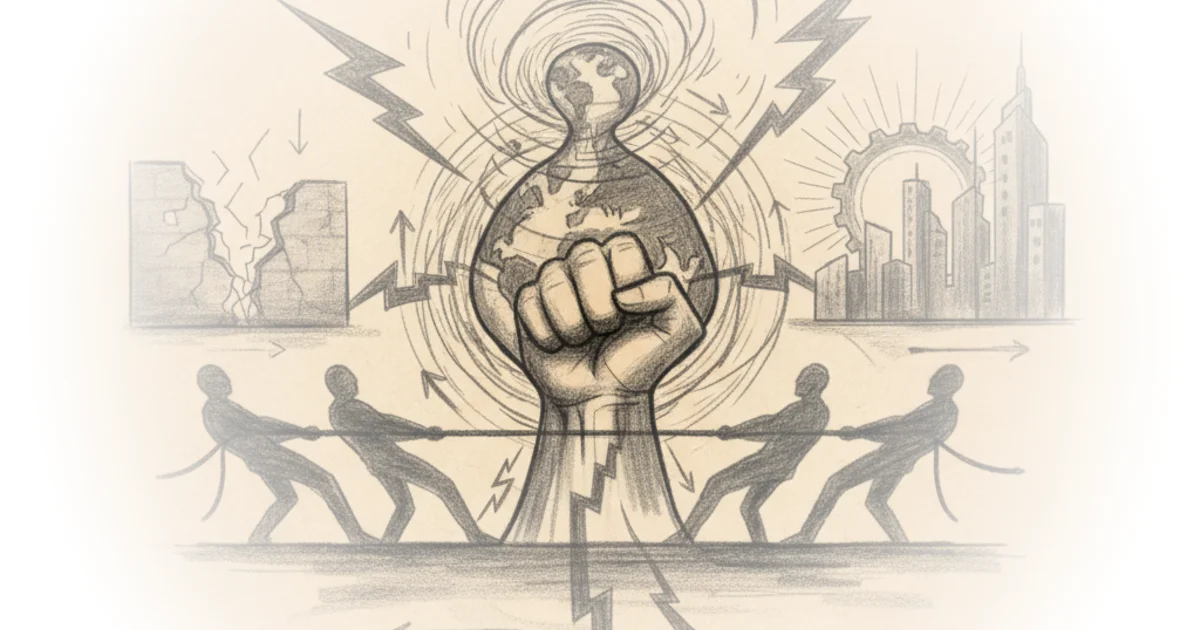
The scope of this shift is global. The lecture lists a cascade of events: the Brexit vote, the election of a populist president in the United States, and the rise of far-right parties in Austria, Belgium, and Italy. In Italy, the League party surged from obscurity to holding 17 percent of the vote, while in Austria, the far-right nearly won the presidency. Yale University synthesizes these events to argue that this is not a series of isolated incidents but a systemic phenomenon where "anti-establishment parties that sometimes also verge on being anti-system parties are gaining ground."
"The establishment parties are shrinking and becoming weaker and the parties on the fringes are growing and becoming stronger."
A counterargument worth considering is that the lecture may overstate the continuity between the 1930s and today, ignoring the robust institutions and civil societies that prevent a slide into totalitarianism. Yet, the author's focus is on the trend of polarization and the erosion of the center, a trend that is undeniable regardless of whether a total collapse is imminent.
The Road Ahead
The lecture concludes by refusing to succumb to despair. Yale University frames the central questions of the course as a diagnostic and prescriptive exercise: "how did we get from there to here, what are the challenges and prospects going forward and most importantly... how could we get to a better place." The author explicitly states, "don't get too depressed it's not all of course for depression," signaling that the goal is to understand the mechanics of power to navigate the future, not just to mourn the past.
The distinctive approach of the lecture is its use of political science tools to study history, treating the last thirty years as a coherent dataset rather than a chaotic series of news cycles. By grounding the analysis in the specific case of Germany and then expanding to a global view, Yale University provides a structured way to think about the chaos. The argument implies that understanding the trajectory from 1989 to 2017 is the first step toward reversing the current trajectory.
Bottom Line
Yale University's strongest move is reframing the rise of populism not as a sudden outbreak but as the inevitable backlash to the perceived stagnation of the post-Cold War consensus. The lecture's biggest vulnerability is its reliance on the German model as a universal template, which may not fully account for the unique institutional strengths or weaknesses of other democracies. Readers should watch for how the course applies this historical framework to the United States, as the stakes there are arguably the highest. The verdict is clear: the era of benign equilibrium is over, and understanding the mechanics of this shift is the only way to navigate the turbulence ahead.