Why Blake Matters Now
Most readers encounter William Blake as a poet of strange visions and stranger prophecies—a figure locked in the 18th century, relevant only to scholars of English literature. But Dr. Mark Vernon offers something different:Blake can change your life. Not as historical artifact, but as living teacher.
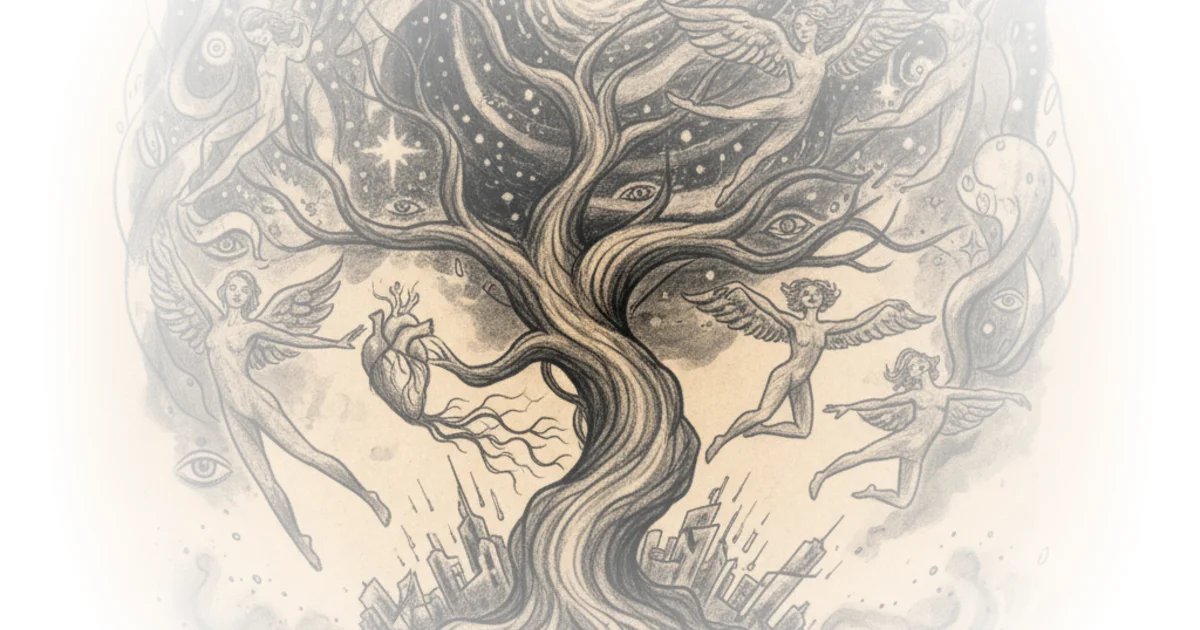
This isn't academic appreciation. This is practical wisdom. Drawing on his recent book Awake, William Blake and the Power of the Imagination, Vernon argues that Blake's four-fold vision wasn't just poetry—it was a training in perception, a sequence of contemplations designed to transform how you see the world.
The Visionary and the Mystic
The distinction between Blake as visionary versus Blake as mystic has plagued literary scholars for generations. North Fry argued Blake belonged more comfortably among the visionary artists—those who work in images and visions—while others placed him squarely in the mystical tradition. But Vernon suggests this debate rests on a misunderstanding of what mysticism actually means.
"The quick answer is I think both," Vernon said during the interview. "And you know, this distinction really was prompted by critics who insisted Blake was a visionary because they had a wrong understanding of what it was to be a mystic."
The key lies in understanding what the imagination truly is. For Blake, imagination isn't a private faculty residing in individual heads—it's the very medium in which all human perception unfolds. The mystic and the visionary are not different types of people; they're different expressions of the same fundamental truth: that the divine is already present, already visible, waiting for someone to see it.
"The mystic makes visible that which seems invisible to others," Vernon explained. "But once seen, it was always already there."
This distinction matters beyond Blake scholarship. It suggests a different relationship to spiritual practice—one where awakening isn't about receiving hidden knowledge but about perceiving what was always present.
A Path of Progressive Unfolding
Blake's work didn't demand immediate comprehension. His earlier poems—the Songs of Innocence and Experience—offer easy, charming access points. But those who stayed with him longer discovered something else: a progressive unfolding into deeper vision.
"His earlier work seems like the easier work," Vernon observed. "Whereas you get to the middle period with the prophecies—they're a bit more complicated. And then you get to Milton and Jerusalem—the emanation of the Giant Albion—and they seem even impenetrable."
This isn't accidental. The apparent difficulty functions as training. Blake designed experiences that train perception rather than transmit doctrine. His proverbs of hell present paradoxes precisely because fixed answers would deaden the imagination. You have to work with contraries—to hold tension, to see dialectically—because that's how genuine perception actually works.
"Sitting with Blake," Vernon said, "whether that means deeply engaging with every single word in a complicated poem like Jerusalem, or even just picking an image or a line that speaks to you and having it in your life—this is a way of letting Blake become your teacher and your guide which he wants to happen."
The path isn't primarily intellectual. It's experiential. Blake himself described receiving his poems as downloads—divine dictation—but also acknowledged working out whether to write like Chaucer or Milton. The creative process mirrors the reader's journey: offering everything you have, then receiving far more beside.
Nature and Indigenous Spirituality
Student questions also explored how Blake's vision relates to nature and indigenous traditions—a topic that reveals surprising depth in his work.
Blake explicitly engaged with Native American spiritual traditions during the period of the American Revolution. In "Marriage of Heaven and Hell," he references encountering indigenous peoples, and what emerges is striking: their visions were the same as his own.
"The vision that they saw was the same as the vision that he saw," Vernon said. "And I don't think he means that the images were identical—but the spirit, the sense of expanse, the sense of what he called the imagination and the divine imagination particularly—Blake knows that these are the ways that particular images come to him."
This matters because Blake didn't treat nature as dead matter. He insisted all things have their own intelligence—their participation in the divine. The mountains, the sea, the stars, the clouds—they're all "men seen afar," beings with mentality. This isn't just human privilege; it's a recognition that consciousness permeates everything.
"The raising to consciousness in the particular way that we are is part of the human offering again to the wider manifestation—for all things, land, living creatures, even what we call inanimate objects," Vernon explained.
Critics might note this sounds like panpsychism before philosophy had a name—and indeed Blake was working centuries ahead of mainstream thought. But his engagement with indigenous traditions wasn't academic tourism. It was recognition that different peoples experience the same fundamental reality differently, and that's exactly what you'd expect if you're encountering something infinite.
Christian Mystics and Hidden Traditions
The questions also turned to Catholic mystics—specifically St. Teresa of Ávila and St. Francis. Did Blake draw from these writers directly?
"He certainly engaged with Theresa Ávila because she's name-checked in his work," Vernon said. "And there's anecdotal evidence that he liked to quote St. Theresa of Ávila to his friends."
The historical context matters. London during Blake's lifetime had strong anti-Catholic feeling—sometimes violent—though the Act of Toleration had changed legal restrictions. Catholic churches could be half-seen, their facades blending into Georgian houses. The point isn't whether Blake directly quoted these mystics; it's that he stood in sympathy with them.
This suggests something important about Blake's spiritual vision: it wasn't sectarian. It wasn't exclusive to one tradition. The imagination as eternal body of man—Blake's language from the "Jerusalem" poem and the famous engraving—identifies imagination with divine humanity itself. This means his path isn't competing with other traditions; it's converging with them.
Blake didn't design a private faculty for individual heads—he was describing the very medium in which all human perception unfolds.
The Practical Question
Perhaps most compelling is how students engaged with Blake as practical spirituality—not just academic study. The course treated his work as spiritual practice: sequences of contemplations, trainings that transform the reader over time.
"This suggests something closer to a really disciplined way of seeing rather than a system of belief," one student question noted—and Vernon confirmed this alignment with how he sees Blake's larger project.
The homework assignments asked students to engage with Blake as both creative and spiritual practice. This isn't unusual for 21st-century seekers; it's exactly what Blake himself underwent. He described receiving words through dictation, then working out whether to write in the style of Chaucer or Milton—calling forth from within him everything he had, meeting those influences where inspiration emerges.
Bottom Line
Dr. Mark Vernon makes a compelling case: Blake can change your life—not as poetry to be studied but as perception to be trained. The strongest argument is that his four-fold vision wasn't meant for passive observation. It's an active stance, offering everything you have and receiving far more besides. The biggest vulnerability is practical: most people won't engage with Blake deeply enough to discover this transformation. But those who do find something the world hasn't offered them elsewhere—a way of seeing that makes the invisible visible, the impossible inevitable.