In a political landscape where the Republican Party is usually defined by its unwavering loyalty to the executive branch, a startling shift has occurred: the party's own leadership is openly predicting electoral catastrophe. Sarah Longwell, Tim Miller, and Bill Kristol expose a rare moment of institutional panic, where the chair of the Republican National Committee is not rallying troops but managing expectations for a "pending, looming disaster." This is not the usual noise of opposition research; it is a candid admission from within the fortress that the current administration's policies are creating an untenable environment for the very candidates tasked with defending it.
The Architecture of Doom
The authors begin by highlighting a paradox that defines the current political moment: the RNC chair, Joe Gruters, is a diehard loyalist who is simultaneously forecasting a "hard" defeat for his party. "It's not a secret. There's no sugarcoating it. It's a pending, looming disaster heading our way," Gruters reportedly told conservative radio hosts. Longwell, Miller, and Kristol argue that this pessimism is a strategic maneuver to lower the bar for failure, yet the admission itself is unprecedented. "It's remarkably abnormal to see the chair of the institutional Republican party—the head of the party's campaign apparatus!—openly predict doom for his candidates."
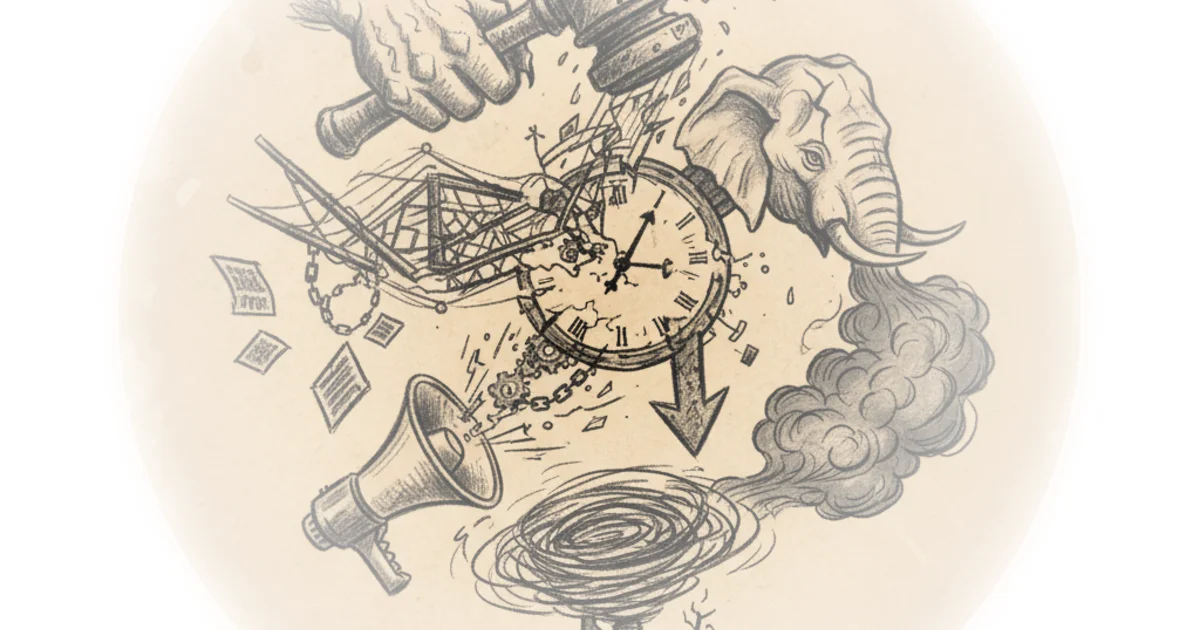
The commentary suggests this isn't just about historical trends where the incumbent party loses midterms; it is about a specific, self-inflicted wound. The authors note that while Gruters blames the cycle, the real problem is the economic message being forced upon candidates. One anonymous strategist bluntly tells the authors, "His message sucks. It's absolute trash. 'Affordability is a Democrat hoax'? Give me a break." This quote cuts to the heart of the disconnect between the White House's rhetoric and the lived reality of voters. The administration's insistence on framing economic hardship as a political hoax rather than a policy failure is landing "like doo doo," as another operative puts it, particularly in swing states where the cost of living is the primary concern.
"The only person that could bring the nose up and help us win is the president of the United States, Donald J. Trump."
This quote, attributed to Gruters, underscores the authors' central thesis: the party has become so dependent on the president's personal brand that it has lost the ability to critique the policies that are driving voters away. Longwell, Miller, and Kristol point out that in previous administrations, candidates were allowed "some strategic distance" to address local concerns, such as the impact of tariffs on prices. That flexibility is gone. "There have been past White Houses where it's okay to have some distance between yourself and the president," a strategist explains, noting that "that is clearly not the case with this administration."
The Erosion of Federalism and Institutional Norms
The piece shifts from electoral math to the broader erosion of institutional norms, illustrating how the administration's desire for total control is fracturing the party even at the state level. The authors highlight a remarkable event in Indiana, where state senators rejected a mid-cycle gerrymander despite intense pressure from the White House. The administration had threatened to back primary challenges and strip federal funding, yet the state Republicans held firm. "My opposition to mid-cycle gerrymandering is not in contrast to my conservative principles, but because of them," said GOP state Sen. Spencer Deery. Longwell, Miller, and Kristol frame this as a critical test of whether state-level conservatism can survive the centralization of power in the executive branch.
This resistance is particularly poignant given the historical context of the Insurrection Act of 1807, a law the administration has increasingly threatened to use to deploy military force domestically. The authors note that the president has blurred the lines between foreign adversaries and domestic political opponents, threatening Chicago's governor with the same language used against foreign dictators. "At some point we'll just go in and do what we have to do, if the governor doesn't wise up," the president warned. The commentary argues that this rhetoric is not just bluster; it signals a worldview where coercion is the primary tool of governance. "A strongman won't just go after countries or people you don't like. Sooner or later, he'll come for you," the authors warn, drawing a direct line from threats against Colombia to threats against American cities.
Critics might note that the administration argues these measures are necessary to combat drug trafficking and restore order, framing the deployment of forces as a law enforcement imperative rather than political coercion. However, the authors counter that the lack of distinction between foreign and domestic targets undermines the very concept of federalism. The Indiana vote serves as a counter-example, proving that local officials can still resist federal overreach, even when the threat of retribution is severe.
The Human Cost of Policy
Perhaps the most harrowing section of the coverage details the human toll of the administration's deportation policies. The authors recount a congressional hearing where DHS Secretary Kirsti Noem was confronted with the case of Sae Joon Park, a U.S. Army combat veteran who was deported to South Korea. When asked how many veterans had been deported, Noem initially claimed none, only to be shown video evidence of Park, who had been shot twice in service to the country. "Sir, we have not deported U.S. citizens or military veterans," Noem stated before the evidence was presented. Longwell, Miller, and Kristol use this moment to illustrate the administration's disconnect from the realities of its own policies.
The authors do not shy away from the gravity of the situation. They describe the scene where a staffer held up an iPad showing Park, forcing the Secretary to stumble through an explanation. "Park earlier this year was forced to self-deport to South Korea, where he had not lived since he was a child," the authors write. This is not a policy debate about numbers; it is a story of a veteran being cast aside. The commentary emphasizes that this is the logical endpoint of an administration that prioritizes ideological purity over human consequence. "It's the non-college-educated version of the Biden message, and we saw how well that worked," a strategist notes regarding the economic message, but the deportation issue goes deeper, striking at the core of the social contract.
"A strongman won't just go after countries or people you don't like. Sooner or later, he'll come for you."
The authors also touch on the administration's foreign policy ambitions, noting leaked details that the White House is actively trying to persuade Austria, Hungary, Italy, and Poland to leave the European Union. This "Make Europe Great Again" strategy, aimed at dismantling the EU, further illustrates the administration's disruptive approach to global alliances. The authors suggest that this isolationism is part of a broader pattern of destabilization that extends from domestic cities to international borders.
Bottom Line
The strongest part of this argument is its unflinching documentation of a party in crisis, where the leadership's fear of electoral defeat is palpable even as the policies driving that defeat remain unchallenged. The authors effectively use anonymous insider quotes to bypass the official messaging and reveal the raw anxiety within the ranks. However, the piece's biggest vulnerability is its reliance on anonymous sources who, while credible, cannot be publicly verified, leaving room for the administration to dismiss the claims as partisan fiction. The reader should watch for whether the Indiana resistance to redistricting becomes a model for other states, or if the pressure from the executive branch eventually overwhelms local autonomy. The central tension remains: can a party survive when its leader predicts its own doom while refusing to change the course that leads there?