Dan Carlin is asking a question that sounds simple but isn't: could fighters from boxing's past beat fighters from its present? The answer he arrives at — yes, especially in heavier weight classes — isn't just a hot take. It's the spine of a podcast that uses boxing as a lens to examine how we judge athletic performance across generations.
The One Exception
Carlin opens with a distinction he's spent episodes refining: most sports don't hold up well to historical comparison. Football players from the 1970s were smaller, slower, less trained than today's players. Basketball players from the 1960s would be considered average today. But boxing, he argues, is different.
"boxing has certain elements in the sport that make it inherently exciting and something that it's hard to take your eyes off of"
This matters because most sports have a minimum time limit — you can sit down at a tennis match and recover when you look away. Boxing doesn't work that way. Carlin points out that a fight can end in one second. A first-round knockout. Mike Tyson versus Michael Spinks. Gone in 90 seconds. The audience is locked in from the moment it starts because anything could happen.
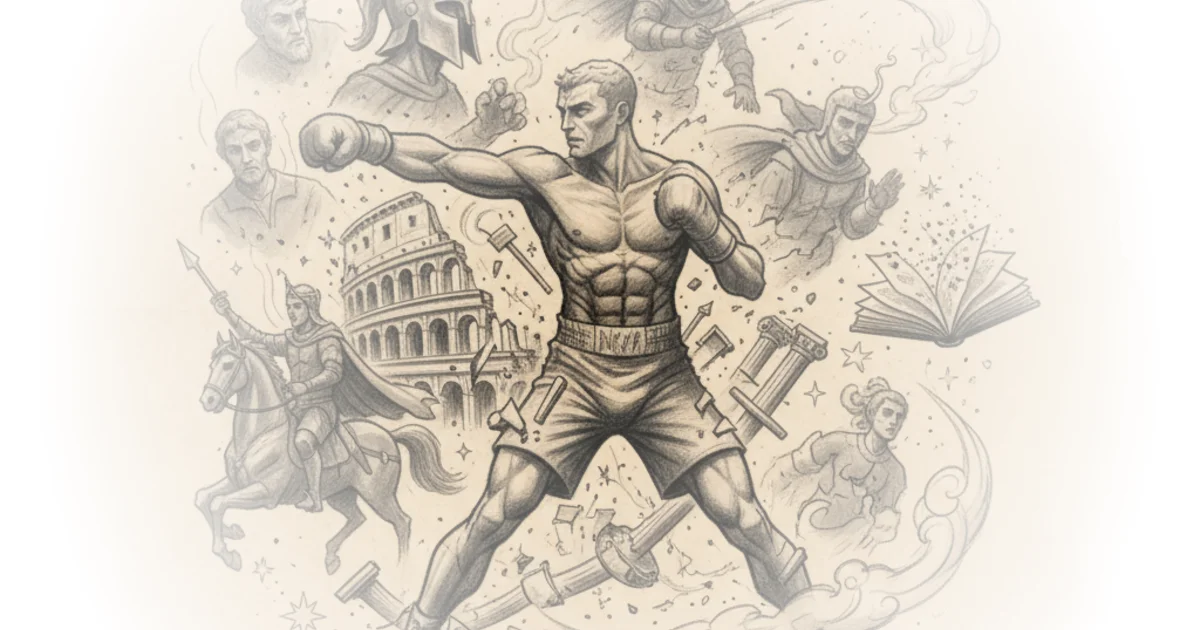
The other element that makes boxing uniquely dramatic: you can never get so far behind that you can't instantly win. Carlin uses George Foreman's comeback against a much younger, better-conditioned opponent as his example — down hundred to nothing with thirty seconds left, and then two punches end the fight. This isn't just about size or speed. It's about the rules of the game.
"I can't think of another sport where there's no minimum time limit where you can sit down at a match or a game and it can be over in one second right when it starts"
The Sweet Science Argument
Carlin then introduces what he's reading — Mike Silver's book The Arc of Boxing: The Rise and Decline of the Sweet Science — which makes the case that boxing is the one athletic competition where past athletes would beat modern ones. Not just compete against — destroy.
"he's suggesting that the people of the past would destroy the people of the present"
This is the podcast's central claim, and Carlin builds it carefully using weight classes as his evidence. In most boxing divisions, comparing a 140-pound fighter from today to one from fifty years ago involves the same weight class — so nutrition, training, and conditioning are the only variables. But in heavier categories where size doesn't matter — 190 pounds and up — Silver argues the gap is even wider.
Carlin uses Joe Lewis as his example. The legendary champion fought Primo Carnera at six foot six, 270 pounds, and Buddy Bear at six foot seven, 250 pounds. Both were annihilated in six rounds or less. Compare that to Tyson Fury — six foot nine with an 85-inch reach — and Deontay Wilder — six foot seven, 83-inch reach — and the question becomes sharper.
"the old adage a good big fighter can always defeat a good little fighter provided they are equal in ability"
This is where Carlin's argument gets interesting. He's not saying bigger fighters beat smaller ones. He's saying that when you account for training, nutrition, and the so-called intangibles — heart, craft, timing — the gap between eras favors the past in ways most sports don't.
The Intangibles Problem
But there's a tension Carlin acknowledges but doesn't fully resolve: the very thing that makes boxing attractive — the sweet science, brain over brawn — has been replaced by something his friend Mike Silver calls "a human demolition derby."
"it's like a human demolition derby out there now and that's not what I watch it for"
The concern is that modern boxing has devolved into brawler contests where defense doesn't matter, and that the artistry of the sport has been lost. This undercuts his own argument about past fighters being superior — if the sweet science is gone, what's the comparison measuring?
Carlin frames this as a generational shift: he became a fan through Muhammad Ali, who was "probably the biggest sporting figure who's ever lived" and whose fights taught him the intricacies of the sport. The pathways to understanding boxing — learning the chrome, the details — are what made it endlessly fascinating.
"for me what AJ Lee bling referred to as the sweet science became endlessly fascinated right the idea of brain over Brawn of people who were smaller or weaker or less athletic but because they were better Craftsmen could beat the bullies in the ring"
The Frame That Works
What makes this episode work isn't just the argument. It's how Carlin frames it — through Russ Francis, through Mike Silver, through his own evolution as a fan. He uses specific examples (Foreman vs. Lister, Joe Lewis vs. Carnera) to ground the abstraction.
Critics might note that comparing fighters across eras requires actually watching those fights — and that the gap in training and nutrition alone doesn't settle whether someone from 1970 could play in today's NFL. The boxing comparison is more apples-to-apples because of weight classes, but it's still not a controlled experiment. Carlin acknowledges this by bringing in multiple experts, but the conclusion remains interpretive.
Bottom Line
Carlin's strongest move is identifying what makes boxing unique among sports: the dramatic structure of the rules themselves — no minimum time, never being too far behind, instant reversals — combined with weight classes that make comparison meaningful. His vulnerability is that he leans on Mike Silver's conclusion without fully exploring whether the sweet science has really been lost, or whether modern fighters simply fight differently. The episode works because it treats boxing not as a simple debate but as a lens for understanding how we judge athletic performance across time — and what we mean when we say someone from the past could compete today.