Mehdi Hasan delivers a chilling warning that cuts through the usual political noise: the greatest threat to the 2026 midterms isn't a foreign adversary, but the American federal government itself. He marshals a disturbing pattern of recent raids, legal maneuvers, and executive threats to argue that the administration is actively preparing to nationalize and disrupt local elections. This is not speculation; it is a forensic accounting of actions already taken in Georgia, Arizona, and Puerto Rico, framed as a blueprint for what comes next.
The Pattern of Seizure
Hasan opens with a stark reality check regarding a late January FBI raid in Atlanta. He writes, "When FBI agents showed up at a warehouse in the Atlanta area in late January, local officials were surprised, to say the least." The surprise stems from the target: hundreds of thousands of ballots from the 2020 election, seized not to solve a crime, but to fuel a conspiracy theory that has already been debunked. The author notes that the Justice Department is now fighting to keep these records, a move that has prompted fears of a broader strategy.
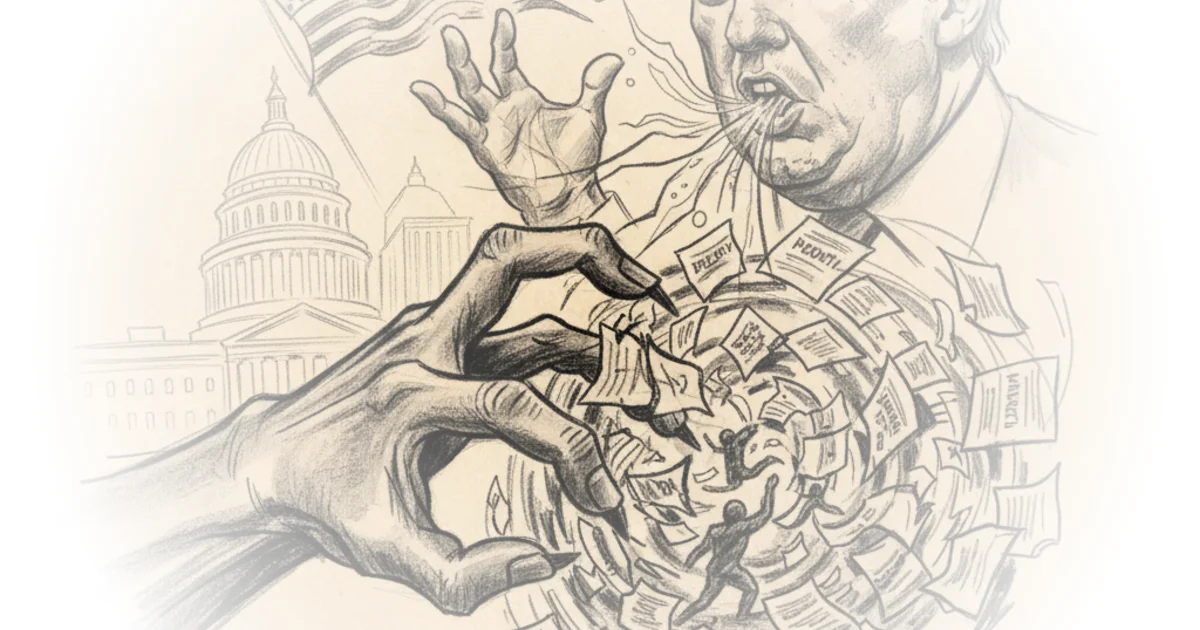
The core of Hasan's argument is that these isolated incidents are not anomalies but components of a coordinated effort. He points out that "Trump's Justice Department is fighting to hold on to the ballots and other records seized by the FBI as Fulton County, Georgia, fights in court to retrieve the materials." This legal battle is significant because the administration's lawyers are asserting "extraordinary powers over election records," a precedent that could allow the federal government to seize voting machines or ballots during the actual counting process in November. The author's evidence is compelling because it connects the dots between the Fulton County raid, similar seizures in Arizona and Puerto Rico, and a GOP sheriff in California who recently confiscated 650,000 ballots based on flimsy claims.
"Our highest risk in 2026 and potentially in 2028 is the federal government trying to disrupt and undermine our elections. It's not Russia, it's not China, it's Donald Trump."
Hasan effectively uses Colorado Secretary of State Jena Griswold's quote to reframe the national security narrative. By shifting the focus from external threats to internal subversion, he forces the reader to confront a domestic crisis. Critics might argue that the administration's actions are legitimate investigations into election integrity, but Hasan counters this by highlighting that the affidavits rely on "disproven or highly questionable fraud claims championed by Kurt Olsen," a lawyer now working for the administration. The sheer volume of debunked claims makes the legal justification for these raids appear thin at best.
The Legal Precedent and Unchecked Power
The piece deepens its analysis by examining the legal arguments the Justice Department is making in court. Hasan explains that federal lawyers have argued that Fulton County does not possess Fourth Amendment rights or sovereignty claims over the seized records. This is a radical departure from established legal norms. He quotes retired US circuit judge Diane Wood, who asks, "We're in this area of, can the federal government come in and run wild over the sovereignty of the state?" This question strikes at the heart of the federalist system, suggesting that the administration is testing the limits of executive power.
The author highlights a disturbing detail: the Justice Department is refusing to allow an evidentiary hearing on the merits of the search warrant, claiming it would interfere with an ongoing investigation. Hasan notes that this refusal could "set a precedent that would grant the federal government unchecked power to interfere with the local administration of elections." This is a critical point because it suggests the administration is more interested in establishing legal dominance than in finding actual evidence of fraud. As Wood points out, the statute of limitations for 2020 election crimes has likely expired, and many of the officials involved are no longer in their positions, raising the question of who is actually being investigated.
A bipartisan group of former Justice Department officials has filed a brief arguing against these tactics. Hasan cites their filing, which states, "DOJ is not simply counsel to the executive branch, much less a tool through which executive branch officials may pursue personal vendettas or grievances." This adds significant weight to the argument, as it comes from within the legal establishment rather than from political opponents. The author's coverage here is particularly strong because it relies on internal legal dissent to validate the severity of the situation.
Emergency Powers and the Threat of Intimidation
Hasan then pivots to the potential use of emergency powers and federal agents to intimidate voters. He discusses a draft executive order circulating among election-denial activists that would declare a national emergency over false claims of foreign interference. The order would reportedly ban voting machines and mail-in ballots. "A possible scenario from those facts — DHS submits a report detailing security holes in current election equipment, Trump hops on that and issues an EO demanding his wish list," explains Republican election official David Hancock. This reveals a clear strategy: manufacture a crisis to justify sweeping changes to the electoral process.
The author also addresses the deployment of Immigration and Customs Enforcement (ICE) agents. He notes that Steve Bannon has called the presence of ICE at airports a "test run" for November, arguing that federal agents should "check IDs" at polling locations. While Homeland Security Secretary Markwayne Mullin claims officers would only be deployed if there was a "specific threat," the vague assurances and the recent use of unmasked agents at airports have raised alarms. Hasan writes, "Vague assurances from Mullin and others that ICE will not be used to intimidate voters, and Trump's use of ICE agents at airports, have reinvigorated concerns that Trump will send federal agents to polling locations in November."
"We will use every tool in our power to resist the unconstitutional nationalization of elections. Those tools include strategic noncompliance, litigation, communications and coordination."
Maine Secretary of State Shenna Bellows' statement underscores the defensive posture of state officials. They are preparing for "lawless threats" and are ready to use "strategic noncompliance" to protect local control. This suggests a potential constitutional crisis where state and federal authorities are on a collision course. The author's inclusion of this perspective is vital, as it moves the narrative from fear to active resistance.
Bottom Line
Hasan's strongest asset is his ability to synthesize disparate legal battles and political threats into a coherent narrative of systemic assault on democracy. The piece's greatest vulnerability lies in its reliance on the assumption that the administration will follow through on these threats, though the evidence of recent actions makes that assumption increasingly difficult to dismiss. Readers should watch closely for the outcome of the Fulton County hearing and any movement on the rumored emergency executive order, as these will be the first concrete indicators of whether the administration intends to act on its rhetoric.