Adam Tooze identifies a seismic shift in global diplomacy that most leaders are still trying to ignore: the era of predictable American hegemony has not just paused, it has shattered. While other speakers at the World Economic Forum danced around the elephant in the room, Mark Carney delivered a stark diagnosis that reframes the current crisis not as a temporary transition, but as a fundamental rupture in the international order. This is essential listening for anyone trying to navigate the coming decade of economic fragmentation and geopolitical volatility.
The End of the Fiction
Tooze highlights how Carney’s speech at Davos stood in sharp contrast to the evasive rhetoric of his peers. While European leaders offered mild criticisms or described the situation as merely "crazy," Carney refused to sugarcoat the reality of great power rivalry. Tooze notes that Carney invoked the 1978 essay by Czech dissident Václav Havel to make a crucial point: "it is essential to refuse to repeat a lie, even if that may be the path of least resistance." This framing is powerful because it exposes the decades-long charade where middle powers pretended the "rules-based international order" functioned as advertised, ignoring the fact that the strongest nations routinely exempted themselves.
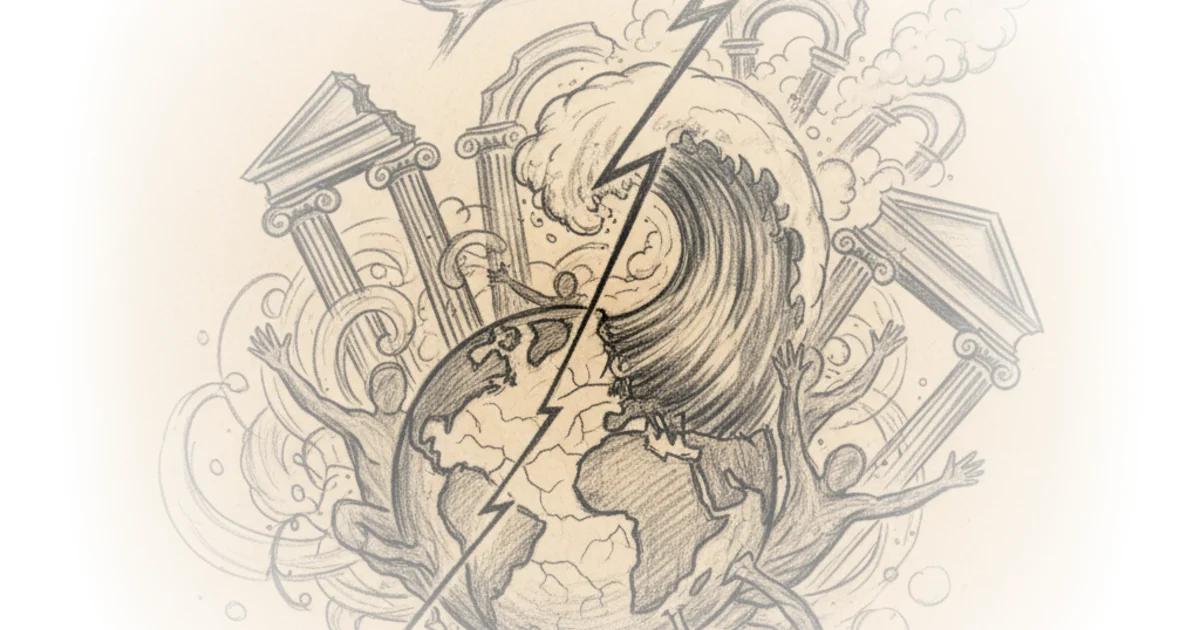
The author argues that the bargain is now broken. For years, nations like Canada and the UK prospered under the protection of American hegemony, accepting the fiction that trade rules were enforced equally. Tooze writes that Carney was clear on the new dynamic: "You cannot live within the lie of mutual benefit through integration, when integration becomes the source of your subordination." This is a sobering admission that the very mechanisms of globalization—supply chains, financial infrastructure, and trade dependencies—have been weaponized by the executive branch and other great powers to coerce rather than cooperate.
Critics might argue that abandoning the old order entirely is too risky, potentially accelerating a chaotic descent into protectionism. However, Tooze suggests Carney’s analysis holds up because the alternative—continuing to "go along to get along"—has already failed to buy safety. The administration's use of tariffs and financial leverage has proven that compliance no longer guarantees security.
"We are in the midst of a rupture, not a transition."
Value-Based Realism
So, what is the path forward? Tooze details Carney’s proposal for "value-based realism," a strategy that blends principled commitments with hard-nosed pragmatism. This approach rejects the idea that middle powers must choose between isolation and submission. Instead, Carney advocates for "collective investments in resilience," arguing that shared standards are "cheaper than everyone building their own fortresses." Tooze explains that this means diversifying partnerships to reduce vulnerability, noting that Canada has already signed twelve new trade and security deals in six months across four continents.
The core of this strategy is "variable geometry," or forming different coalitions for different issues based on common interests rather than rigid alliances. Tooze paraphrases Carney’s warning against the current state of affairs: "when we only negotiate bilaterally with a hegemon, we negotiate from weakness. We accept what’s offered. We compete with each other to be the most accommodating. This is not sovereignty. It’s the performance of sovereignty while accepting subordination." This distinction is vital; it suggests that true sovereignty now depends on the ability to withstand pressure, not just on diplomatic rhetoric.
Echoes from 2019
What makes this commentary particularly insightful is Tooze’s connection of these recent remarks to Carney’s 2019 speech at Jackson Hole. Tooze points out that the structural tensions Carney identifies today were already visible under the previous administration, though the response was then more muted. In 2019, Carney warned that the global financial system remained "obstinately dollar-centered" despite a multipolar world economy. Tooze writes that Carney concluded then that "any unipolar system is unsuited to a multi-polar world," advocating for a diversified international monetary and financial system to reduce fragility.
The continuity between the 2019 central banking perspective and the 2026 geopolitical stance is striking. Tooze notes that the solution proposed then—moving away from a single currency hegemon to a system with multiple reserve assets—mirrors the diversification strategy Carney now urges for trade and security. "The main advantage of a multipolar IMFS is diversification," Carney argued in 2019, a sentiment that now underpins his call for middle powers to hedge against uncertainty by building their own strategic autonomy.
A counterargument worth considering is whether a multipolar system might actually increase instability by creating competing spheres of influence without a clear arbiter. Tooze acknowledges this risk but emphasizes that the cost of inaction—allowing the current system to collapse into chaos—is far higher. The focus shifts from hoping for a return to the past to actively building a new, more resilient architecture.
Bottom Line
Tooze’s analysis succeeds in stripping away the diplomatic euphemisms to reveal the raw power dynamics driving the current crisis. The strongest part of the argument is the historical continuity it reveals: the rupture we see today was a structural inevitability that policymakers have been warning about since at least 2019. The biggest vulnerability, however, lies in the execution; building "variable geometry" coalitions requires a level of coordination and trust that is currently in short supply. Readers should watch for whether middle powers can actually unite to create a third path, or if they will fracture into competing blocs, leaving the world more dangerous and less predictable than ever.