Dave Borlace doesn't just ask if Ford's CEO has lost his mind; he argues that Jim Farley is the only one with the clarity to see that the company's century-old survival strategy is now its greatest liability. While most analysts focus on quarterly losses or political headwinds, Borlace zeroes in on a radical, billion-dollar bet to scrap the very assembly line Henry Ford invented. This isn't a story about electric vehicles; it's a story about whether an American icon can survive by admitting it needs to learn from its fiercest competitors.
The Weight of the Brand
Borlace frames Farley's position with stark immediacy, noting that the CEO inherited a company drowning in debt and now faces a "metaphorical tightroppe walk across the Grand Canyon of transition." The author is right to highlight the sheer scale of the financial burden: before Farley took the helm in 2020, Ford had amassed "a slightly eyewatering 160 billion dollars of debt," a figure that costs the company more than $1.6 billion annually just in interest. This context is crucial because it explains why the stakes are so high; there is no room for a slow, cautious pivot.
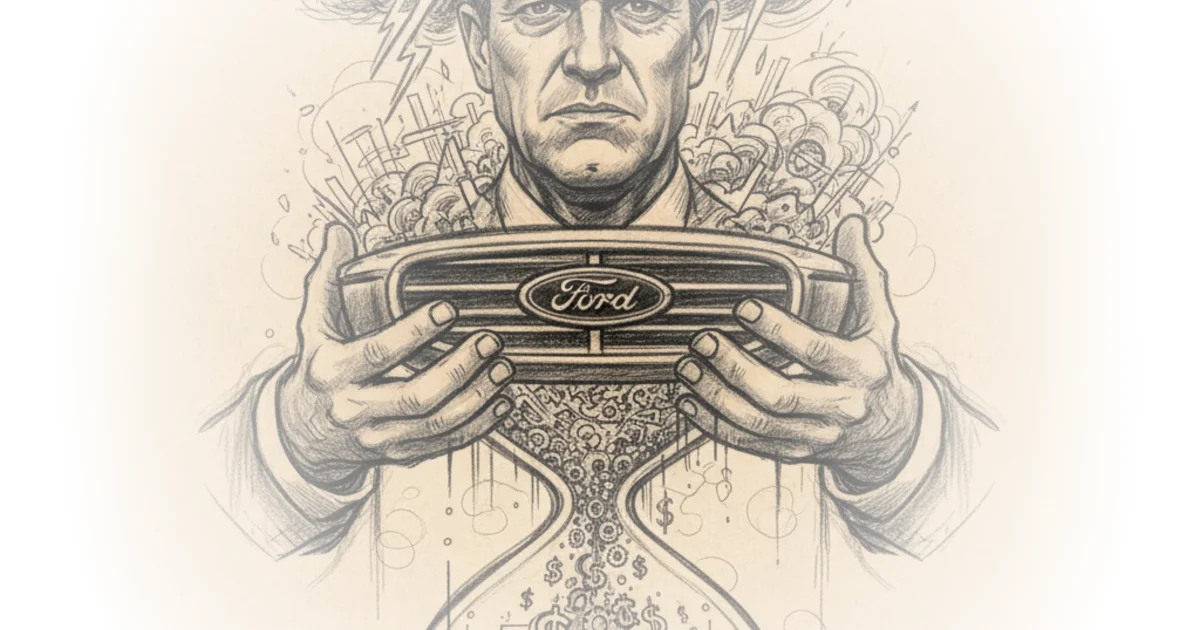
The author's assessment of Farley's personal demeanor adds a human dimension often missing from corporate analysis. Borlace writes, "I like his understated pragmatism. I like his refreshingly open-minded attitude." This observation is significant because it contrasts Farley with the typical defensive posture of legacy automaker executives. Instead of doubling down on past successes, Farley is willing to admit that other brands are "doing the whole electric vehicle thing much better and more efficiently." This humility is not a weakness; in this specific context, it is the only viable strategy for survival.
The Political and Global Headwinds
The commentary effectively separates the internal challenges from the external storm. Borlace details a "breathtaking assault on anything to do with the green transition" in the United States, citing the expiration of the $7,500 federal tax credit and a political climate that has turned hostile toward electric mobility. He notes that under the current administration, "sales of all electric vehicles in the US only nudged up by about 1.5% year-on-year," with a sharp decline in the second quarter. This data point is vital for understanding why Ford's EV division has lost $12 billion since 2023.
However, Borlace goes beyond domestic politics to address the structural disadvantage Western manufacturers face. He points out that "over 75% of lithium ion battery production takes place in China," giving Chinese competitors like BYD a massive cost advantage. The author argues that this isn't just about tariffs but about a fundamental supply chain reality: "China controls those materials, and it's been tightening its grip on their global export volume." A counterargument worth considering is that this reliance on China creates a geopolitical vulnerability that no amount of production efficiency can fully mitigate, regardless of how well Ford executes its new plan.
We ended the last administration's insane electric vehicle mandate.
Borlace uses this quote to illustrate the rhetoric fueling the market slowdown, but he pivots quickly to the solution Farley is pursuing. The author suggests that while the political environment is toxic, the business imperative remains unchanged. The core of the argument is that Farley is running toward the challenge with "considerable gusto" rather than hiding from it. This framing is effective because it shifts the narrative from victimhood to agency.
The Universal EV Production System
The most distinctive part of Borlace's coverage is his deep dive into the "Universal EV Production System." He explains that Farley has announced a "clean break from the timehonored and almost sacred production line methodology pioneered by Henry Ford himself." This is a bold claim, given that the moving assembly line is the bedrock of Ford's identity. Borlace describes how the new system abandons the linear conveyor belt for a "production tree" where three distinct lines build the front, back, and middle of the car separately before converging.
The author highlights the efficiency gains, noting that the new approach is "40% faster than a straight through line." This speed is achieved through "aluminium unicasting," a technique that eliminates dozens of components that previously had to be bolted or welded. Borlace writes, "Ford essentially came back and handed a blank piece of paper to a group of talented engineers and asked them to take the best practice from our friends in the east." This willingness to reverse-engineer the success of Chinese manufacturers is the piece's most compelling insight. It acknowledges that the West has fallen behind in manufacturing efficiency and that catching up requires admitting defeat in the old game to win the new one.
Critics might note that retooling an entire global supply chain is fraught with execution risk, and the $5 billion investment is a massive gamble. If the new system fails to deliver the promised cost reductions, the financial hole could deepen. Yet, Borlace's analysis suggests that the alternative—sticking with a broken model—is a guaranteed path to obsolescence. The author emphasizes that this isn't just about speed but about safety and ergonomics, making it easier for workers to access parts without "having to reach around other components."
The Path Forward
Borlace concludes by framing Farley's strategy as a necessary evolution rather than a desperate scramble. He notes that Ford is investing $2 billion in a new plant in Kentucky and $3 billion in a battery park in Michigan, aiming for vertical integration. The author also points to the partnership with JMC in China to produce an electric Bronco, suggesting that Ford is willing to learn from its partners even in the production of its own iconic models.
The piece ends on a note of cautious optimism. Borlace writes, "I hope it works for Ford because I, for one, think it would be a great shame if such an iconic brand disappeared from our roads." This sentiment underscores the cultural weight of the transition. The argument is that the survival of Ford is not just a corporate matter but a test of whether American industry can adapt to a new technological reality. The author's coverage succeeds because it treats the CEO's decisions as a high-stakes strategic maneuver rather than a series of reactive fixes.
Ford has eaten some humble pie, diligently done its homework, and seen a vision of the future global automotive industry that will most likely only include those companies willing to embrace the changes necessary.
Bottom Line
Dave Borlace's strongest argument is that Jim Farley's willingness to dismantle Henry Ford's legacy production line is the only logical response to the dominance of Chinese manufacturing efficiency. The piece's biggest vulnerability is the assumption that political headwinds in the US will eventually subside or that the new production system can be scaled quickly enough to offset the current losses. Readers should watch closely to see if the "Universal EV Production System" delivers on its promised 40% efficiency gain by 2027, as that metric will determine whether Farley's tightrope walk ends in a bounty or an abyss.