This piece from Reason delivers a startling thesis for the 250th anniversary of the Declaration: the American Revolution is not a historical event that concluded in 1783, but an ongoing ideological war where the very concept of self-rule is under siege from both the left and the right. It forces busy listeners to confront a uncomfortable reality—that the most significant threats to the republic today aren't foreign armies, but domestic intellectuals and officials who openly advocate for "regime change" and the concentration of executive power.
The Counterrevolution Within
The article argues that while the ground war ended at Yorktown, the ideological battle has merely shifted terrain. It highlights a disturbing trend where figures close to the current administration are reimagining government not as a protector of liberty, but as an instrument for enforcing a specific moral or economic order. Reason reports, "The Declaration of Independence had three great ideas in it. That all of us are equal. That each of us has inalienable rights given to us by God, not government. And that we have the right to rule ourselves." This framing is crucial because it sets up a stark contrast between the Founders' intent and the modern "postliberal" vision.
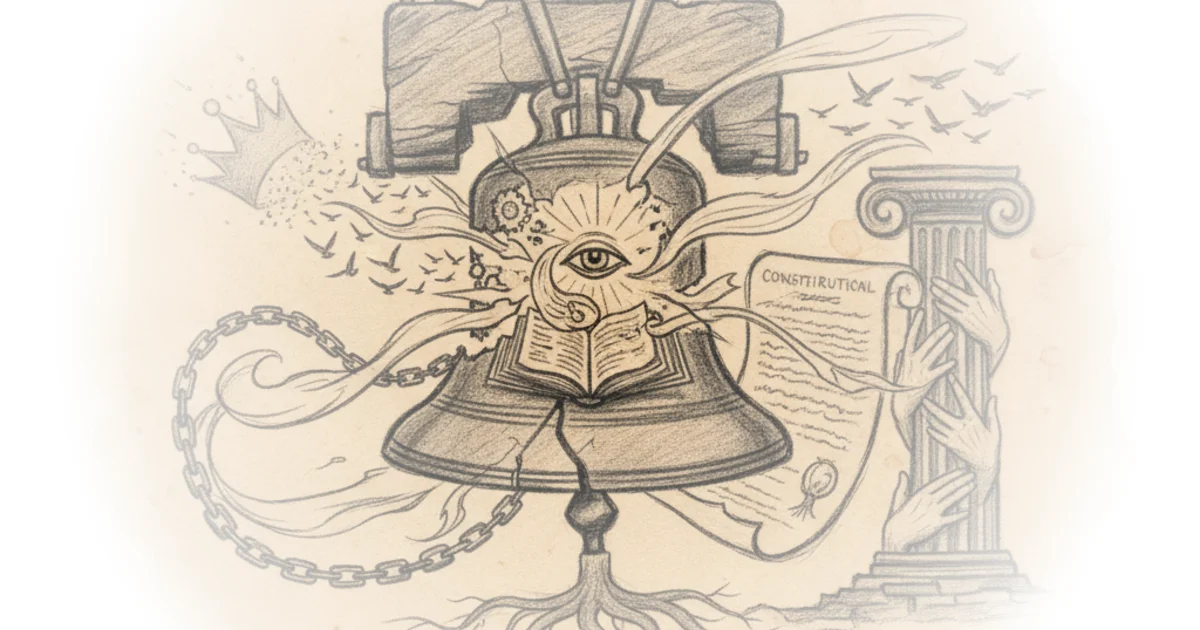
The piece identifies a specific intellectual movement calling itself "postliberals," who view the American founding as a mistake that needs correcting. They are not content with mere policy tweaks; they want to overturn the liberal regime entirely. The editors note that this group includes figures like Patrick Deneen, who argues for the "peaceful but vigorous overthrow of a corrupt and corrupting liberal ruling class." This is a radical departure from traditional conservatism, which usually seeks to preserve institutions rather than dismantle them.
They might say, yeah, America did have a liberal founding and that's why it was a mistake. Actually, this whole experiment was a mistake, and it maybe took a couple hundred years for that mistake to play out.
The commentary suggests this mindset is particularly dangerous because it justifies the erosion of constitutional checks in the name of achieving "good rule." The article points to Adrian Vermeule, a Harvard Law professor appointed to an executive council, who wrote that the Constitution's aim should be to promote "good rule, not to 'protect liberty' as an end in itself." This directly contradicts the Federalist logic that men are not angels and power must be checked. The piece effectively uses this quote to show how legal theory is being weaponized against the separation of powers.
Critics might argue that focusing on these fringe intellectuals exaggerates their actual influence over policy, suggesting they are more academic theorists than practical policymakers. However, the article counters this by pointing to concrete actions: the unprecedented use of executive orders, the deployment of troops to domestic cities without local consent, and the dismissal of judicial rulings. The text notes a specific parallel to history, stating that one of the grievances in the Declaration was King George III's penchant for shipping the accused "beyond Seas to be tried for pretended offenses," mirroring recent decisions to send detainees overseas.
The Economics of Monarchy
The coverage takes a sharp turn into economics, arguing that the postliberal right has converged with the socialist left on a rejection of free markets. This is a surprising claim in a polarized landscape, but the piece supports it by showing how both sides view individual property rights as secondary to state goals. It invokes Adam Smith's 1776 observations that the colonies' prosperity came from the "liberty to manage their own affairs their own way," contrasting this with modern calls for tariffs and corporate-state mergers.
The article highlights a specific moment where the current administration embraced mercantilism, quoting the President saying, "I love tariffs. Most beautiful word... I said my favorite word in the English dictionary is the word tariff." This quote serves as a powerful anchor for the argument that economic nationalism is replacing the revolutionary ideal of free trade. The editors argue that this shift represents a betrayal of the Founders' vision, which saw economic freedom as a natural right.
Reason reports that the postliberal right argues conservatives have "outsourced our economic and domestic policy thinking to libertarians," preferring instead to use political power to accomplish specific social ends. This aligns with the views of Tucker Carlson, who praised Elizabeth Warren's "economic patriotism" because it sounded like a Trumpian approach. The piece suggests that this convergence creates a "horseshoe" where both extremes seek to remarry the corporation and the state.
It is really important to recognize that what the postliberal right is pushing in terms of economics is progressivism. It's not conservatism.
The article notes that this economic shift isn't just theoretical; it involves tangible steps like the government taking a 10 percent stake in Intel, echoing Obama's bailouts but with a different ideological underpinning. The editors argue that this "right-wing progressivism" undermines the revolutionary promise of self-ownership.
The Threat to Conscience and Self-Rule
The final section of the piece connects these economic and political shifts back to the core issue of freedom of conscience, arguing that both sides are willing to use state power to enforce conformity. It references the historical plot to install a Prussian prince as king and Jefferson's fear that the presidency could devolve into monarchy. The editors remind readers that Jefferson warned, "The tree of liberty must be refreshed from time to time with the blood of patriots and tyrants," a grim reminder that preserving self-rule is an active, often violent struggle.
The coverage concludes by noting that the current administration's actions—such as declaring national emergencies and ignoring court orders—are not anomalies but part of a deliberate strategy to centralize power. The piece quotes J.D. Vance suggesting the President should "fire every single mid-level bureaucrat" and dare the courts to enforce their rulings, echoing Andrew Jackson's defiance. This is presented as a dangerous precedent that threatens the rule of law.
That's a really dangerous idea to be even casually trotting out there, let alone for somebody who is now the sitting vice president to be on the record.
The article suggests that this mindset treats political power as a tool to reward friends and punish enemies, violating the principle of equal treatment under the law. It draws a parallel between modern calls for a "Red Caesar" and historical precedents like FDR's court-packing attempt, noting that even revered figures can be seen as dictators when they rule alone.
Bottom Line
The strongest part of this argument is its ability to connect disparate political movements—postliberal intellectuals, economic nationalists, and executive aggrandizers—into a single coherent threat to the American founding. By weaving in direct quotes from key figures like Vance and Vermeule, the piece makes it clear that these are not fringe ideas but are being actively promoted by those near power. Its biggest vulnerability is perhaps its tendency to equate all deviations from strict laissez-faire or separation of powers with a desire for monarchy, which may oversimplify complex policy debates. However, the warning remains urgent: if the revolution was about self-rule and property rights, then the current trajectory toward centralized control demands immediate vigilance from citizens who value liberty.