Fred Mills doesn't just report on a construction project; he exposes a terrifying gamble where geology and human hubris collide. While most coverage of India's Himalayan infrastructure focuses on the strategic or economic benefits, Mills zeroes in on the raw, visceral reality that the mountains are not passive obstacles but active, living adversaries. He argues that the recent near-misses and catastrophic failures are not bad luck, but the inevitable result of ignoring the dynamic, shifting nature of the world's highest mountain range.
The Living Mountain
Mills opens by dismantling the romanticized view of the Himalayas as merely a scenic backdrop for pilgrimage. He notes that while the region is known as the "land of the gods," the reality for engineers is far more hostile. "I attribute the mountains with a sense of life," Mills quotes Professor Arnold Dix, who served as a key adviser during the 2023 Silkyara rescue. "I don't see them as like dead rock. actually see them as a living thing because actually they move and they squeeze and they they misbehave and they do all sorts of things."
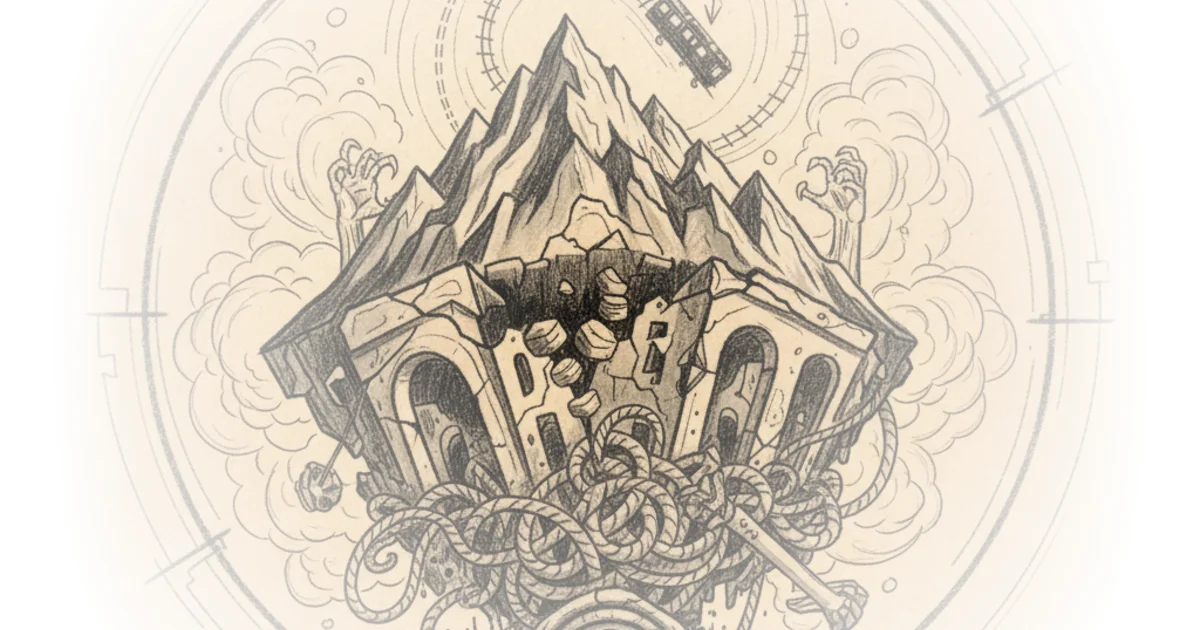
This personification of geology is the article's most potent rhetorical device. By framing the rock as an active participant that "misbehaves," Mills shifts the narrative from a simple engineering challenge to a confrontation with an unpredictable force. The author explains that the rock in this region is not stable stone but ancient seabed pushed up rapidly, meaning it behaves differently deep underground than it does on the surface. This context is crucial; it explains why standard tunneling assumptions often fail here. Critics might argue that attributing agency to rock is poetic license rather than scientific rigor, but the metaphor effectively communicates the sheer unpredictability of the terrain to a lay audience.
The Cost of Negligence
The piece takes a darker turn when addressing the human element of the Silkyara tunnel collapse, where 41 workers were trapped for 17 days. Mills is unflinching in his assessment of the causes, moving beyond geological inevitability to point at systemic human error. He cites an investigation that found "defamations were not properly addressed and there was negligence from the contractor towards previous issues."
Mills highlights the chilling discovery made by Professor Dix upon entering the tunnel: "I count 21 prior collapses. I can see the scars as I'm walking down through the tunnel. And so I realize this hasn't just happened out of the blue. There's something systemic wrong." This evidence is devastating. It suggests that the collapse was not a sudden, unforeseeable event but the culmination of ignored warning signs. The author argues that the rescue was a miracle, but the conditions that necessitated it were entirely preventable. "It was awful," Mills writes, quoting Dix's reaction to the lack of adaptive strategy. "They might have experienced difficulties lately, but tunnelers in this country have had some success in the past... But even this had its challenges."
I count 21 prior collapses. I can see the scars as I'm walking down through the tunnel. And so I realize this hasn't just happened out of the blue. There's something systemic wrong.
The author juxtaposes this failure with the successful Atal Tunnel, noting that even there, "up to 8,000 L of water a minute were coming into the tunnel," requiring extreme caution. The contrast serves to prove that success is possible, but only through relentless vigilance and respect for the environment, a lesson the Silkyara project seemingly ignored until it was too late.
The Next Gamble
Despite the trauma of the Silkyara incident, Mills points out that India is doubling down, with 19 new projects in the pipeline, including the massive Zojilla Tunnel. The author details the adoption of the "New Austrian Tunneling Method," which relies on the surrounding rock's strength and continuous monitoring. "It's where the strength of the surrounding material is utilized as much as possible with ground stability monitored continuously," Mills explains.
However, the author tempers this optimism with the reality of delays. Even with advanced techniques, the Zojilla project has already slipped four years behind schedule, pushing the deadline to 2030. This delay is presented not as a failure, but as a necessary correction. "Despite all the care that's been taken, despite all that high-tech equipment, things haven't gone as smoothly as everyone would have liked," Mills observes. The narrative suggests that the only way to tame this landscape is to accept that it will fight back, forcing timelines to bend. The stakes are incredibly high, particularly in the disputed border regions of Jammu and Kashmir, where these tunnels are strategic necessities. Yet, the author leaves the reader with a lingering unease: "Let's just hope the mountains don't have other ideas."
Bottom Line
Mills' strongest asset is his ability to blend technical engineering details with a gripping, almost cinematic narrative of human vulnerability against geological power. His argument that the Himalayas are a "living" adversary effectively reframes infrastructure development from a triumph of will to a delicate negotiation. The piece's biggest vulnerability lies in its reliance on the assumption that current delays and new methods will be sufficient to prevent future catastrophes, a hope that remains unproven in such volatile terrain. Readers should watch closely whether India's new projects can truly adapt to the "living" rock or if the scars of the past will simply multiply.