Cyril Hédoin delivers a provocative twist on a familiar evolutionary puzzle: he argues that our deep-seated moral self-righteousness, far from being the engine of human cooperation, is actually a dangerous obstacle to it. While we often assume that shared ethics bind us together, Hédoin suggests that the very mechanism that allowed our ancestors to mobilize for war now paralyzes our ability to negotiate peace in a pluralistic world. This is not just a biological curiosity; it is a critical lens for understanding why modern political discourse feels so intractable and why the path forward requires us to rethink the role of morality itself.
The Hive and the Human
Hédoin begins by dismantling the intuition that morality is a prerequisite for cooperation. He points to the natural world, where the most successful cooperators are often devoid of any ethical framework. "It is true, that certain living creatures (as bees, and ants), live sociably one with another," he quotes Thomas Hobbes, noting that these creatures have no speech to signify what is expedient for the common benefit, yet they thrive. Hédoin writes, "Cooperation is not the result of a preexisting morality. It's the other way around: human morality evolved from the development of cooperative relations."
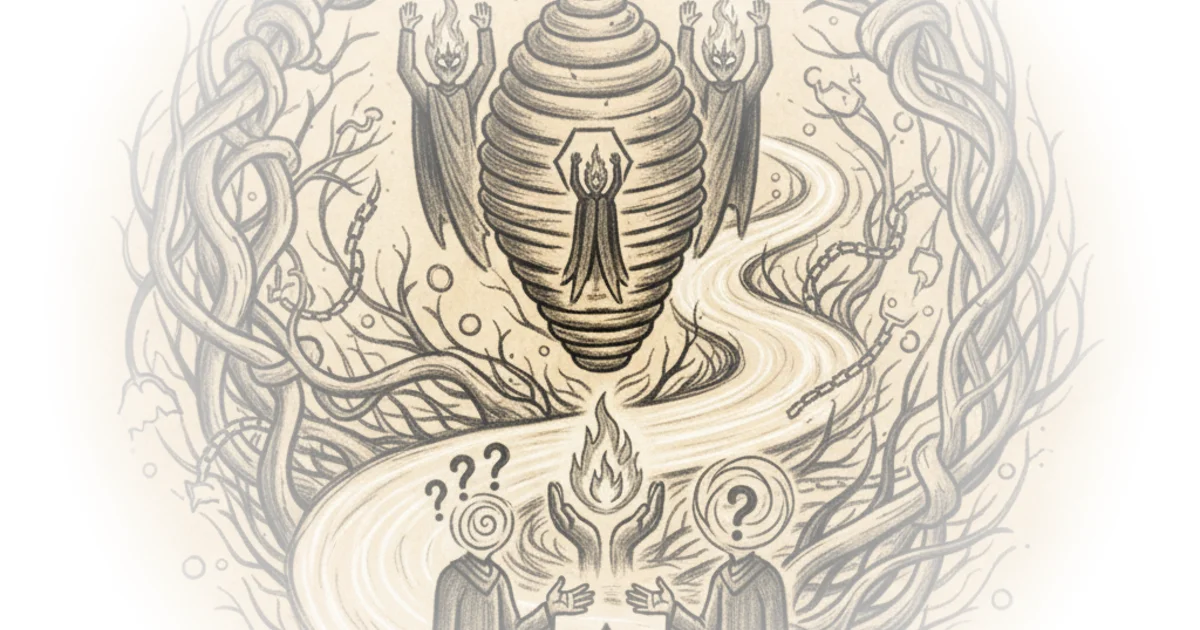
This reversal is crucial. In the insect world, cooperation is driven by genetic mechanics like haplodiploidy, where the genetic relatedness between worker sisters is 75%, a biological imperative that aligns with Hamilton's rule. Humans, however, lack this genetic shortcut. We achieved cooperation beyond our kin circles not through biology alone, but through culture and institutions. Hédoin argues that "group selection is stronger among humans than among any other species on earth because it is not only biological, but also cultural." This cultural evolution was forged in the fires of conflict.
"Warfare, and especially mass warfare, has been made possible only because humans have evolved the capacity to mobilize their fellows to fight other human groups, either through coercion or moralization."
The author traces a direct line from the evolutionary advantage of group fighting to our current psychological makeup. The "culture of warfare" created a positive feedback loop where the ability to mobilize resources for conflict favored groups with strong internal cohesion. This history explains why we are so prone to self-righteousness. As Hédoin puts it, "We are prone to doubt many things, but morality is generally not among them." This certainty, while useful for uniting a tribe against an external threat, becomes toxic when applied to internal political disagreement.
The Trap of Moral Self-Righteousness
The core of Hédoin's argument is that morality, by its very nature, tends toward authoritarianism. Because moral beliefs are not just about our own duties but about what others should do, they become inherently coercive. "Self-righteousness makes moral disagreement particularly difficult to resolve and easily lends itself to the justification of forcing others to comply with one's moral beliefs," Hédoin writes. He illustrates this with the debate over mandatory military service, where the moral conviction that one must fight for their country can easily devolve into viewing dissenters as cowards or traitors.
This framing is particularly potent because it challenges the liberal assumption that more moral clarity leads to better outcomes. Hédoin suggests the opposite: "The ultimate cooperative stage occurs when individuals are willing to reflect on and eventually revise their moral beliefs." He cites philosopher Gerald Gaus to argue that true social morality is impossible when individuals are purely conscientious and unwilling to compromise their internal ethical codes. The tragedy, Hédoin notes, is that we are trapped by our own evolutionary history. "We are not bees, and so it's not a question of cooperating without morality. The issue is rather to achieve cooperation given our strong moral beliefs."
Critics might note that this view risks underestimating the role of shared moral values in building trust and facilitating large-scale collaboration. Without a baseline of shared ethical norms, the argument goes, institutions cannot function at all. However, Hédoin's point is not that we should abandon morality, but that we must recognize its limitations as a tool for political consensus.
Politics as the Antidote to Hive Thinking
If morality is the problem, what is the solution? Hédoin identifies politics not as a battleground for moral victory, but as the necessary infrastructure for managing disagreement. "Fortunately, humans have not only evolved morality; they have also evolved politics," he writes. The foundational role of politics, he argues, is to "establish the conditions for peaceful moral disagreement."
This requires a shift in how we view our institutions. Instead of seeking a society where everyone agrees on the "good," we need systems that respect the diversity of beliefs. "In many cases, this entails giving people rights to believe and to live as they wish," Hédoin states. When coercion is unavoidable, such as in national defense, politics must be "even more mindful of moral disagreement and accommodate the diversity of beliefs by limiting coercion." This is a sobering reminder that the "hive morality" of our ancestors is ill-suited for the complex, pluralistic societies we inhabit today.
"Morality is naturally 'hive morality': we are prone to assume that everybody thinks, or should think, like us about what is good for all. Politics is often contaminated by the same hive thinking, even more so in populist times."
Hédoin's analysis forces us to confront the uncomfortable truth that our deepest moral convictions may be the very things preventing us from solving our most pressing collective problems. The path forward is not to preach harder, but to listen better and to build institutions that can withstand the friction of genuine disagreement.
Bottom Line
Cyril Hédoin's most compelling insight is that our evolutionary heritage has equipped us with a moral psychology optimized for tribal warfare, which now hinders our ability to cooperate in a diverse, peaceful society. The argument's greatest vulnerability lies in its potential to be misread as an endorsement of moral relativism, rather than a call for institutional humility. The reader should watch for how this framework applies to current debates on national security and civic duty, where the line between necessary defense and moral coercion is increasingly blurred.