N.S. Lyons presents a provocative thesis: that the United States has ceased to function as a constitutional republic and has instead morphed into a "total state" run by a self-perpetuating managerial elite. This piece is notable not for its policy prescriptions, but for its structural diagnosis, arguing that the real power in Washington lies not with elected officials, but with a unified class of bureaucrats, corporate leaders, and media figures who operate in lockstep. For the busy reader trying to make sense of recent political turbulence, Lyons offers a framework that moves beyond personality clashes to examine the machinery of governance itself.
The Rise of the Managerial Class
Lyons anchors his argument in the work of Auron MacIntyre, whose book The Total State suggests that the erosion of democracy was not a sudden coup but a slow, inevitable drift toward "managerialism." The author explains that this new ruling class is defined not by what they produce, but by their ability to manage, surveil, and control people and information. "The business of such people is not producing or building anything... but the manipulation and management— that is, surveillance and control—of people, information, money, and ideas," Lyons writes, attributing this definition directly to MacIntyre's analysis. This framing is striking because it shifts the blame from a specific political ideology to a structural incentive: managers multiply to justify their own existence.
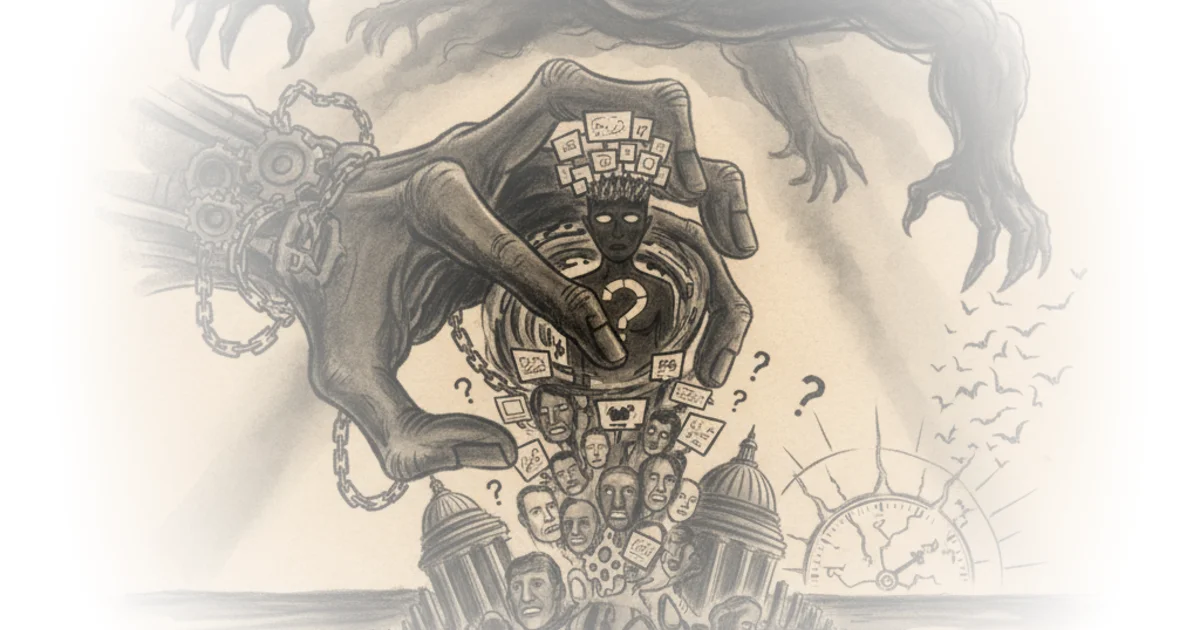
The commentary suggests that this dynamic has led to a situation where the state expands not to solve problems, but to create more jobs for the managerial class. Lyons notes, "Bureaucracy expands to meet the needs of the expanding bureaucracy." This observation resonates with many who feel that government solutions often create more red tape than they resolve. However, critics might argue that this view oversimplifies the complexity of modern governance, ignoring the genuine necessity for specialized expertise in areas like public health, environmental regulation, and national security. Not all expansion is self-serving; some is a response to a more interconnected world.
The Illusion of Choice
Perhaps the most controversial aspect of Lyons' coverage is his assertion that the current political system is a "simulacrum" of democracy, where the appearance of choice masks a unified reality. He describes a phenomenon where major institutions, from universities to the press, move in "near complete synchronicity," creating a "flock of birds" effect that stifles dissent. "The ability of managers to move from public government postings to private corporate positions while using the exact same language and skill set is key to the unification of the state and economy," Lyons quotes MacIntyre, highlighting the revolving door that binds the public and private sectors.
This unification, the author argues, has turned political loyalty into a prerequisite for career advancement. "If you want to rise to the top in America, then your 'cultural fit'—your ideological reliability—is your most important asset," Lyons writes. This is a powerful claim that challenges the notion of meritocracy in the professional world. It suggests that the "deep state" is not a conspiracy of shadowy figures, but a natural outcome of a system where everyone is trained in the same schools and rewarded for the same behaviors. Yet, this perspective risks underestimating the genuine ideological divides that still exist within these institutions, as well as the internal debates that often precede major policy shifts.
The ruling class thus became deeply involved in controlling the information the public receives and the narrative that information shapes.
The Challenge of Dismantling the Machine
Lyons turns to the emerging "New Right" movement, particularly the figure of J.D. Vance, as a potential counter-force to this managerial hegemony. The author contrasts the New Right's strategy of seizing institutions with the more traditional approach of relying on the personality of a single leader. Lyons explains that Vance believes real change requires a "decisive blow" to the administrative state, citing Vance's past advice to "Fire every single midlevel bureaucrat, every civil servant in the administrative state, [and] replace them with our people."
The piece highlights the tension between this structural approach and the more populist, personality-driven wing of the movement. Lyons notes that while some believe a charismatic leader can fix the system, New Right thinkers argue that without a disciplined plan to reclassify and replace unaccountable civil servants, "nothing is likely to significantly change in Washington." This is a crucial distinction that moves the conversation from who wins the election to how the government actually functions. The author points to "Project 2025" as a concrete example of this strategy, describing it as a plan to solve the problem that "personnel is policy."
However, the argument here faces a significant hurdle: the legal and constitutional implications of mass firings and the reclassification of civil servants. Critics might note that such a move could trigger immediate legal challenges and potentially destabilize essential government functions, raising questions about the rule of law that the New Right claims to defend. The feasibility of dismantling the "total state" without causing a constitutional crisis remains an open and contentious question.
Bottom Line
N.S. Lyons' commentary offers a compelling, if unsettling, lens through which to view the current political landscape, successfully arguing that the crisis of American democracy is structural rather than merely personal. The strongest part of the argument is its identification of "managerialism" as a self-reinforcing system that transcends traditional partisan lines. Its biggest vulnerability lies in the proposed solution: the practical and legal difficulties of dismantling a bureaucracy that has become deeply embedded in the fabric of modern life. Readers should watch for how the New Right attempts to translate this theoretical critique into actionable policy without triggering a constitutional collapse.