Most economic histories treat recessions as inevitable hangovers from past excesses, a moral reckoning for speculative greed. This piece from Works in Progress dismantles that comforting narrative, arguing instead that economic downturns are often the result of random, unpredictable shocks—like locust swarms or oil price spikes—rather than the natural correction of a overheated market. For busy leaders trying to navigate volatile global markets, the implication is stark: the patterns we think we see are often statistical illusions, and the tools we use to predict crashes may be fundamentally broken.
The Myth of the Inevitable Bust
The core of the argument challenges the popular and academic belief that booms inevitably breed their own destruction. Works in Progress reports that Tyler Goodspeed's book, Recession, targets the "intuitive account of recessions: payback for good times." The piece notes that Goodspeed's antagonists are celebrated Austrian economists like Friedrich Hayek and Joseph Schumpeter, who viewed downturns as necessary purges of "malinvestments" and "mistaken economic decisions." However, the data Goodspeed presents tells a different story. By extending business cycle data back to 1700 for both the US and UK, he demonstrates that "British and American expansions do not resemble Dorian Gray, looking beautiful but hiding an inevitable accumulation of malinvestments."
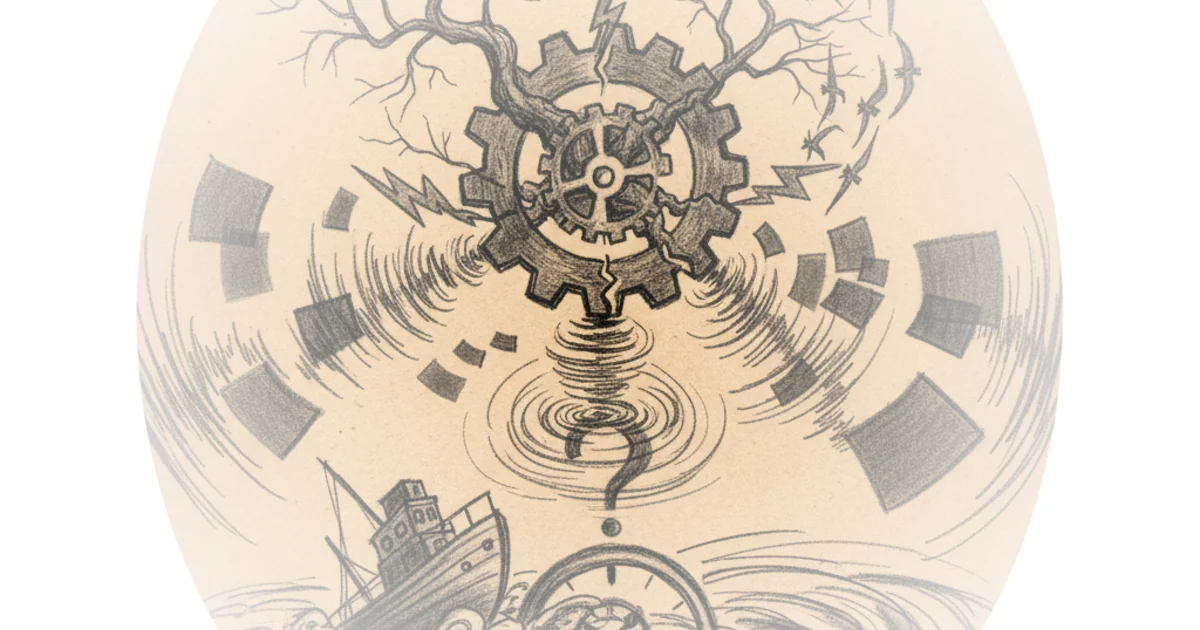
This evidence is compelling because it strips away the moralizing often attached to economic crises. The piece argues that "the relationship between the age of an expansion and the probability of death is essentially zero." In other words, a long period of growth does not make a crash more likely. This directly contradicts the idea that policymakers should be constantly looking for a bubble to burst. Instead, the article suggests that "recessions remain essentially unpredictable" and that any perceived regularity is likely a "statistical illusion." Critics might note that this macro-level data could miss micro-level distortions in specific sectors, but the sheer volume of historical data makes the case for randomness difficult to dismiss.
"Macroeconomic events are not morality plays, nor always under policymaker control or influence."
Shocks, Not Cycles
If recessions aren't self-correcting mechanisms, what causes them? The piece pivots to the concept of "shocks," drawing a vivid parallel to the Locust Plague of 1874. While history books often blame the 1873 crisis on railway mania, Goodspeed points to the "devastating role of a surprise that had nothing to do with economics or economic policy: the great grasshopper plagues of 1873-1876." A single swarm covered an area larger than California, destroying the very regions the railroad was meant to develop. The article uses this to illustrate that "exogenous shocks have played an important role even into modern times."
The commentary extends this logic to the Great Depression and the 2008 financial crisis. It notes that while contemporaries blamed land speculation, the reality involved a "succession of overlapping and interacting shocks, often highly region-specific." Similarly, the 2008 downturn wasn't just about subprime mortgages; it was triggered by a "negative supply shock that saw the price of gasoline reach $5.86 per gallon" before the financial sector even collapsed. The piece argues that policymakers often make things worse by acting as "arsonists" rather than firefighters, citing the Federal Reserve's failure to lower interest rates during the 2008 crisis. "The Fed failed to decisively lower interest rates in the face of declining economic activity," the article states, turning a manageable shock into a global catastrophe.
The Limits of Prediction and Policy
The most sobering takeaway for decision-makers is the futility of trying to forecast these events with current tools. Works in Progress highlights that standard indicators like the yield curve or the Sahm rule are "overfitted to US data and don't work for the UK." The piece suggests that we should stop trying to predict the unpredictable and instead focus on resilience. "Rather, Goodspeed argues we should imagine several dice being rolled as if in a game of chance," where a recession occurs only if multiple negative shocks hit simultaneously.
This reframing challenges the hubris of modern central banking. The article concludes that "policymakers simply don't have enough information to even distinguish between a robust expansion and a speculative bubble in real time." Instead of trying to engineer the perfect economy, the best approach is "rule-based monetary policy" that allows for stable expectations while accepting that shocks will happen. The piece warns against the temptation to over-interpret data, noting that "attempts to forecast recessions... are overfitted to US data and don't work for the UK." A counterargument worth considering is that while exogenous shocks are real, the financial system's fragility (as argued by Hyman Minsky) might amplify these shocks in ways that pure randomness cannot explain. However, the data presented suggests that even financial crises are often the result of specific, independent failures rather than an inevitable systemic collapse.
"If they cannot do that, their theories risk becoming more metaphysics than economics."
Bottom Line
The strongest part of this argument is its rigorous dismantling of the "boom-bust" morality play, replacing it with a data-driven case for randomness and exogenous shocks. Its biggest vulnerability lies in the difficulty of testing micro-level investment distortions with macro-level data, leaving some economic theories unrefuted rather than disproven. Readers should watch for how this perspective shifts the focus from preventing bubbles to building systems robust enough to survive the inevitable dice rolls of history.