In an era obsessed with automation, Freddie deBoer offers a rare and sobering counter-narrative: large language models are not just failing to replace human creativity; they are actively obstructing the very meta-textual workflows that make complex writing possible. While the industry fixates on generating text, deBoer argues that the real bottleneck for writers is not the production of words, but the management of narrative continuity and structural integrity—tasks where these tools remain surprisingly brittle.
The Illusion of Abundance
Freddie deBoer begins by dismantling the prevailing hype cycle surrounding artificial intelligence. He acknowledges that while these systems have clear implications for digital goods like code or images, he remains "deeply, deeply skeptical of claims that this technology will be the first in history to result in long-term net job loss rather than long-term net job growth." This stance is significant because it shifts the debate from fear of displacement to an analysis of actual utility. He notes that even in programming—a field predicted to be decimated—the market has recently been getting healthier, suggesting that the narrative of inevitable obsolescence relies on "raw assertion" rather than evidence.
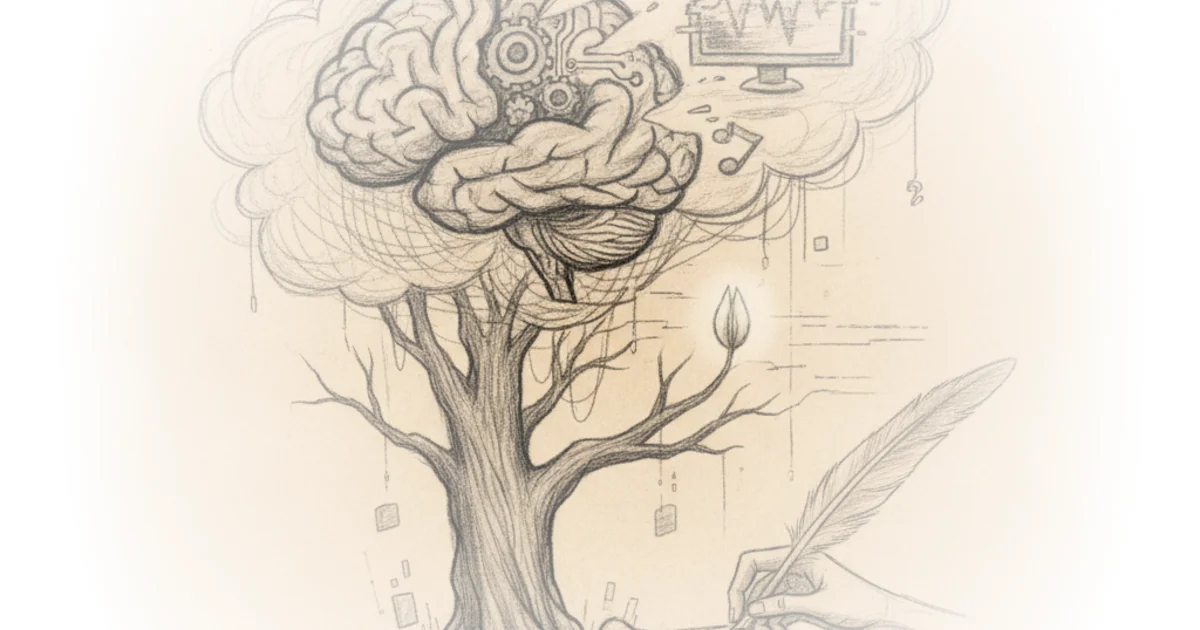
The core of his argument rests on a fundamental distinction between information and problem-solving. DeBoer writes, "most of our major problems as a species cannot be solved with information; indeed, I suspect that coming to understand the limits of computing will prove to be among the most profound scientific lesson of the 21st century." This framing is crucial for busy readers who are tired of being sold on efficiency gains that don't materialize. It suggests that the abundance these models create is merely an abundance of things we already had, not a solution to new complexities.
"I look to art to access the human... I access human-made art because I know there's a human behind it and that's what I'm looking for, other humans, showing me in art what they hide in their selves."
The Paradox of Prompting
DeBoer then pivots to his personal experiment: attempting to use these tools to manage the "mental juggling" required for writing a novel without letting them generate a single word of the final text. He identifies a paradox that many professionals will recognize immediately. To get a specific, nuanced argument out of an LLM, one must explain exactly what they want in excruciating detail. As he puts it, "writing enough to explain the argument I might ask them to make takes so much time and effort... that it's not a time saver."
This observation strikes at the heart of the productivity promise. If the input required to get a high-quality output exceeds the cost of doing the work oneself, the tool has failed its primary economic function. DeBoer notes that relying on these systems often leads to "trite, well-worn grooves," effectively shrinking the range of arguments a writer produces. He argues that this is not just a technical limitation but an ethical one: "My readers expect me to actually write the things I represent as mine." This commitment to authenticity is what separates professional work from automated content farming.
Critics might argue that deBoer's standard for utility is too high, suggesting that even imperfect assistance can save time on rough drafts. However, his experience suggests that the friction of correcting "profoundly goofy results" often outweighs the initial speed gain.
"With LLMs, what you get back is always inevitably what you've already gotten. No thanks."
The Limits of Machine Logic
The most revealing section of deBoer's analysis involves his attempt to use these models for practical tasks like chapter summaries and continuity checks. He found that while the tools could generate "at-a-glance" summaries, they often emphasized minor elements in ways that misrepresented the author's intent. More tellingly, when he tested their ability to count words—a task seemingly trivial for a computer—the models struggled due to the tokenization process.
He points out a critical disconnect: "the whole economic value of chatbots is that ordinary people can use them without special knowledge; the computer is supposed to be doing all of that thinking for you." When the user needs to write a script or understand tokenization to get a basic word count, the tool has failed its design purpose. This echoes historical debates about human-computer interaction, reminiscent of the "Chinese Room" argument which questions whether a system manipulating symbols truly understands them. Just as a person following rules in a room doesn't understand Chinese, an LLM processing tokens doesn't grasp narrative continuity.
Despite these failures, deBoer found some utility in checking for plot holes in his complex, non-linear manuscript involving nearly two dozen characters. The models could identify when events were out of order or when a character remembered something incorrectly. Yet, even here, the results were "a little wonky," with false positives that required human verification. This reinforces his conclusion that these tools are best viewed as clumsy assistants rather than autonomous partners.
"I sincerely believe I'm better at this than the LLMs are. Pretty self-explanatory."
Bottom Line
Freddie deBoer's most compelling contribution is the refusal to accept the premise that more data equals better art; he demonstrates that the human capacity for nuanced judgment remains irreplaceable in complex creative workflows. The argument's greatest vulnerability lies in its reliance on current model limitations, which are rapidly evolving, yet his core insight—that the cost of alignment often exceeds the benefit—remains a vital check against blind technological adoption.