Intyre believes modern moral conversations are broken — and he has a striking explanation for why.
In his influential book After Virtue, MacIntyre argues that today's discussions about right and wrong feel hollow because we've inherited moral language without understanding what gave these concepts meaning. He uses a vivid metaphor to make this point: imagine people stopped believing in the scientific method but continued using terms like gravity and inertia in everyday conversation. Eventually, everyone would have their own definitions. Someone might say "atoms behave differently for me than they do for you" — and that absurdity is exactly how MacIntyre sees modern moral discourse.
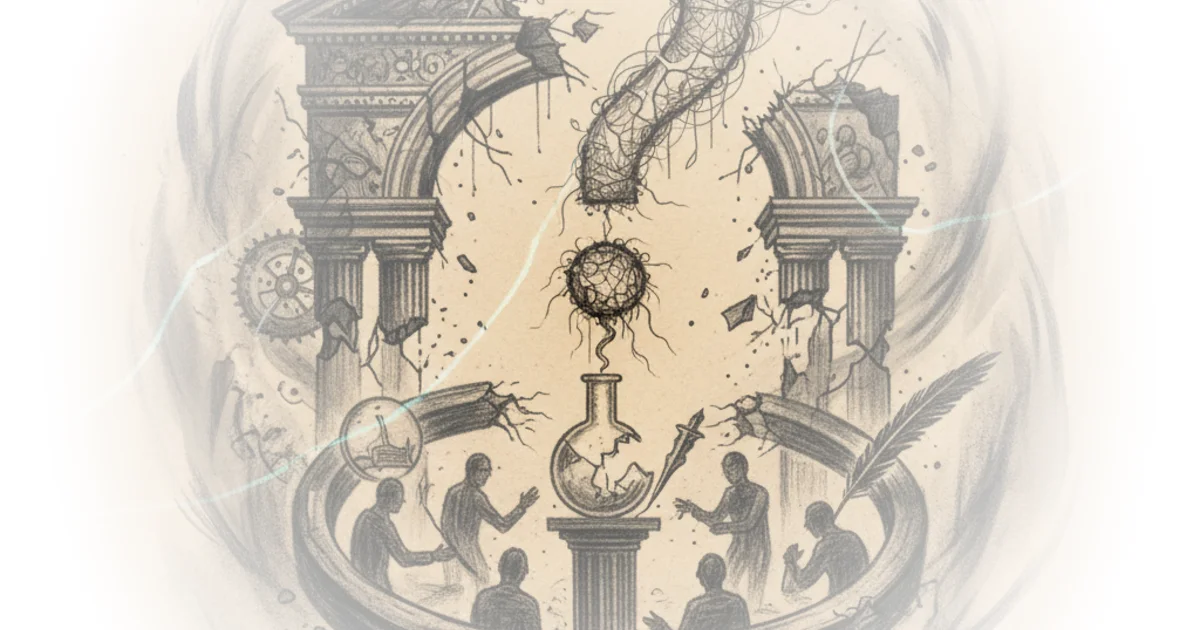
This isn't just an academic observation. It's a diagnosis of why arguments about ethics never resolve, why people talk past each other, and why something feels fundamentally wrong with how we discuss morality today. To fix this requires understanding the history of moral thought — specifically, what was lost that once made these conversations productive.
The Age of Roles
To understand where modern morality went wrong, you have to go back further — to ancient Greece around the 6th century BC, when people discussed ethics through storytelling rather than philosophical theory. In Homer's Iliad and Odyssey, calling someone virtuous meant they were good at a specific role: a warrior, a king, a friend. Virtue wasn't abstract moral correctness. It was excellence in a function.
This approach worked for a time, but it had serious gaps. Greek tragedies by playwrights like Sophocles and Euripides exposed the problem. A person isn't just a warrior. They occupy many roles simultaneously — parent, neighbor, citizen — and each role demands different behaviors. Helping a sick grandmother requires compassion. Storming a battlefield requires courage. Both virtues are valid, but following both can create genuine inner conflict.
The tragedies featured characters forced to choose between competing roles where every option feels wrong. This revealed something crucial: how do we prioritize when virtues clash? Which role takes precedence?
Plato's Answer
This moral complexity caught the attention of Plato, who responded with a revolutionary idea. He proposed that all these different virtues — courage, compassion, justice — stem from a single universal good. This higher form of the Good gave order to moral choices. Instead of agonizing over which virtue wins, you simply ask: what brings my life into alignment with the Good?
It was a consolidating move. The concept of a universal good became the foundation for productive moral conversation across centuries.
Aristotle and Teleology
But MacIntyre considers this next development far more significant than Plato's response — it's Aristotle's introduction of teleology, the idea that things have purposes or ends they should aim for.
Aristotle reasoned that everything in nature has a function. A good knife cuts well because that's what knives are designed to do. A good eye sees well. The same logic applies to human beings: there's a function tied to what humans are, and living well means fulfilling that function through virtues like courage, practical wisdom, and friendship.
This requires accepting some claim about human nature — that there's a correct way for humans to exist, an end or telos that represents flourishing. Courage isn't just subjectively good. For Aristotle, it's almost a moral fact derived from examining what kind of creature humans are and what the universe demands of them.
The virtues become bridges: they take you from where you are now to who you could be.
The Religious Turn
Ancient Greece passed, and Christianity became Europe's dominant moral framework. Islam spread across regions. Both traditions adopted Aristotle's teleological ethics, weaving it into religious forms while maintaining the core insight about human flourishing as a guiding principle.
This continued all the way through the Enlightenment — until philosophers attempted something radical: remove all predefined purposes entirely and rebuild morality from scratch using purely secular foundations.
The Enlightenment Problem
The project was well-intentioned. Could morality work without assuming any end or purpose? But MacIntyre argues this was doomed to fail from the beginning.
Here's why: these thinkers threw out teleology — the understanding of what a good human life looks like — yet they continued using moral terms that only made sense within that framework. Terms like "good," "just," and "virtue" remained, but the tradition that gave them meaning was gone.
The result is what MacIntyre calls a simulacrum of morality. People use the same language without shared understanding of what they're actually discussing. Kant attempted to ground morality in pure practical reason — rules valid for any rational being regardless of individual desires. But MacIntyre sees this as smuggling teleology back in under different cover.
The Enlightenment failed to create a foundation for moral conversation that doesn't assume some picture of human flourishing — and that's why modern debates feel so unsatisfying.