A Course That Transforms How You Read Literature — Using Tarot Cards
Close Reading Poetry argues that recovering our symbolic imagination is essential to understanding art, mythology, and the deepest patterns of human experience.
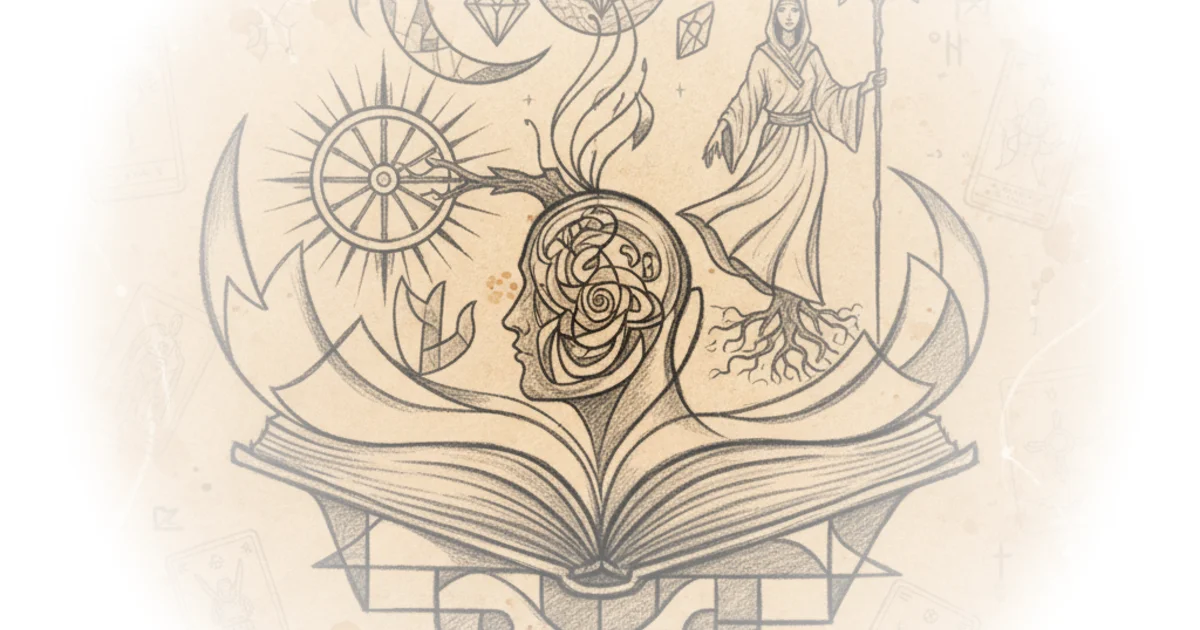
We live in an age of digital monolution. Our thinking has flattened into what scholars call monological thinking — a single track, linear process that misses the rich resonances found in mythopoetic language. The creative power of culture depends on recovering our capacity to read symbols dynamically, not just as static signs but as windows into layers of human consciousness.
This course uses the Major Arcana of tarot not for divination or fortunetelling, but as what scholars call archetypes — figures that represent particular aspects of human development and consciousness. The reason tarot works so well is that each card presents only an image and a number. It offers barebone symbolism that corresponds to patterns found in ancient scriptures, world literature, and art across cultures.
A symbol contains meaning within itself. Unlike a sign that merely points outward, a symbol always implies something more than its obvious and immediate meaning — something vague, unknown, or hidden from us.
What Is the Symbolic Imagination?
Carl Jung defined a symbolic image as one that implies something beyond its immediate meaning. The symbol becomes translucent: through it we see truths about greater reality, and the boundary between signifier and what is signified dissolves entirely.
The course distinguishes five key terms:
Sign points to a meaning outside itself — look there, and you find the thing.
Symbol contains meaning within. It always implies more than its obvious interpretation.
Archetype represents universal patterns found in myth and literature across all human cultures.
Mystery involves spiritual truths that cannot be directly communicated. In ancient Greece, mystery rites were initiation processes into cults of particular gods — experiences that reproduced the soul's journey to higher states of consciousness. The early Christian church used this term for sacraments like the Eucharist.
Arcanum refers specifically to these tarot cards and their hidden meanings.
Why Tarot? A Teaching Tool
Tarot accommodates many traditions simultaneously. Medieval cathedral doors in Europe taught spiritual lessons through images rather than words — figures that told stories to people who couldn't read. The symbolic imagery works for both literacy and visual learning.
The course uses the Marsai deck, popular in 17th and 18th century France for card games, alongside the Rider-Waith deck designed by Pamela Coleman Smith for occult purposes. The Rider-Waith deck particularly interested poet W.B. Yeats, who was required to hand-paint his own deck when joining the Order of the Golden Dawn.
The Archetypes in Literature
The Fool appears throughout literature as both comic relief and prophetic wisdom figure. Dostoevsky's Prince Mishkin embodies this archetype. Wordsworth wrote "The Idiot Boy." St. Francis began his ministry as a fool according to society. Shakespeare's King Lear contains the wise fool who diffuses psychological tensions of court. The medieval jester served an essential role in maintaining royal homeostasis — far more than comic relief.
The High Priestess, or Lady Pope, represents inspiration and intuition. She is the divine Sophia of Greek philosophy, the face behind Isis's veil, the Lady of the Lake who gives Arthur his sword. Her shadow appears as Morgan le Fay in Arthurian legends. More recent versions include Mary Poppins or the benevolent grandmother of folk tales.
The Empress symbolizes the sexual woman and great mother — Earth itself. She can be virginal or fertile. Gaia and Venus embody her. The Blessed Virgin Mary represents her heavenly state, while darker aspects appear as the Dark Mother or Queen of Orgiens in Arthurian myth.
Counterpoints
Some literary scholars might argue that tarot is not the only way to teach symbolic reading. Fairy tales from Grimm or Hans Christian Andersen could serve equally well. The Bible contains archetypes found throughout scripture. The Bhagavad Gita and Hindu traditions offer similar patterns. But what makes the arcana unique is their ability to stand in relationship to all these individual traditions simultaneously — they are a meeting point.
Bottom Line
This course's strongest argument is that symbolic imagination has been worn down by digital media, and recovering it matters for anyone creating art, poetry, or literature. The vulnerability? The course requires subscription fees to access, though three or four sample lectures release publicly each year. For creative writers seeking deeper well-springs of inspiration than AI can provide, this approach offers something machines cannot replicate — the crystal pool of human consciousness reflected through centuries of archetypal imagery.