What makes this piece notable is its live, unscripted quality — you're getting real-time reaction to a leadership race that could reshape Britain's economy. The hosts frame the stakes immediately: we have the worst economic outlook since 2008, inflation set to hit 13%, and five quarters of recession ahead. This isn't campaign rhetoric polished for television — it's raw commentary on what these candidates are actually saying.
The Economic Backdrop
Novara Media immediately establishes why tonight matters. "This comes on a massive day in british politics and the british economy and british society more generally," they note, "the bank of england today announced that inflation is set to hit 13 and that we are set for five quarters of recessions." That's the core context: the economy is expected to shrink by 1.5% next year. The hosts immediately pivot to what this means for the leadership race — with polling suggesting "liz trust has run away with this leadership race she's on you know double the support of rishi sunak."
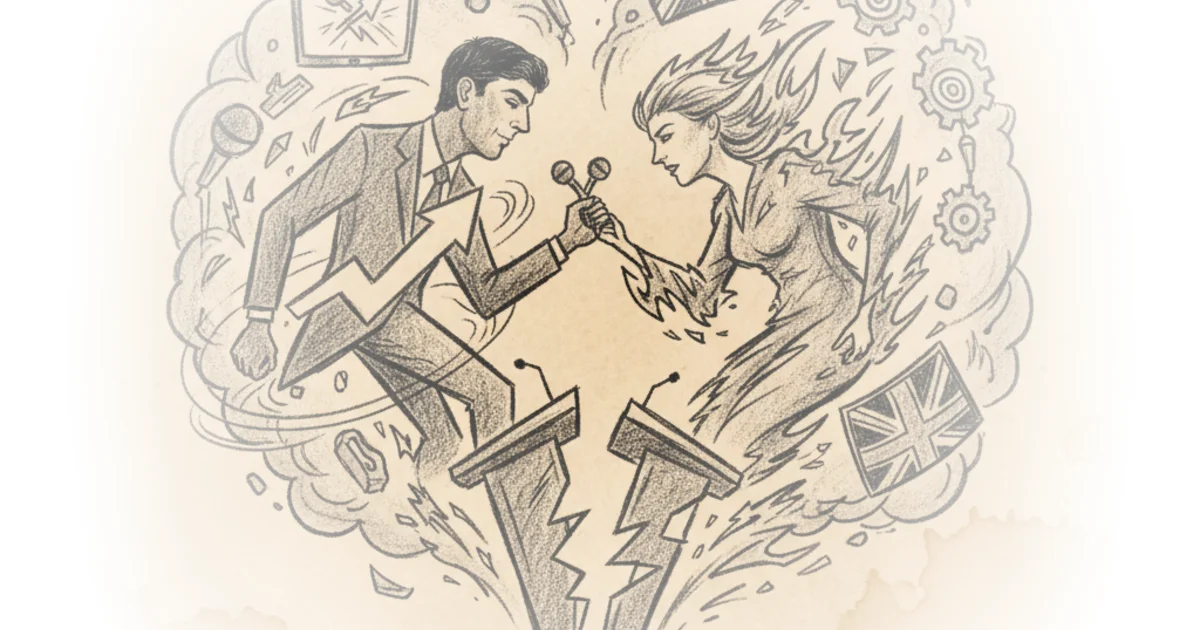
This framing works because it places the candidates' policies directly against the economic crisis they'll inherit. You're not just watching a debate — you're watching two people who could become prime minister answer questions about how to handle the worst financial outlook in over a decade.
The Debate Format
The format itself becomes part of the story. "they thought they were taking too many chunks out of each other and it was damaging the tory party so instead there's going to be questions from a studio audience." This explains why it's not a head-to-head debate — the candidates apparently decided direct confrontation was too damaging. Instead, they'll face separate interviews.
The hosts toss a coin to decide who goes first — Liz Trust wins and "she chose to go first." The format is described as hopefully "more illuminating than other events" because the audience of over 60 conservative members are "largely reflecting the demographic makeup of the party many of them are still undecided over who to back."
The Recession Question
When Diana asks about recession, Liz Trust's answer becomes the centerpiece. She responds: "what the bank of england have said today is of course extremely worrying but it is not inevitable we can change the outcome and we can make it more likely that the economy grows." Her proposed solutions include reversing the national insurance increase immediately, a temporary moratorium on green energy levies to save people money on fuel bills, and keeping corporation tax low to attract investment.
We can change the outcome and we can make it more economical grow
This is the most quotable line from the debate — it's direct, it's optimistic, and it frames recession as something that can be avoided if the right policies are implemented. The hosts immediately follow up with "promising cuts to the public sector just earlier this week" — pushing her on whether she's proposing austerity.
Party Credibility
A question from Neha surfaces a vulnerability: "i'm amongst very few of my age group i can't hear you aaron we're gonna get that sorted out members of the conservative party i've been speaking to some of us and we are afraid that the party has lost credibility so my question is how will you repair the damage to the party's reputation." Liz Trust's answer emphasizes delivering on manifesto promises — "the most important thing is we deliver on the promises we made we got elected across the country in 2019."
The hosts interject: "politicians always say that our party is a broad church and i always point out to them that people die in broad church" — a skeptical note about whether vague promises of party reform will actually address the credibility problem.
The NHS Crisis
A medical consultant asks about hospital understaffing. Liz Trust's answer centers on removing "central dictats" and reducing layers of management, saying "i've on the campaign trail over the last few weeks there's more than two percent pay rise that's what matters." She also commits to addressing doctor pension issues that are driving early retirement.
The hosts note this is a significant policy area: "i know that people that i work with would be really really happy if you looked into pension tax because a lot of people are going into early retirement exactly i'm sure that will help bring the waiting lists down."
Ukraine and Peace
When David asks about brokering peace negotiations in Ukraine, Liz Trust's answer is firm: "the only way this war will end is when the russians leave ukraine and we need to make sure that we enable the ukrainians to defeat vladimir putin." She argues against any peace settlement that involves "giveaway of Ukrainian territory" — citing the Minsk accords as a failed precedent.
The hosts push on her position: "what she's saying all the germans have happened especially it's really it's really appalling how putin made the germans give up nuclear energy now." This is a critical moment — she's being asked whether continuing to arm Ukraine while still buying Russian gas is coherent. Her answer emphasizes continuing weapons supply and toughening sanctions.
Counterpoints
Critics might note that Liz Trust's answers often rely on vague promises — "deliver on the promises," "be bold," "keep taxes low" — without specifying how she'll actually implement these policies. The recession response mentions reversing national insurance but doesn't explain how that addresses inflation at 13%. Similarly, her NHS answer focuses on removing "dictats" and management layers without specifying which ones or how this solves understaffing.
The hosts also note something telling about the timing: "i think actually just as long as 2008 she's talking about who's going to be the tory party chairman" — suggesting that internal party politics is being prioritized over addressing the economic crisis. The holiday absence of both Boris Johnson and the Chancellor during this crisis is noted: "the deems of hawaii has incidentally um boris johnson and nadeem zaharawi the prime minister and the chancellor are both on holiday."
Bottom Line
The strongest part of this coverage is how it frames tonight as "make or break" — you're watching a leadership contest where one candidate will become prime minister, and their answers to audience questions reveal actual policy intentions. The economic context makes this extraordinary: inflation at 13%, recession for five quarters, the worst outlook since 2008.
The biggest vulnerability is that Liz Trust's answers frequently lack specifics — vague commitments about "delivering promises" and "being bold" don't actually address how she'll reverse inflation or fix the NHS crisis. You're getting commentary on what candidates say, but not necessarily on whether what they say will work.