When Citizens Outpace Their Leaders
A grand jury in Washington declined to indict six Democratic lawmakers who reminded military personnel of their duty to refuse unlawful orders. Ordinary citizens on that jury rejected what federal prosecutors sought. This moment reveals something deeper about American political life: civic institutions sometimes hold when formal leadership hesitates.
The Jury's Decision
Sarah Longwell, Tim Miller, Bill Kristol writes, "It was remarkable that the U.S. attorney's office in Washington . . . authorized prosecutors to go into a grand jury and ask for an indictment of the six members of Congress, all of whom had served in the military or the nation's spy agencies." The authors continue: "But it was even more remarkable that a group of ordinary citizens sitting on the grand jury in Federal District Court in Washington forcefully rejected Mr. Trump's bid to label their expression of dissent as a criminal act warranting prosecution."
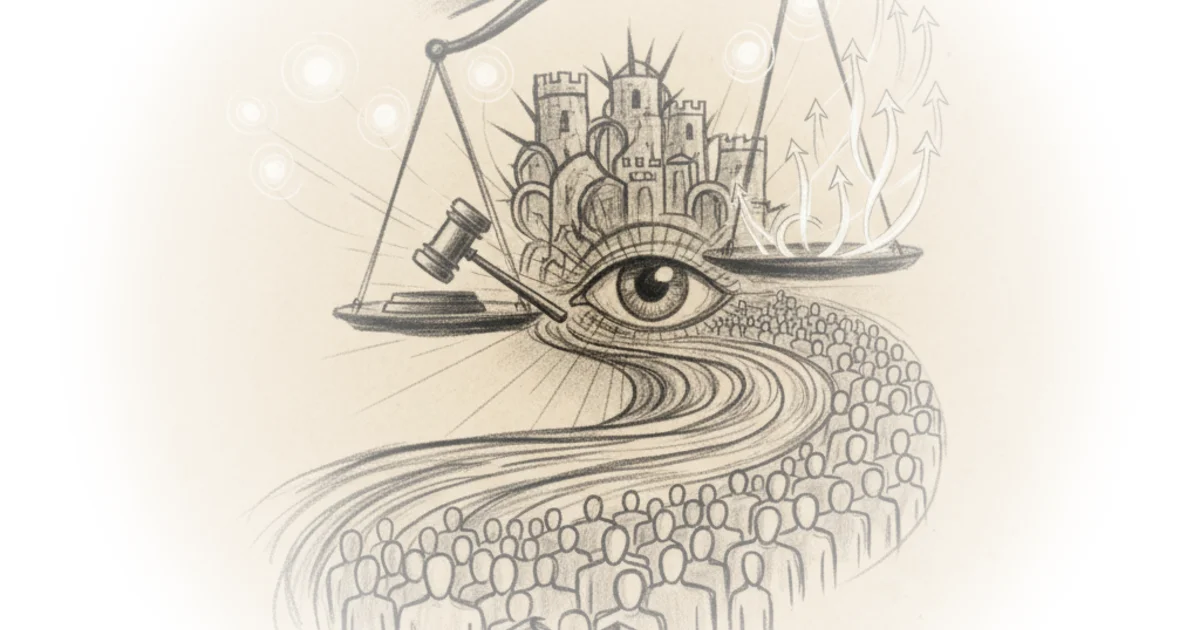
The grand jury system dates to medieval England, designed as a buffer between government power and individual citizens. These panels hear evidence in secret, deliberate without judicial oversight, and can refuse charges even when prosecutors present strong legal theories. Their independence is absolute.
As Sarah Longwell, Tim Miller, Bill Kristol puts it, "Ordinary citizens: What can't they do?"
Leadership Lag
The authors identify a pattern across multiple fronts. Congressional Democratic leaders remain cautious about opposing Department of Homeland Security funding despite public alarm about potential election interference. Senate Minority Leader Chuck Schumer emphasized cooperation: "There's no reason we can't get this [a deal with Republicans] done by Thursday."
Sarah Longwell, Tim Miller, Bill Kristol writes, "Why not aggressively make the case for no new funding for Immigration and Customs Enforcement and the Border Patrol (while making clear they're willing to separate out funding for the unproblematic parts of DHS)? Why not take the position that ICE and the Border Patrol should have to draw down at least some of the massive five-year appropriation Republicans gave them in last year's reconciliation bill?"
The October 2025 No Kings protests drew massive crowds nationwide. Minneapolis residents organized sustained civic action against federal deployments. Epstein survivors persisted through congressional legislation and administrative resistance. Each instance shows public energy exceeding institutional response.
"Public sentiment isn't self-effectuating. Elected officials have to translate public sentiment into political action."
Sarah Longwell, Tim Miller, Bill Kristol writes, "The public's rallying to the cause of democracy and liberty is the most heartening development of the last twelve months. But there are limits to what the public can do." The authors cite Abraham Lincoln's 1858 debate statement—"Public sentiment is everything"—then note Lincoln knew this overstated reality. He ran for office because sentiment requires power to effect change.
What Leaders Could Do
The authors suggest concrete alternatives. Democratic senators could refuse further empowerment of immigration enforcement agencies. Congress could insist legislation they passed is enforced. Members could clarify laws the Justice Department claims to enforce, making judicial resistance easier.
Sarah Longwell, Tim Miller, Bill Kristol writes, "Perhaps Democratic members of Congress should accept that we aren't living in business-as-usual times? Perhaps they should choose not to attend the State of the Union as long as ICE continues its rampages and the Justice Department continues its Epstein coverup?"
Some could travel to Minneapolis. Some could meet with Epstein survivors. Some could show solidarity with citizens who have stood against authoritarian overreach.
Other Developments
The newsletter covers additional political friction. Commerce Secretary Howard Lutnick maintained contact with Jeffrey Epstein years after claiming he had cut off contact. House Republicans largely shrugged. Three Republicans joined Democrats to defeat a rule blocking future votes on tariff termination—an embarrassment for Speaker Mike Johnson.
Vice President JD Vance's X account posted about honoring " victims of the 1915 Armenian genocide" during a memorial visit, then quickly deleted it. Staff blamed a staffer. Vance had called it "a very terrible thing that happened a little over 100 years ago." The Armenian National Committee of America condemned the deletion as denialist.
Counterpoints
Critics might note that grand juries occasionally refuse indictments for reasons unrelated to constitutional principle—juror confusion, evidentiary gaps, or simple unpredictability. Reading democratic resilience into one jury's decision may overinterpret.
Critics might also argue that congressional caution reflects strategic calculation rather than timidity. Aggressive opposition could trigger shutdowns, alienate swing voters, or harden Republican resistance. Incremental negotiation sometimes produces more than maximalist confrontation.
Critics might question whether public protests translate to lasting policy change. The No Kings demonstrations drew crowds, but concrete legislative outcomes remain unclear. Energy without electoral translation risks becoming performance rather than power.
Bottom Line
Grand juries and street protests show civic muscle when formal leadership hesitates. But sentiment without institutional power remains incomplete. The authors' verdict: citizens are leading. Leaders should follow—or risk being left behind by the energy they claim to channel.