Sam Jennings delivers a stinging indictment not just of a single film, but of an entire cinematic ecosystem that has settled for "pretty" over "profound." He argues that contemporary "independent" cinema has become a factory of middlebrow safety, where formal innovation is sanding down the very edges that make art dangerous or truly moving. For the busy listener seeking to understand why modern prestige films feel so hollow, Jennings offers a diagnosis that goes beyond plot holes to question the soul of the industry.
The Trap of the Picturesque
Jennings opens his critique by dismantling Train Dreams, a film he describes as "an unfortunately empty film" that mistakes visual competence for emotional depth. He notes that while the movie is "a pretty film, in some ways," it ultimately fails because "everything which could possibly be said about it is already so present at the surface, already so obvious and literal and exhaustively clear, it's transparent." The film attempts to tackle the weighty themes of American industrialism and the loss of nature, but Jennings argues it merely "telegraphs" these themes to the audience rather than exploring them.
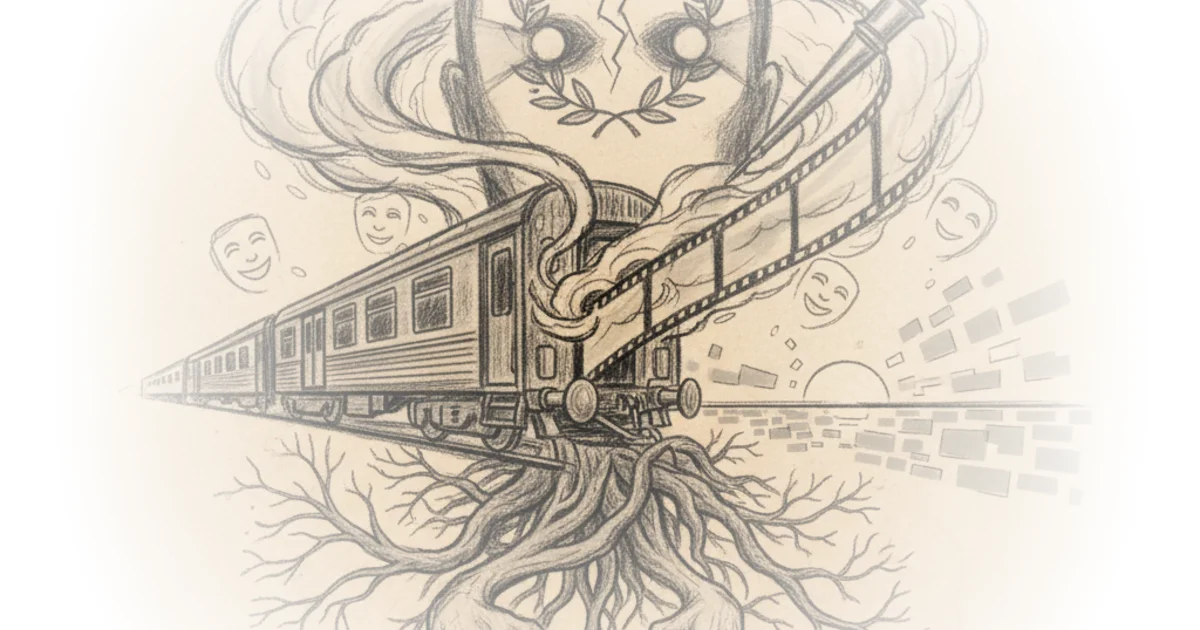
The core of his argument is that the film relies on a familiar, safe aesthetic to mimic profundity. Jennings writes that the movie is "a long, muted, gentle lament on the old themes of American industrialism and on the fading of nature at the hands of those American industries." However, he contends that this approach results in a work that feels more like "a more artful episode of Planet Earth" than a genuine human drama. This framing is effective because it exposes how easily "artistic" credentials can be faked with high-resolution nature shots and a melancholic score, a tactic that has become a hallmark of the current "elevated" indie wave.
"The problem — generally — is that it's too frequently middlebrow. The filmmakers have simply gotten better at hiding it."
Jennings suggests that the film's director, Clint Bentley, is "perfectly adept at locating and arranging some very pretty vistas" but lacks the vision to make them matter. He points out that the film's strict 3:2 aspect ratio, chosen to mimic old photographs, ends up feeling "tall and quite constrictive," trapping the characters in a "dull shorthand for suggesting 'realism' and 'poetry'." Critics might note that some filmmakers intentionally use restrictive framing to evoke historical claustrophobia or memory, but Jennings makes a compelling case that here, it serves only to flatten the narrative into a series of static "idols of static photographic 'history'."
The Illusion of Depth
Moving beyond the visuals, Jennings attacks the character work, describing the protagonist as a "vaguely spiritual proletarian cipher" who never truly registers as a person. He observes that even with talented actors like Joel Edgerton and Felicity Jones, "neither of them register much as characters" because they are "so interiorized and withdrawn that almost nothing comes across in the way of personality." The film relies on a narrator to explain the protagonist's feelings, a choice Jennings calls "a complete miscalculation" that strips the story of any ambiguity.
He contrasts this with the few moments of genuine life in the film, noting that "William H. Macy, who gives a wonderful, brief performance as an eccentric old dynamite man" and "the great Irish actor Kerry Condon" are the only ones who "have so much personality behind their eyes." This sharp contrast highlights the film's central failure: it treats human beings as allegorical stand-ins rather than individuals. Jennings writes that the film "gestures towards" deep ideas "without much thought as to what it would actually entail to suggest either idea more definitely."
This critique resonates with a broader historical context. While the article references the influence of Terrence Malick, a filmmaker known for his spiritual and nature-focused epics, Jennings argues that Train Dreams only captures the surface-level aesthetics of that style without the philosophical rigor. Much like the "middlebrow" label applied to Denis Johnson's original novel (which Jennings admits he hasn't read but assumes the film simplifies), the film risks becoming a watered-down version of its influences. The result is a movie that feels "perched somewhere between a more artful episode of Planet Earth and Iñárritu's The Revenant," a space where "competent" filmmaking replaces "compelling" storytelling.
"It's a sensibility I don't yet have a name for, though it's much closer to middlebrow than many would like to admit."
The Crisis of Contemporary Criticism
Jennings expands his scope to indict the critical establishment itself, arguing that critics have become too "easy on this contemporary strain of middlebrow cinema." He draws a sharp line between "serious" films and the current crop of "indie" movies, suggesting that the latter are often just "too legible" and "too contained." He challenges the notion that these films are "about" important issues, stating that "their way of going about this never extends to formal considerations."
To illustrate the decline, he compares modern "elevated" films to the raw, dangerous energy of 1970s cinema. He writes, "put Baker's Oscar-winning sex worker thriller next to something like Alan Pakula's 1971 masterpiece Klute — you'll see just how sexless contemporary 'sexiness' is; how tepid its sense of real risk and social commentary." This comparison is powerful because it forces the reader to confront the "tameness and prudery" of modern filmmaking. Jennings argues that what is now deemed "mature" is often just "a kind of leeching off of the saddest, emptiest leftovers of a movie culture that seems close to being forgotten."
However, he acknowledges that there are exceptions—filmmakers like the Safdie Brothers, Ari Aster, and Robert Eggers—who manage to be "too singular and weird to be middlebrow." He notes that "Robert Eggers remains the purest exception to the era's overweening sensibility," creating work where "formal constrictions worked with the 'content,' not against it." This distinction is crucial: it suggests that the problem isn't "independent" cinema itself, but rather the specific, safe subset of it that has come to dominate the awards circuit.
"When it comes to the middlebrow, even the critics themselves need rescuing. Who is going to do it?"
Jennings concludes with a scathing attack on the current state of film criticism, accusing many reviewers of "swallowing" hollow blockbusters and prestige films without complaint. He asserts that "anyone who reviews a film like Wicked without calling it exactly what it is (a cultural nadir and an embarrassment to cinema) no longer deserves to call themselves a critic." While this is a hyperbolic stance that some might find too harsh, it underscores his central point: the loss of critical rigor is allowing "empty prestige filmmaking" to thrive.
Bottom Line
Jennings' most potent argument is that the "middlebrow" aesthetic has become a shield for a lack of ambition, allowing filmmakers to hide behind "pretty" images and "familiar" themes while avoiding the formal risks that define great art. His biggest vulnerability lies in his sweeping dismissal of a wide range of filmmakers, potentially overlooking the subtle ways these films might resonate with audiences seeking comfort over challenge. Ultimately, the piece serves as a necessary wake-up call for both creators and critics to demand more than just "competent" storytelling in an era where "sameness" is the only constant.