Kevin Xu's 2025 annual letter cuts through the noise of AI hype with a framework that treats geopolitics not as optional context but as unavoidable icing you must scrape through before tasting the technology cake underneath.
Xu runs Interconnected Capital, a global technology long-only fund targeting what he calls the "picks and shovels" of the digital AI economy. His background spans GitHub senior leadership, Stanford law and computer science, Brown international relations, and Obama administration roles at the White House and Department of Commerce. That operator-plus-political-antenna combination shapes how he reads both code and power.
The Fund's Position
Xu opened with blunt transparency about performance. After doubling in Q3, the fund faced Q4 volatility that cut his own performance fees in half. He framed this alignment as intentional rather than accidental.
Kevin Xu writes, "As the largest shareholder of this fund, my own performance fees also got cut in half after Q4 was said and done. I'm not complaining about it. I'm actually very happy about it. This shows that my interest is always aligned with my investors in the same direction, no matter which direction."
The fund closed to new outside investors except for strong referrals and current investor additions. Xu added 18 outside investors in 2025 and expressed gratitude to the "founding 18" who took a chance on him. He's now courting larger institutional investors, including an unsuccessful but validating final-round interview with Yale's Prospect Fellowship program.
Critics might note that closing the fund to new investors while still chasing institutional validation creates tension between exclusivity and growth ambitions.
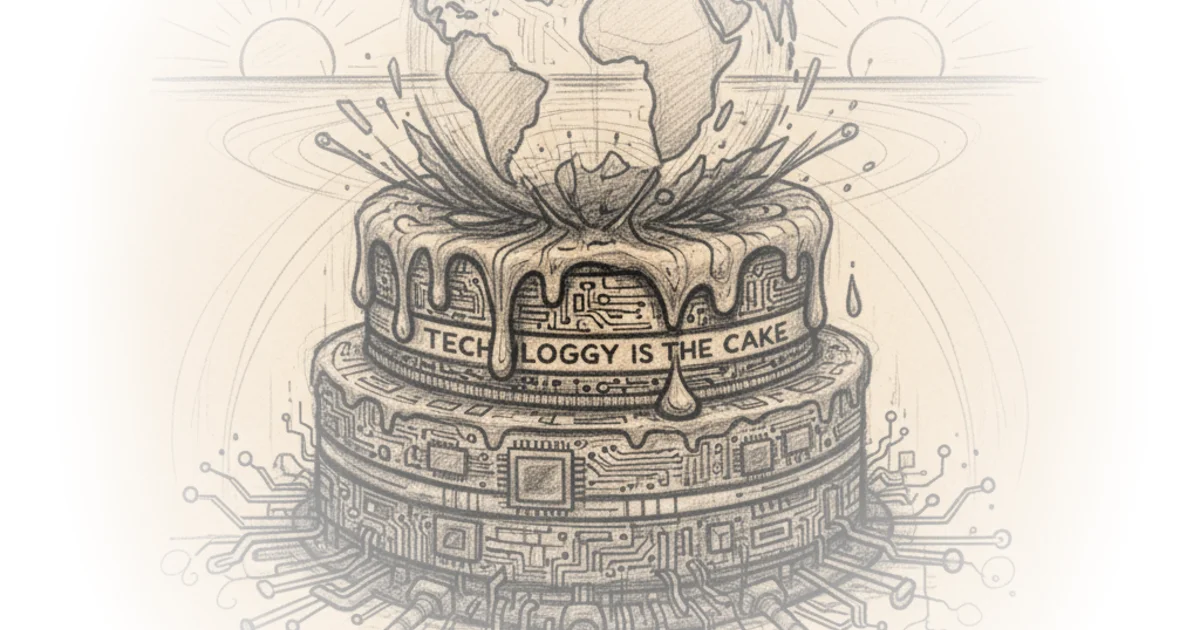
"Technology is the cake, geopolitics is the icing. Layers of cake are like layers in a tech stack. We all want to eat the cake, but to get to the cake, we must get through the icing surrounding the cake first, whether we like icing or not."
Sharpened Sequence
Xu refined his investment process into a strict four-step sequence: technology fundamentals first, geopolitical evaluation second, company analysis third, price assessment fourth. He rejected the vague notion of "combination" in favor of explicit prioritization.
As Kevin Xu puts it, "Technology fundamentals come first. Identifying the technology in the stack that has a right to win is always step #1. Geopolitical evaluation, whether it is a tailwind or headwind assessment, is step #2."
The cake-icing analogy captures his core insight: you cannot access technology's value without first navigating geopolitical constraints. This ordering reflects a world where chip export controls, sanctions, and supply chain sovereignty determine which technologies can actually reach markets.
Agents and Guardrails
Xu identified two opportunity areas for 2026. The first: deterministic guardrails around probabilistic AI agents. He observed that 2025's "year of AI agents" mostly disappointed until Claude Code's late surge. Enterprises will demand agents in 2026, but agents built on large language models cannot guarantee output 100 percent of the time.
Kevin Xu writes, "A probabilistic model generates many creativity and productive possibilities. But you can never guarantee and verify an AI agent's output 100% of the time. That is the nature of probability. So you need deterministic guardrails, rules, observable and auditable boundaries placed around these agents, as they do the things they do best."
He holds a small, tentative position in UiPath, a robotic process automation leader, but admits the guardrail space remains muddy and confusing. No vendor has yet released a solution that satisfies the market. The necessity, however, is clear: guardrails are not optional when agents operate inside enterprises.
Critics might note that UiPath itself faces competitive pressure from newer automation platforms, and Xu's low conviction suggests he's betting on a theme rather than a specific winner.
From GPUs to CPUs
The second opportunity: a hardware demand shift from graphics processing units to central processing units. GPUs dominated three years of conversation because training large models requires parallel matrix multiplication. Agents differ. They query proprietary data, access browsers, scan files, coordinate with other agents. The workload becomes heterogeneous rather than homogenous.
As Kevin Xu puts it, "Whereas a training workload is computationally demanding but homogenous, an agentic workload needs less raw compute but is heterogeneous. That's what CPUs are designed to do."
Intel reported inability to meet large customer demand for server CPU products. AMD showed sequentially increasing data center CPU demand. Even NVIDIA entered the space, announcing the Vera CPU as a standalone product via CoreWeave. The GPU shine wears off; CPUs make a comeback.
Critics might note that NVIDIA's GPU dominance remains unchallenged for training workloads, and the agent-driven CPU shift may be overstated if training continues to drive most compute demand.
The Human Survey Problem
Xu identified two risks. First: from quiet quitting to quiet resisting. How do we know if AI agents deliver? Surveys. Who answers surveys? Humans whose employability agents threaten. The rational response: make agents look bad.
Kevin Xu writes, "If the agents are working really well, it does not take a genius human to see the writing on the wall of his or her employability. So when a survey inevitably comes from either the CIO or the HR office about those agents, the natural and rational reaction is to make the agents look bad and complain about them."
He chuckled at a Wall Street article published in the Lifestyle section that should have been front-page Business. The era of quiet quitting gives way to quiet resistance against the machine. Xu noted the tech industry still relies on Stackoverflow surveys and Gartner roundtables when telemetry and log data are plentiful.
Critics might note that Xu's dismissal of human survey data overlooks legitimate concerns about AI's actual workplace impact that telemetry alone cannot capture.
AI as Political Punching Bag
Xu's second risk: AI becomes the midterm punching bag. He described himself as a recovering ex-professional political junkie watching the US barrel toward political uncertainty. The reference to Yale's investment office hedging Snapple with short sales and put options informed his own modest hedging experiment.
As Kevin Xu puts it, "If it's good enough for Yale, it is good enough for me."
The Yale reference connects to his unsuccessful but validating fellowship application process. Two hours with six Yale team members discussing strategy and vision. No spot in the program, but the experience sharpened his thinking about institutional capital allocation.
Bottom Line
Xu's cake-icing framework captures the new reality: technology investors must navigate geopolitics before accessing returns. His guardrail thesis and CPU shift observation deserve attention, though his low conviction on UiPath suggests he's still researching rather than betting. The fund's Q4 drawdown and hedging experiment reveal an operator learning to manage volatility without abandoning long-only conviction. For readers tracking AI's enterprise adoption, Xu's insistence on deterministic boundaries around probabilistic agents marks the clearest investment signal in a muddy space.