Heather Cox Richardson does not merely report on a series of administrative failures; she constructs a chilling narrative where the machinery of government is being systematically dismantled to serve a singular, ideological purpose. Her most startling claim is that the current administration's actions—from diverting National Park Service funds for personal vanity projects to politicizing scientific grants—are not chaotic errors but a coordinated strategy to turn public assets into private power. This piece matters now because it connects the dots between a cracked walkway in Washington and the rising death toll of newborns, revealing a pattern where the cost of loyalty is measured in human lives.
The Cost of Vanity and Silence
Richardson begins by dismantling the myth of fiscal responsibility, exposing how the executive branch has treated public lands as a personal piggy bank. She highlights a report by Michael Scherer regarding the White House West Colonnade, where the administration replaced historic Tennessee flagstone with polished black African granite. When pressed on funding, the President claimed it was "Paid for by me," but Richardson notes that budget documents reveal taxpayers shelled out $689,232 for the walkway alone. This deception is not an isolated incident; she points out that a separate project to hang pictures of presidents alongside the current leader's opinions cost another $347,503 in taxpayer money, labeled simply as a "Rush project at request of POTUS."
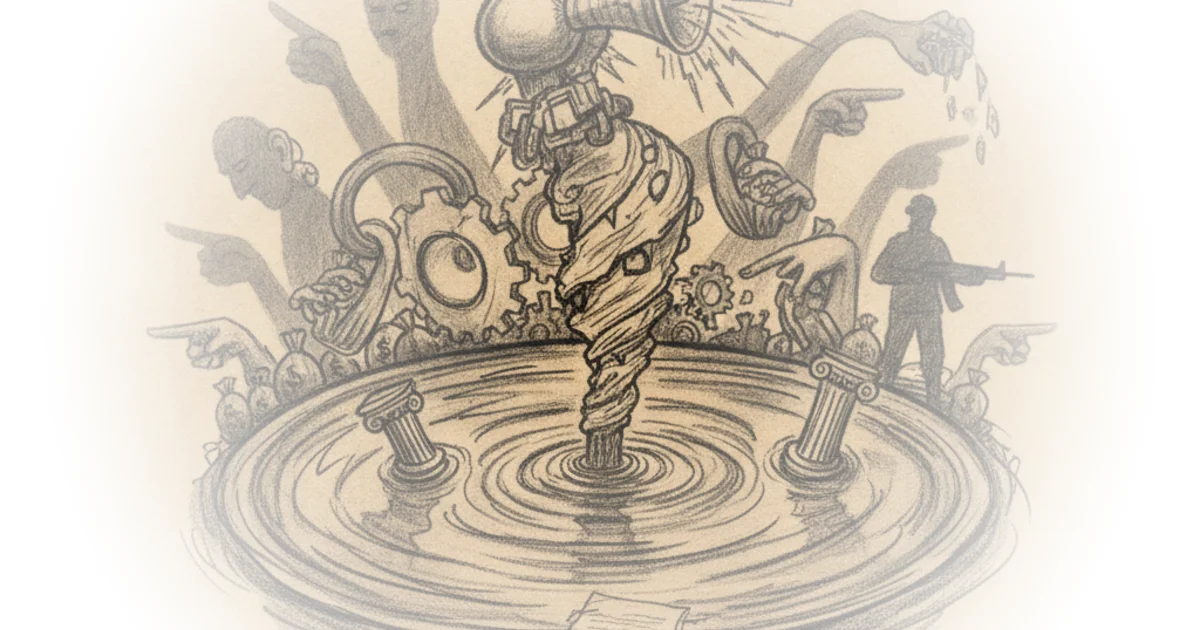
The argument gains weight when Richardson contrasts these luxuries with the neglect of public safety. She writes, "Expected funding for more than 900 Park Service projects never arrived—including $424,000 to replace a guardrail on the edge of a cliff in Colorado's Gunnison National Park that National Park Service employees identified as 'a significant safety hazard for visitors.'" This is a stark illustration of misplaced priorities: while the administration beautifies its own surroundings, critical infrastructure elsewhere crumbles. The stakes are no longer just financial; they are mortal. Richardson details how the Department of Interior now blocks the release of information regarding deaths on public lands, a policy that directly contributed to two more heat-related fatalities in the Grand Canyon after an initial death was hidden from the public.
"We are paying for their theft with a significantly diminished country, and even with our lives."
This framing is effective because it strips away the bureaucratic euphemisms often used to describe budget cuts or policy shifts. By linking the silence of the Interior Department directly to preventable deaths, Richardson forces the reader to confront the human cost of administrative opacity. Critics might argue that centralizing communications is a standard efficiency measure, but the evidence presented—specifically the delay in warning visitors about extreme heat—suggests a deliberate suppression of safety data rather than mere red tape.
The Dismantling of Science and Readiness
The commentary shifts from physical infrastructure to intellectual and military foundations, arguing that the administration is actively eroding the systems that have kept the nation safe and innovative for decades. Richardson traces the history of federal research grants, noting that the post-World War II system was built on merit-based peer review precisely because "it became clear that it was more cost effective for the federal government to award grants to those researchers doing work their peers recognized as the best in the country." Now, she argues, this system is being replaced by political approval. She identifies Russell Vought, a key author of Project 2025 and head of the Office of Management and Budget, as the architect of this shift, which would allow political appointees to "divert tax dollars to channels he approves, rather than those scientists support."
The consequences of this ideological purge are immediate and deadly. Richardson cites economist Paul Krugman's warning that destroying faith in experts leaves people vulnerable to anti-science movements, noting that "spending on wellness in the U.S. alone amounts to about $500 billion a year." She connects this directly to the refusal of Health and Human Services Secretary Robert F. Kennedy Jr. to recommend Vitamin K shots for newborns, a move that has led to a rise in preventable infant deaths. As Richardson puts it, "As the administration tears up the system, people die."
This section is particularly potent because it moves beyond abstract policy debates to tangible outcomes. The argument holds up under scrutiny: the correlation between the rejection of established medical consensus and rising mortality rates is well-documented by sources like ProPublica. However, one might note that the administration's stated goal of reducing "politicization" in science could be framed by supporters as a necessary correction to perceived biases in current research funding, even if the execution appears to favor ideology over merit.
The erosion extends to the military, where Richardson argues that Defense Secretary Pete Hegseth is prioritizing loyalty over competence. She lists the removal of dozens of senior leaders, including former Joint Chiefs chair General C.Q. Brown Jr., as part of a "purge" driven by "bro-culture bravado." The result was not a more efficient force but a vulnerable one; after Hegseth called mandatory flu vaccinations "overly broad and not rational," an outbreak at Lackland Air Force Base sickened over 220 troops and killed one trainee. Richardson quotes Senator Thom Tillis, who described the firings as "yet another unforced error from a Secretary leading the Pentagon with bro-culture bravado rather than restraint."
"Hegseth is more interested in purging people he perceives as insufficiently loyal than empowering proven patriots who can actually lead."
This critique of military leadership strikes at the heart of national security. By removing experienced commanders and ignoring established health protocols, the administration has arguably weakened the very institution it claims to protect. The historical context here is vital; just as the National Park Service's neglect mirrors a broader disregard for public stewardship, the military's decline reflects a rejection of professional standards in favor of political conformity.
The Illusion of Control and the Reality of War
The piece concludes by examining how these domestic failures ripple outward into foreign policy, creating a cycle of aggression that benefits no one but the aggressors. Richardson describes the administration's handling of Iran as a "debacle," where military strikes have only strengthened Tehran's position. She notes that despite apocalyptic threats from the White House regarding the Islamic Republic's existence, Iran now expects to collect $40 billion annually for security services in the Strait of Hormuz—a direct payoff for the chaos unleashed by US actions.
The domestic political reaction to this foreign policy failure is equally telling. Richardson highlights how Republican leaders in Congress have refused to investigate, with House Speaker Mike Johnson warning his base that a Democratic victory would lead to "impeachment" and investigations into their own families. This creates a closed loop where accountability is impossible because the party in power views oversight as an existential threat rather than a constitutional duty.
"Administration officials and their cronies are turning the country we worked so hard to build into a vehicle for building their own power and their own wealth."
This final synthesis ties together the disparate threads of the article: the vanity projects, the silenced scientists, the purged generals, and the failing foreign policy all serve one master—the consolidation of power. Richardson's argument is that this is not a series of mistakes but a coherent strategy of "looting" public trust for private gain. While some might argue that strong executive action is necessary in turbulent times, the evidence presented suggests that the current approach is dismantling the very institutions required to navigate those turbulences safely.
Bottom Line
Richardson's most compelling argument is her ability to link the granular details of budget documents and medical protocols to a grand narrative of institutional decay, proving that the cost of this administration is measured in both dollars and human lives. Her biggest vulnerability lies in the sheer scope of her indictment, which may feel overwhelming to some readers, but the specific, documented examples—from the Grand Canyon deaths to the Lackland flu outbreak—anchor the piece in undeniable reality. The reader must now watch whether Congress will continue its silence or if the evidence of this "looting" will finally force a reckoning before further irreversible damage is done.