Freddie deBoer delivers a provocative counter-narrative to the current sports media frenzy, arguing that the very conditions that cemented LeBron James's legacy are the same ones that will ensure its rapid erosion. While the world obsesses over counting stats and longevity records, deBoer posits that sports greatness is not a mathematical constant but a fleeting cultural moment, destined to be swallowed by the relentless tide of presentism. This is a necessary corrective for anyone tired of the endless, circular debates that ignore how fandom actually functions.
The Illusion of Permanence
The core of deBoer's argument rests on the uncomfortable reality that athletic greatness is defined by attention, not just ability. He writes, "Because perceptions of sports greatness are like grains of sand in an hourglass, steadily falling, and your favorite is not an exception." This metaphor lands with particular force because it reframes the GOAT debate from a question of objective truth to one of temporal relevance. DeBoer suggests that the moment a player retires, the clock begins ticking on their cultural centrality, regardless of their statistical accumulation.
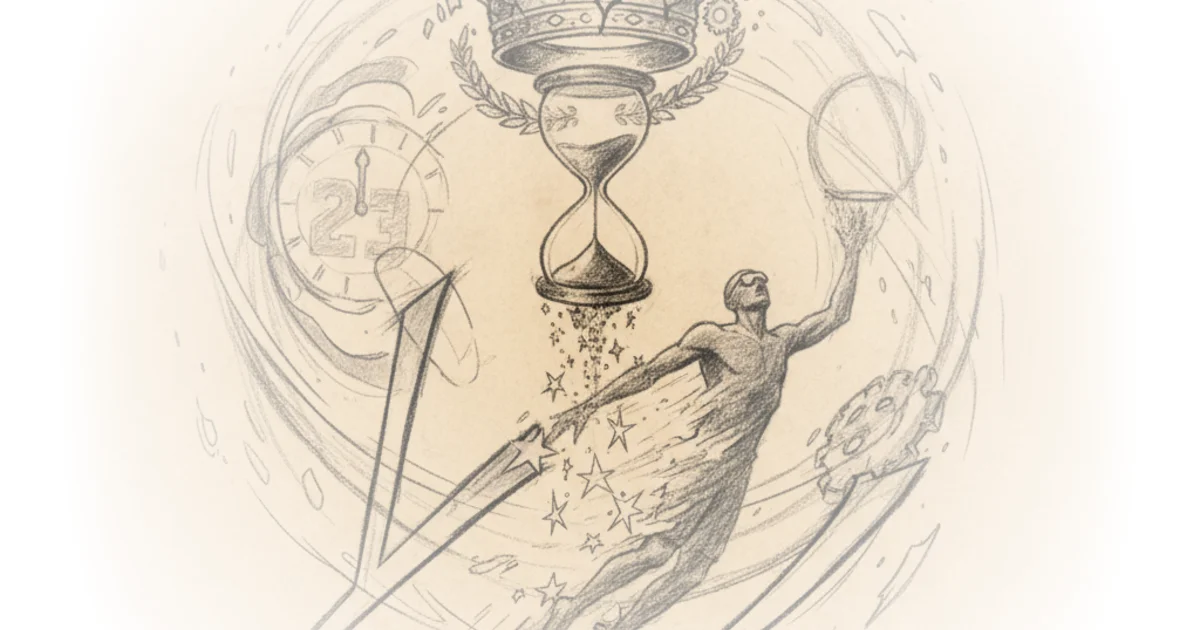
He points out that the current obsession with the "now" has flipped the script on sports history. In the past, older fans were accused of living in the past; today, the media landscape is dominated by "presentists" who assume the current generation is inherently superior. DeBoer notes, "Contemporary sports discourse is relentlessly future-facing and now-obsessed. Analysts trip over themselves to declare that today's players have rendered yesterday's obsolete." This framing is effective because it exposes the hypocrisy in how we treat historical data. We celebrate LeBron's longevity while simultaneously dismissing the dominance of players from previous eras as a product of "worse" competition or outdated rules.
Nothing is more powerful in sports analysis than presentism. Recency bias isn't just a quirk of fandom, but rather the dominant intellectual force shaping how we talk about athletics.
Critics might argue that this view underestimates the sheer weight of statistical records, which remain fixed even as memories fade. However, deBoer counters this by highlighting how quickly the narrative shifts. He reminds us that after Michael Jordan retired, his status as the greatest was treated as an "absurdity" to challenge, only for the debate to reignite within a few years. The lesson is clear: no legacy is immune to the shifting sands of public attention.
The Myth of the "Natural Athlete"
DeBoer takes aim at another pillar of modern sports discourse: the belief that today's athletes are biologically superior to their predecessors. He dismantles the idea that modern stars are "better natural athletes," arguing instead that we have simply become better at finding and developing talent. "Human evolution simply does not operate on that timescale; there has not been enough time for any meaningful, population-wide change in innate athletic capacity," he writes. This is a crucial distinction that many fans overlook. The perceived superiority of current players is a result of global scouting, advanced training science, and optimized nutrition, not a genetic leap.
He illustrates this by comparing the debate to swimming, where Michael Phelps's records have been broken, yet he remains the greatest of his era. DeBoer asks, "Does it follow that Michael Phelps is therefore not the greatest swimmer of all time? Of course not." The logic is sound: greatness is relative to the context in which it is achieved. If we accept that modern athletes benefit from decades of accumulated knowledge and technology, then comparing them directly to players from the 1960s or 1980s becomes an apples-to-oranges exercise.
Athletic greatness is not a transhistorical race conducted under imaginary neutral conditions; if it is, then the newest guy always really is the GOAT, then whoever breaks Usain Bolt's 100m record will by definition be the greatest sprinter of all time, no matter his dominance.
This argument gains even more traction when considering the specific historical context of players like Wilt Chamberlain. Just as some fans absurdly claim Chamberlain's 100-point game never happened because they lack the video evidence, the lack of context for past eras leads to a dismissal of their achievements. DeBoer notes that "box scores just can't excite the same way highlights on Twitter can," highlighting how the medium of consumption shapes our perception of history. The visual nature of modern media favors the current star, making it harder for the legends of the past to compete for attention.
The Inevitable Fade
Ultimately, deBoer's piece is a meditation on the impermanence of fame. He argues that LeBron's case for GOAT status is already beginning to crumble, not because his performance has failed, but because the cultural moment that elevated him is passing. "Once he retires, the clock starts ticking - not on his numerical achievements, which are fixed, but on his cultural centrality," he writes. This is a sobering thought for fans who believe that statistical accumulation guarantees eternal relevance.
He predicts that in twenty years, new fans will view LeBron's era with the same skepticism that current fans apply to the past. "Twenty years from now, someone will confidently explain that LeBron couldn't hang in the faster, more spaced, more analytically optimized game of 2045," deBoer writes. This cycle of revisionism is inevitable, driven by the human tendency to romanticize the present and dismiss the past. The argument is compelling because it acknowledges the emotional reality of fandom: we are always looking for a new hero, and the old ones must eventually make room.
Out of sight, out of mind is not a moral failing; it's how fandom works.
Bottom Line
DeBoer's most powerful insight is that the GOAT debate is less about basketball and more about our relationship with time and memory. While his dismissal of statistical dominance might irk data-driven fans, his analysis of cultural dynamics is undeniable. The biggest vulnerability in his argument is that it assumes a linear decline in relevance, ignoring the possibility that certain legends transcend their eras to become timeless icons. However, as the media machine continues to churn out new "generational" talents every season, the question remains: how long can any player stay in the spotlight before the next grain of sand falls?