Kings and Generals reframes the aftermath of Pharsalus not as a clean victory, but as a precarious pivot where a single assassination robbed a general of his greatest political weapon. The piece argues that Caesar's emotional reaction to Pompey's death was a calculated PR failure for the victor, transforming a defeated rival into a martyr and forcing the administration into a defensive siege in Alexandria. This is not just a retelling of battles; it is a study in how the loss of a target can destabilize an entire strategic campaign.
The Martyrdom of Pompey
The narrative begins by dismantling the assumption that the Battle of Pharsalus ended the conflict. Kings and Generals writes, "the winner was decided during the last battle [Pharsalus] but that wasn't the end of the war as Caesar had to contend with the remainder of the optimate party and external enemies." This distinction is crucial for understanding the subsequent chaos in Egypt. The author highlights a critical moment of irony: Caesar's desire to capture and pardon his rival, a standard move to legitimize his authority, was thwarted by Pompey's murder.
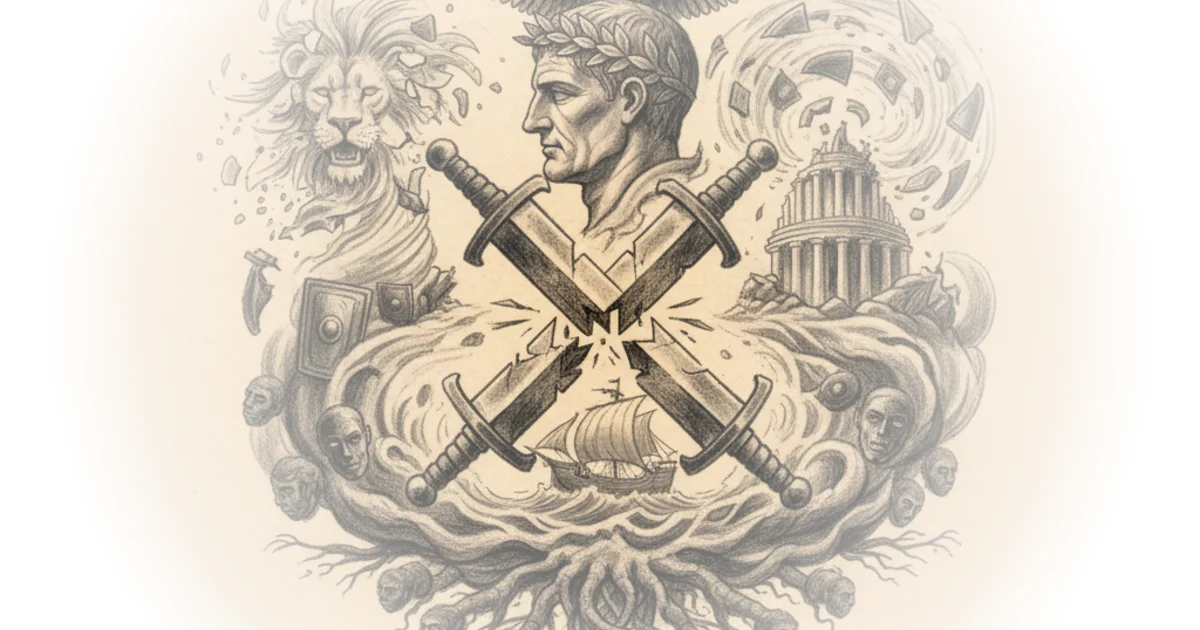
The coverage details Caesar's arrival in Alexandria, noting that "when Caesar was first presented with Pompey's head he turned away disgusted... at which point Caesar broke down in tears." Kings and Generals presents two historical interpretations of this grief: Plutarch's view of genuine sorrow versus Dio's claim that it was a performance. The commentary suggests that regardless of Caesar's true feelings, the outcome was a strategic disaster. As Kings and Generals puts it, "Pompey's assassination made him a martyr for the optimate cause something Caesar would have surely wished to avoid in Rome."
This framing effectively shifts the focus from the battlefield to the psychological and political battlefield. By removing the enemy leader, the administration lost the ability to use him as a bargaining chip or a symbol of their clemency. Critics might argue that the historical sources are too ambiguous to definitively state Caesar's frustration was the primary driver, yet the strategic consequence remains undeniable: the war of attrition continued because the war of symbols was lost.
Pompey's assassination made him a martyr for the optimate cause something Caesar would have surely wished to avoid in Rome.
The Alexandrian Siege and the Water War
The narrative then shifts to the complex dynastic struggle in Egypt, where the administration's attempt to act as an arbitrator quickly devolved into a military siege. Kings and Generals explains that the boy Pharaoh Ptolemy XIII, advised by his regent Pothinus, viewed Caesar's presence as a threat to royal authority. The author notes the high stakes: "Caesar was badly in need of money to pay his growing armies and also saw an opportunity to solidify Roman influence in the area."
The coverage details the escalation, where diplomatic overtures were met with defiance. When Caesar's emissaries were killed, the conflict turned physical. Kings and Generals writes, "Caesar was aware that he did not have enough men to fight in the open only having the 4,000 he had brought from Greece instead he ordered his men to seize the Royal quarters." This highlights the precarious nature of the administration's position; a small force was holding the capital against a massive, mobilized enemy.
The most distinctive part of this analysis is the focus on the environmental warfare tactics employed by the Egyptian commander Ganimedes. The author describes how the enemy "ordered that those sections [of the water courses] that flowed into the parts of the city controlled by Caesar be blocked and then had these sections polluted with seawater rendering them undrinkable." This detail underscores the desperation of the siege. The commentary notes that while panic set in among the troops, Caesar's leadership held firm. "He instead ordered wells to be dug day and night and fresh water was soon found avoiding disaster," Kings and Generals writes. This moment serves as a microcosm of the broader campaign: a test of logistics and will against overwhelming odds.
Naval Superiority and the 37th Legion
The piece concludes by examining the turning point of the siege: the arrival of reinforcements and the naval engagement that secured Caesar's position. The narrative emphasizes the fragility of the situation before the 37th Legion arrived. Kings and Generals writes, "Caesar badly needed these men and so leaving all his infantry to hold their positions in Alexandria he left with his Fleet... to meet the 37th on Route."
The description of the naval battle is particularly vivid, focusing on the tactical shift required when infantry was absent. The author notes, "with no heavy infantry to carry out the customary Roman tactic of boarding an enemy Caesar trusted his crew seamanship to RAM and as many ships as possible while avoiding boarding." This adaptation of Roman naval doctrine to the specific constraints of the siege is a key analytical point. The victory was not just about numbers, but about the flexibility of command. As Kings and Generals puts it, "the superior ships of Caesar's fleets were able to sink one ship and capture another with night closing in the Egyptians gave up the battle and retreated."
The arrival of the 37th Legion, bringing 5,000 men, finally broke the stalemate. The author frames this as the moment the administration regained its footing, transforming a desperate holding action into a counter-offensive. However, the coverage also hints at the lingering costs, noting that the fire in the harbor "partially burning The Great Library of Alexandria," a detail that adds a layer of historical tragedy to the military victory.
Bottom Line
Kings and Generals delivers a compelling analysis of how a political assassination can unravel a military victory, forcing an administration into a defensive siege against a fragmented but determined enemy. The piece's greatest strength lies in its focus on the logistical and psychological dimensions of the Alexandrian War, particularly the water crisis and the naval adaptation. Its biggest vulnerability is the reliance on ancient sources that may romanticize Caesar's reactions, though the strategic analysis remains robust. Readers should watch for how these early logistical constraints shaped the long-term Roman policy in Egypt.