This October roundup from Mona Mona does not merely list philosophical texts; it constructs a sharp, unsettling diagnosis of a world where technology, empire, and existential dread have fused into a single, accelerating machine. The collection's most striking claim is that the current global crisis is not a failure of policy, but the logical outcome of a system designed to extract value from human suffering and digital attention alike. For the busy reader seeking to understand the structural forces shaping late 2025, this curation offers a rare clarity: the apocalypse is not coming; it is already being managed for profit.
The Architecture of Extraction
Mona Mona opens the digital section with a searing critique of how modern crisis management has morphed into a new form of colonialism. In the piece "Argentina's Bailout and the New Digital Extractivism," the author argues that the fusion of austerity measures and artificial intelligence has created a mechanism where "the fusion of austerity and AI 'innovation' turns crisis management into a frontier for U.S. power and corporate profit." This is not a subtle observation; it is a direct indictment of how the executive branch and international financial institutions are leveraging technology to deepen inequality rather than solve it.
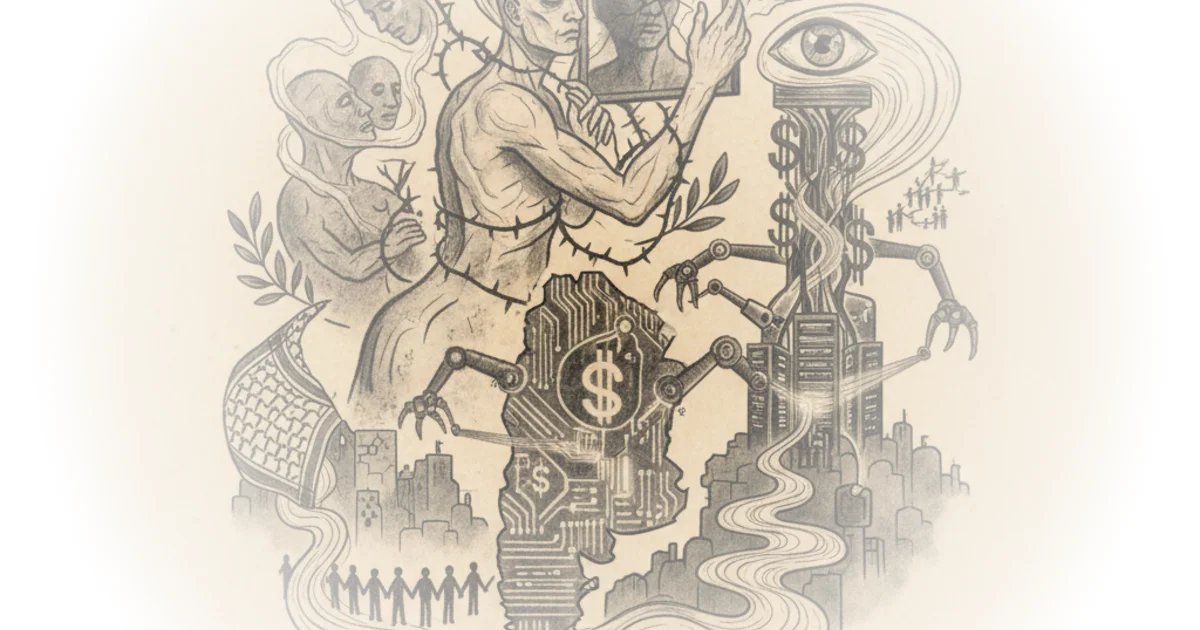
The commentary here is particularly effective because it refuses to treat AI as a neutral tool. Mona Mona writes, "The Hidden Theurgy of Information Tech" reveals that semiconductors and binary code are not just engineering feats but part of an "Arcane Art of Digital Modernity" that demands a new kind of worship. By framing technology through the lens of theurgy—an ancient religious practice—the author forces the reader to confront the quasi-religious devotion we hold for these systems. This reframing is crucial. It suggests that our reliance on these technologies is not rational but spiritual, making them harder to regulate or dismantle.
Critics might argue that equating software development with religious ritual obscures the material realities of labor and resource extraction. However, the piece's strength lies in its ability to show how the mystique of the "innovation" narrative hides the brutal mechanics of control. As Mona Mona puts it, the result is a system where "AI needs Fascism" and, conversely, "Fascism needs AI," creating a feedback loop that threatens to lock in authoritarian governance under the guise of efficiency.
The fusion of austerity and AI 'innovation' turns crisis management into a frontier for U.S. power and corporate profit.
The Theology of Power and Empire
Moving from the digital to the geopolitical, the roundup tackles the spiritual underpinnings of American foreign policy with equal rigor. In "Jesus and the Doomsday Clock, part 1: The Cross and the Sword," the author explores how apocalyptic Christianity has evolved into a dominant political theology. Mona Mona notes that this is not a fringe belief but a central driver of statecraft, where "Apocalyptic Christianity became America's new theology of power."
This section is particularly vital for understanding the current conflict in Gaza. The piece highlights the resilience of the Palestinian people, quoting Haidar Eid: "The people of Gaza did not give up, they did not surrender." This quote serves as a stark counter-narrative to the official framing of the conflict as a temporary security operation. Instead, the commentary positions the resistance as a long-term struggle against an imperial logic that views certain lives as expendable. The inclusion of this perspective ensures that the human cost remains central, refusing to let the discussion drift into abstract strategic analysis.
Mona Mona also examines the prison system in "In the shadow of an empire," arguing that it is not a failure of the system but its intended function. The author writes, "The Purpose of a System is What It Does (Not What It Claims to Do)," a line that cuts through the rhetoric of rehabilitation and reform. This argument is devastating in its simplicity: the prison industrial complex exists to manage surplus populations, not to correct behavior. The commentary here is unflinching, forcing the reader to confront the reality that the state's violence is often a feature, not a bug.
Critics might suggest that this deterministic view of the state leaves no room for incremental reform or democratic agency. Yet, the piece's power comes from its refusal to offer false hope. It demands that we look at the system's actual outputs—mass incarceration, endless war, digital surveillance—rather than its stated goals.
The Crisis of the Self and the Future
The roundup concludes by turning inward, examining how these external pressures reshape our internal lives. In "Hell is Other People (But Mostly Exes)," the author revisits Sartre to discuss shame and the lingering presence of those who know our past. Mona Mona writes, "On Sartre, shame, and the people who still know your middle name," connecting existential philosophy to the very modern anxiety of digital permanence.
This personal dimension is woven through the broader political critique. In "Only uncool losers fall in love," the author argues that "romance has lost its cool, love became cringe, and why admitting you have a boyfriend is kind of weird." This observation, while seemingly trivial, is framed as a symptom of a society where human connection is devalued in favor of productivity and self-optimization. Mona Mona suggests that the "cringe" of love is a defense mechanism against a world that demands we be efficient, not vulnerable.
The piece also touches on the "Ouroboros of Intelligence," describing the AI bubble as a self-consuming cycle of hype and investment. Mona Mona writes, "Inside the $10 Trillion AI Bubble," highlighting the absurdity of valuing speculative futures over present realities. This section serves as a warning against the seduction of technological salvationism. As the author notes, "Genesis and madness of the big tech billionaire" reveals a trajectory from the dot-com revolution to a new era of "antichrist" figures who promise to save us while building the tools of our subjugation.
The purpose of a system is what it does, not what it claims to do.
Bottom Line
Mona Mona's roundup is a masterclass in connecting the dots between high theory and the brutal realities of the present. Its strongest asset is the refusal to separate the digital, the political, and the personal; instead, it shows how they are inextricably linked in a system of extraction and control. The biggest vulnerability of the collection is its unrelenting bleakness, which risks paralyzing the reader rather than mobilizing them. However, by grounding its analysis in concrete examples—from the prison system to the Gaza resistance—it offers a clear-eyed map of the terrain we must navigate. The reader should watch for how these theoretical frameworks play out in the upcoming policy debates on AI regulation and international aid, where the gap between system claims and system actions will likely widen further.