Jeff Rich delivers a provocative historical thesis: that the current geopolitical fracture is not a temporary policy dispute, but a civilizational divorce where Europe must sever its ties with a destabilizing North American hegemon to survive. While mainstream analysis often focuses on immediate trade tariffs or election cycles, Rich frames the 2026 Davos World Economic Forum as the moment Europe declared its independence from a "mad king" across the Atlantic, arguing that the era of the "liberal international rules-based order" has collapsed into an empire of lies.
The Rupture of the Atlantic Alliance
Rich anchors his argument in a sweeping historical analogy, comparing the current moment to the fall of Rome. He suggests that empires rarely collapse in a single day but rather "crumble" and "branch off like a fern" as rival power centers seek autonomy. He writes, "In 2026 we are witnessing a process of rupture in the North American empire, or civilization state, sometimes known as the West." This framing is striking because it shifts the narrative from a diplomatic spat to an existential restructuring of global power. Rich argues that the United States, which usurped leadership in 1945, never truly achieved cohesion with Europe, citing Robert Kagan's observation that "Americans are from Mars and Europeans are from Venus."
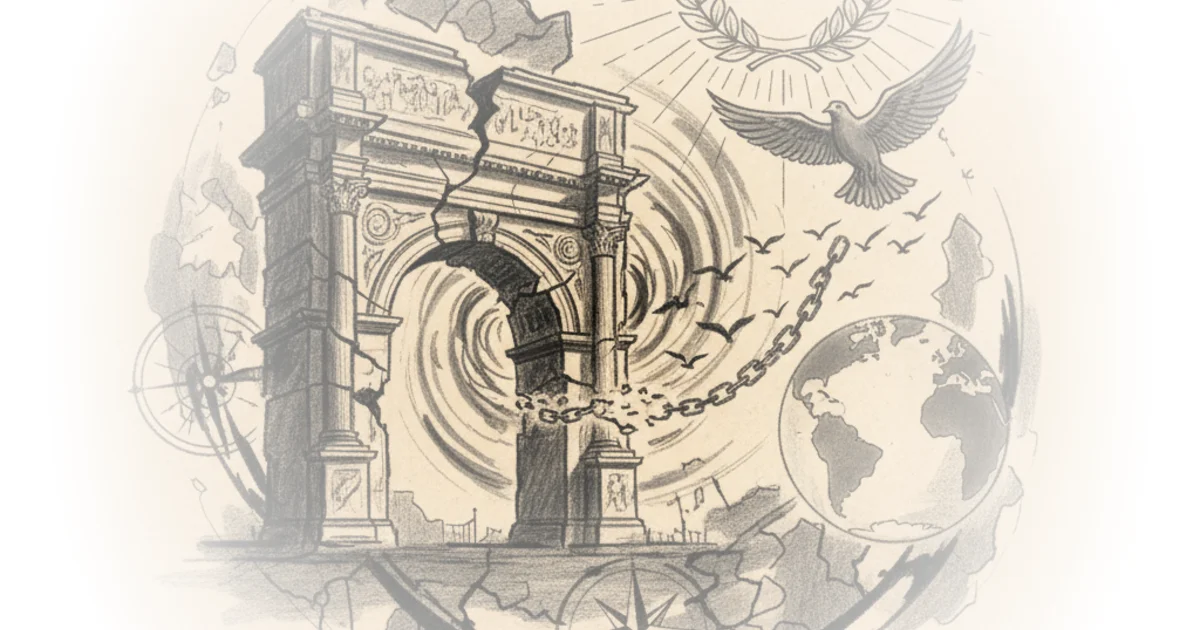
The author's central claim is that the relationship has moved beyond repair. He describes the last decade as "hell for Europe," characterized by disillusionment and what he terms "financial abuse" and "gaslighting." Rich asserts that the time for compromise has passed, stating bluntly, "Divorce the USA now; or burn with your mad king in a marriage unto death." This dramatic language serves to underscore the urgency of his argument: that continuing the alliance under current conditions is a path to mutual destruction. However, critics might note that this binary choice ignores the deep institutional entanglements—such as NATO and shared intelligence networks—that make a clean "divorce" logistically impossible in the short term.
Divorce the USA now; or burn with your mad king in a marriage unto death.
The End of Living in a Lie
Rich draws heavily on the philosophy of Vaclav Havel to explain the psychological shift occurring among European leaders. He references Canadian Prime Minister Mark Carney's invocation of Havel's essay "The Power of the Powerless," which urged dissidents to stop living in a lie. Rich interprets Carney's speech as a signal that Western elites are finally dropping the facade of the "rules-based order." He writes, "We knew the story of the international rules-based order was partially false, that the strongest would exempt themselves when convenient... But like Havel's greengrocer, Western elites and citizens chose to live in a lie."
According to Rich, the recent actions of the executive branch in Washington have forced European leaders to confront this reality. He argues that the "last year of the imploding North American empire has forced the reluctant greengrocer... to take down the signs of subordination." This is a compelling reframing of recent diplomatic tensions, suggesting they are not merely policy disagreements but a moral awakening. Yet, Rich admits that Carney's speech was a "vision of living in half-truths," noting that the Prime Minister still clung to old narratives about Russian threats. This nuance suggests that while the rhetoric of independence is emerging, the strategic reality remains mired in old alliances.
The Strategy of Eurasian Realignment
The piece pivots to a specific strategic vision for a post-American Europe, championed by European Commission President Ursula von der Leyen. Rich highlights her declaration that "Nostalgia will not bring back the old order" and her call to "build a new independent Europe." He contrasts the "petulant tariff slingers" of Washington with the patient, institution-building approach of European leaders like Emmanuel Macron. Rich argues that Europe must "seek its security in Eurasia, rather than from Eurasia," echoing a similar strategic pivot once proposed for Australia by former Prime Minister Paul Keating.
Rich's most controversial suggestion is that a reoriented Europe might find a mentor in Vladimir Putin to manage this transition. He posits that if Europe were to "do away with all the lies they have told themselves since 1991 about the world and Russia," they could repair the partition of Eurasia. He writes, "Europe will, after a decade of turmoil, abandon the identity of the West to become the plurality of Europe again." This argument challenges the dominant security narrative that views Russia solely as an existential threat, suggesting instead that the current conflict is a symptom of American domination that Europe must escape. A counterargument worth considering is that this view dangerously underestimates the immediate security risks of disengaging from the US security umbrella while facing an aggressive Russian military posture.
Europe will, after a decade of turmoil, abandon the identity of the West to become the plurality of Europe again.
Rich concludes by dismissing the idea that the current administration's actions are a temporary aberration. He argues that the "domineering stupidity of USA foreign policy" has led Europe to file for divorce permanently. He notes that while the current leadership may be forgotten in a few years, the structural shift toward a multipolar Eurasia will endure. He writes, "Trump and his cronies will be forgotten in many fewer than a thousand years," emphasizing that the historical arc is moving toward European sovereignty regardless of who sits in the White House.
Bottom Line
Jeff Rich's commentary offers a bold, historically grounded argument that the Atlantic alliance is undergoing a fundamental, irreversible rupture rather than a temporary crisis. While his dramatic framing of a "civilizational divorce" effectively highlights the deepening strategic divergence between Europe and the United States, his suggestion that Europe could find security stability through a rapprochement with Russia remains highly contentious and potentially dangerous given current geopolitical realities. The strongest takeaway is the observation that European leaders are increasingly prioritizing institutional independence over the preservation of a US-led order that no longer serves their interests.