Most histories of the Ottoman Empire begin with the fall of Constantinople or the siege of Vienna, treating the early years as a mere prologue. Kings and Generals flips this script, arguing that the empire's true genius wasn't just in its later machinery of war, but in how it survived the chaotic collapse of its own overlords. This piece offers a rare, granular look at the transition from loose tribal raiding to a centralized state, revealing that the Ottoman military machine was built on a foundation of pragmatic adaptation rather than divine destiny alone.
From Nomadic Fragments to State Power
Kings and Generals opens by dismantling the romanticized notion of the early Ottoman warrior. They write, "A common misconception that military enthusiasts often hold about early Ottoman history is that early Ottoman soldiers were simple tribal Turkman cavalry lacking tactical or technical skills." Instead, the authors present a picture of seasoned veterans who had already served as mercenaries for the Byzantines and other Islamic powers. This reframing is crucial; it suggests that the Ottoman rise was not a sudden explosion of barbarian strength, but the result of a highly skilled, mobile force that knew exactly how to exploit the weaknesses of a crumbling empire.
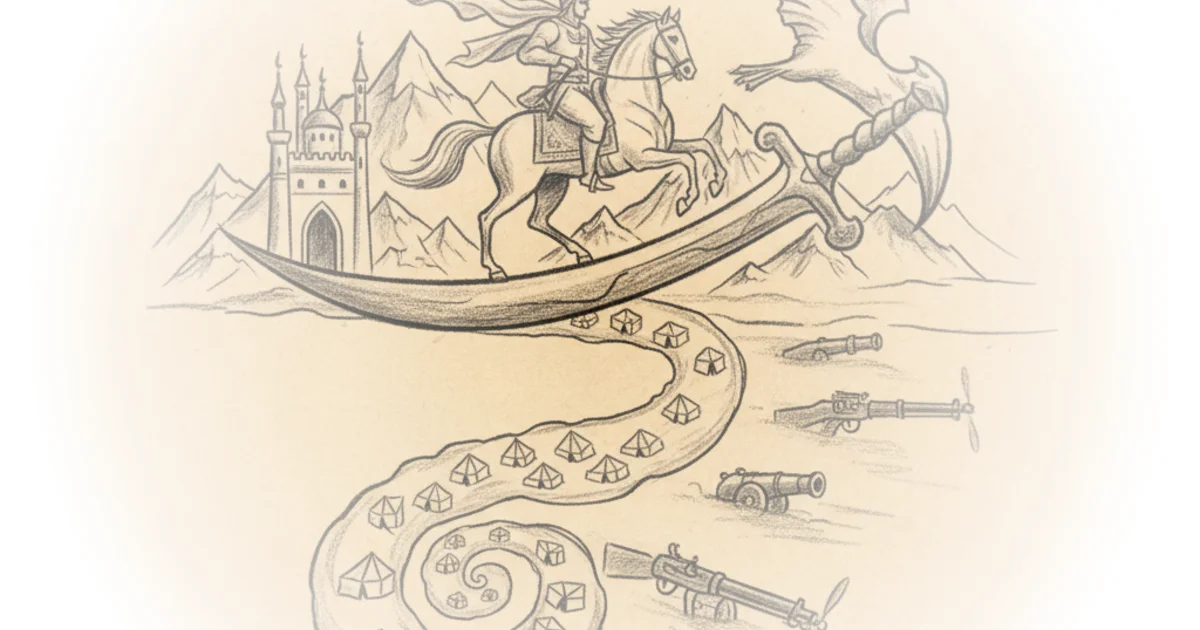
The narrative traces how the Mongol invasions of the 13th century inadvertently created the power vacuum the Ottomans would fill. As the central authority of the Seljuks disintegrated under Mongol pressure, local leaders like Osman Gazi were forced to adapt. Kings and Generals notes, "The Mongol onslaught and victory over the Middle Eastern Islamic states... uprooted the central Asian Turk tribes and forced them to migrate westward... while also destroying the effective government control that had been imposed on them." This context is vital. It shifts the blame for the Byzantine collapse from a single enemy to a systemic failure of governance, where the Ottomans were merely the most effective opportunists in a region of chaos.
The early Ottoman army's infantry was primarily composed of volunteers from the countryside, lacking a formal command structure and occasionally included some Ahis warriors.
The authors also highlight the unique role of the Ahis guilds, which functioned as more than just trade organizations. They were, in effect, paramilitary groups that provided light infantry and, more importantly, the administrative glue to hold conquered towns together. Kings and Generals explains that these guilds "consolidating the Ottomans territorial gains by establishing branches in occupied towns" and quickly organized socio-economic life. This is a sophisticated argument: the empire didn't just conquer land; it immediately installed a parallel social infrastructure that prevented the usual cycle of rebellion and abandonment. Critics might argue that this overstates the cohesion of these early guilds, as historical records from this specific period are often sparse or legendary, but the structural logic holds up against the known instability of the era.
The Mechanics of Decentralization and Control
One of the most compelling sections of the piece is its analysis of the "Gazi" raiders. These were not a unified army marching under a single banner, but rather a decentralized network of chieftains operating with significant autonomy. Kings and Generals writes, "The Turkman marcher lords tended to assign particular regions to their subordinate tribes or groups for ongoing raids after establishing a strong base of operations." This decentralized approach was a double-edged sword. It allowed for rapid, unpredictable harassment of Byzantine defenses, but it also risked fracturing the state if subordinate leaders became too powerful.
The authors point out that while other beyliks (principalities) like the Germiyanids failed to control their own subordinates, leading to their fragmentation, the Ottomans managed this differently. "The Ottomans managed this decentralization successfully and kept commanders under tight control by beginning the transformation of tribal nomadic warriors into a standing army earlier than the other baiks." This early shift toward a standing army, particularly under Osman's son Orhan, was the critical pivot point. It moved the state from a loose confederation of raiders to a centralized military machine capable of sustained siege warfare.
The piece also touches on the famous "Dream of Osman," a foundational myth where Osman sees a tree growing from his father-in-law's chest to cover the world. Kings and Generals treats this not as literal history, but as a political tool: "The tale of Osman's dream would become a significant foundational story for the House of Osman in later centuries, serving to justify Ottoman successes as divinely ordained." This is a sharp observation. It acknowledges the power of narrative in state-building without getting bogged down in the supernatural, treating the dream as a piece of soft power that legitimized the regime's expansion.
The Limits of Early Conquest
Despite their successes, the early Ottomans faced significant military limitations, particularly regarding fortifications. Kings and Generals is candid about this: "It had difficulty capturing fortified positions and castles by direct assault. This was primarily due to the lack of effective infantry and siege equipment." Instead of brute force, the Ottomans relied on bribery, surprise, and the slow strangulation of resources. The fall of Gallipoli in 1354, attributed to an earthquake, is cited as a lucky break rather than a strategic masterstroke.
This admission adds credibility to the analysis. It prevents the narrative from becoming a hagiography of invincibility. The authors note that cities like Bursa and Nicaea held out for years, causing "widespread destruction and long recovery periods." This highlights the brutal, grinding reality of the conquest, contrasting sharply with the romanticized image of swift, glorious victories. The reliance on refugees to starve out castles is a grim detail that underscores the total war nature of the conflict, where civilian suffering was a calculated military tactic.
The rapid capture of castles in Bithynia and later in Thrace depended on bribes, surprise attacks, and natural disasters, most famously seen in the fall of Gallipoli in 1354.
The commentary also explores the religious and ethnic fluidity of the early Ottoman state. Far from a monolithic Muslim crusade, the empire absorbed Byzantine governors and peasants who saw the Ottomans as a better alternative to their own failing central government. Kings and Generals writes, "As the central authority of the Byzantine court weakened in its Anatolian provinces, more and more local Byzantine governors and Christians began making individual deals with the rising Turk powers." This pragmatic coexistence, where religion was a justification but not always a barrier, explains the empire's ability to integrate diverse populations so effectively. A counterargument worth considering is whether this pragmatism was a deliberate policy or merely a necessity of survival that only later became codified as a governing philosophy.
Bottom Line
Kings and Generals succeeds in stripping away the mythological veneer of the early Ottoman Empire to reveal a pragmatic, adaptive, and often messy military evolution. The strongest part of their argument is the emphasis on the transition from decentralized raiding to a centralized standing army as the key to Ottoman survival. However, the piece occasionally leans too heavily on later chronicles to explain early decisions, a vulnerability common in medieval history. For the busy reader, the takeaway is clear: the Ottoman Empire didn't conquer the world because of a divine mandate or superior barbarian ferocity, but because it was the first to successfully institutionalize the chaos of the steppe into a stable, expanding state.