Matthew Clayfield doesn't just review films; he dissects the terrifying gap between believing in God and actually having the courage to trust Him. In a piece that weaves together personal history, film theory, and existential dread, Clayfield argues that Andrei Tarkovsky's cinema offers a far more honest, and far more painful, exploration of faith than the guilt-ridden salvation narratives of Hollywood.
The Architecture of Belief
Clayfield begins by grounding his analysis in his own background—a film school graduate and lapsed Catholic who still knows the liturgy by heart. This personal context allows him to navigate Tarkovsky's work without the pretense of academic detachment. He notes that while he initially saw Andrei Rublev as a film about a young man's bluster, he now recognizes it as a study in self-belief rather than divine intervention. "Having now watched three fairly representative Tarkovskys back to back, I think you have to admit that he is far less interested in belief than he is in faith," Clayfield writes. This distinction is crucial: belief is accepting a fact, while faith requires a leap into the unknown.
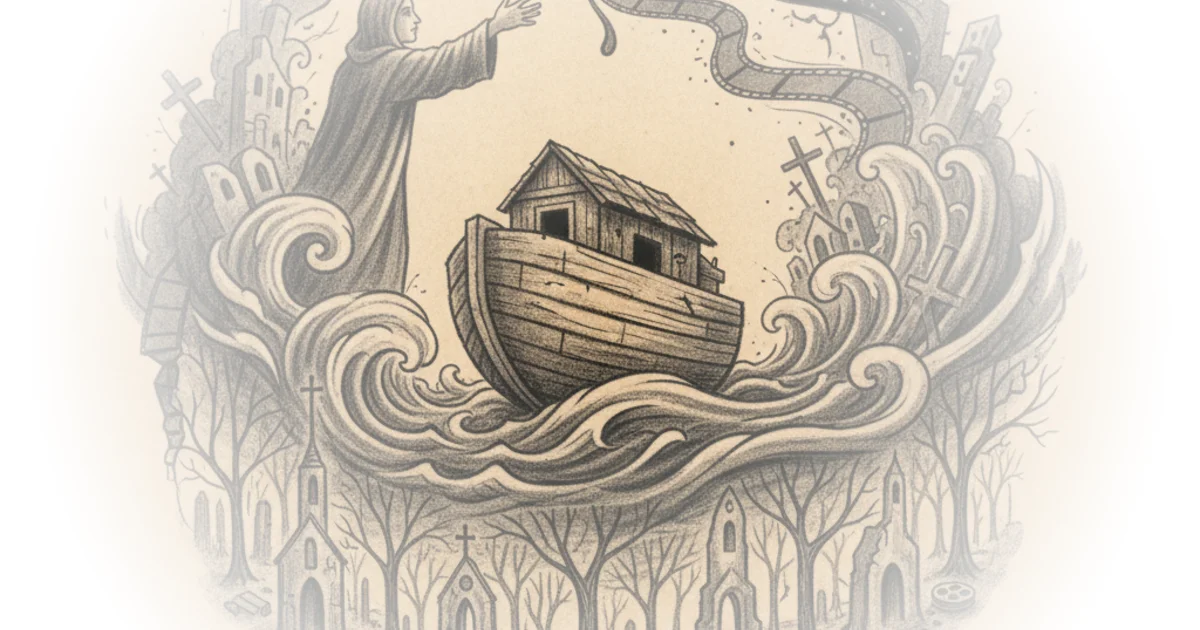
The author highlights the character of Boriska, the young bell-maker in Rublev, as the film's true spiritual center. Boriska lies to authorities, claiming his dead father told him the secret of bell-making, only to reveal he learned it through osmosis and sheer luck. "There is no suggestion, besides the fact that they're making a bell for a church, that God has been involved in the kid's success," Clayfield observes. The success of the bell, and the subsequent breaking of the protagonist's silence, suggests that art itself is the manifestation of the divine, not a transaction with it. This framing challenges the traditional religious narrative where success is a reward for piety, suggesting instead that creativity is an act of stubborn, human persistence.
"Faith, in my conception of it, requires a bit of terror, because it requires more than belief: it requires abandon."
The Tragedy of the Zone
The commentary shifts to Stalker, where Clayfield identifies the film's central tragedy not in the failure of the protagonists to reach their destination, but in the heartbreak of the guide who believes in it. The Stalker urges his companions into the Room, a place that grants one's deepest desires, but they refuse to enter, paralyzed by their own doubts. Clayfield argues that this refusal is the film's most painful moment: "The refusal of the Stalker's guests to walk through the door about as painful a thing as I have seen in the cinema." The horror here is not supernatural; it is the human inability to trust in anything beyond the tangible.
Clayfield points out the grim irony of the film's production history. Nearly everyone involved in making Stalker developed cancer from exposure to toxic chemicals, and the film's fictional "Exclusion Zone" eerily prefigured the real-life Chernobyl disaster. "Unfortunately, Stalker gave us both the visual and even literal language of 1986," he notes. This connection elevates the film from a philosophical puzzle to a prophetic warning. The characters' inability to cross the threshold mirrors humanity's collective failure to confront the existential threats we create, even when we know they are real.
Critics might argue that Clayfield's focus on the "terror" of faith overlooks the comfort that religious communities often provide. However, his point is that true faith, as depicted by Tarkovsky, is not about comfort but about the terrifying risk of trusting in the unseen. The film suggests that without this risk, we remain trapped in a world of our own making, unable to access anything greater.
Hollywood's Guilt Machine
In a sharp pivot, Clayfield contrasts Tarkovsky's cosmology with the moral framework of Hollywood. He describes the American film industry as a "guilt machine" obsessed with punishment and redemption. "Hollywood, thinking itself the Messiah, tries at least some of the time to save it instead, usually by means of, well, Hollywood," he writes. This critique extends to the Western genre, which Clayfield sees as a persistent lie America tells itself to manage its guilt over Manifest Destiny.
He argues that while Westerns often deconstruct the myth of the frontier, they ultimately rely on the same binary of good and evil, sin and salvation. "There is no salvation—and certainly no revenge—in Tarkovsky's cosmology," Clayfield asserts. "God doesn't care about you paying Him back. The only thing He cares about is submission." This fundamental difference highlights the limitations of the Hollywood narrative: it seeks to fix the world through action and retribution, whereas Tarkovsky suggests that the only true response to a broken world is a humble, terrifying submission to the unknown.
"The West is a lie that America has always told itself. Manifest Destiny was a crime."
Bottom Line
Clayfield's piece succeeds by refusing to offer easy answers, instead presenting faith as a difficult, often terrifying act of courage that stands in stark contrast to the transactional morality of popular culture. While his dismissal of Hollywood's redemptive arcs may feel harsh to those who find comfort in them, his analysis of Tarkovsky's work provides a necessary counterweight to the idea that art must always provide closure. The strongest part of his argument is the connection between the fictional "Zone" and the real-world consequences of ignoring the unknown; the biggest vulnerability is the assumption that submission is the only valid response to a broken world, a stance that may alienate readers who believe in the power of human agency to effect change.