While the box office celebrates a record-breaking opening, Kahlil Greene offers a far more provocative thesis: Spider-Man's enduring power lies not in his web-slinging, but in his birth during a moral panic that sought to erase teenagers as a legitimate cultural force. Greene reframes the superhero genre as a battleground where a teenager's financial struggle and autonomy were radical acts of defiance against a government and media apparatus convinced youth were a crime wave waiting to happen.
The Invention of the Teenager
Greene anchors his argument in the sociological construction of youth, noting that the category of "teenager" barely existed in the popular press before the Second World War. He writes, "Young people who once worked beside their parents now spent their days with each other, and they developed customs of their own, largely outside adult supervision." This shift was economic as much as it was cultural; rising wages and smaller families after the war created a "leisure class of the young," a demographic with money to spend but no social standing.
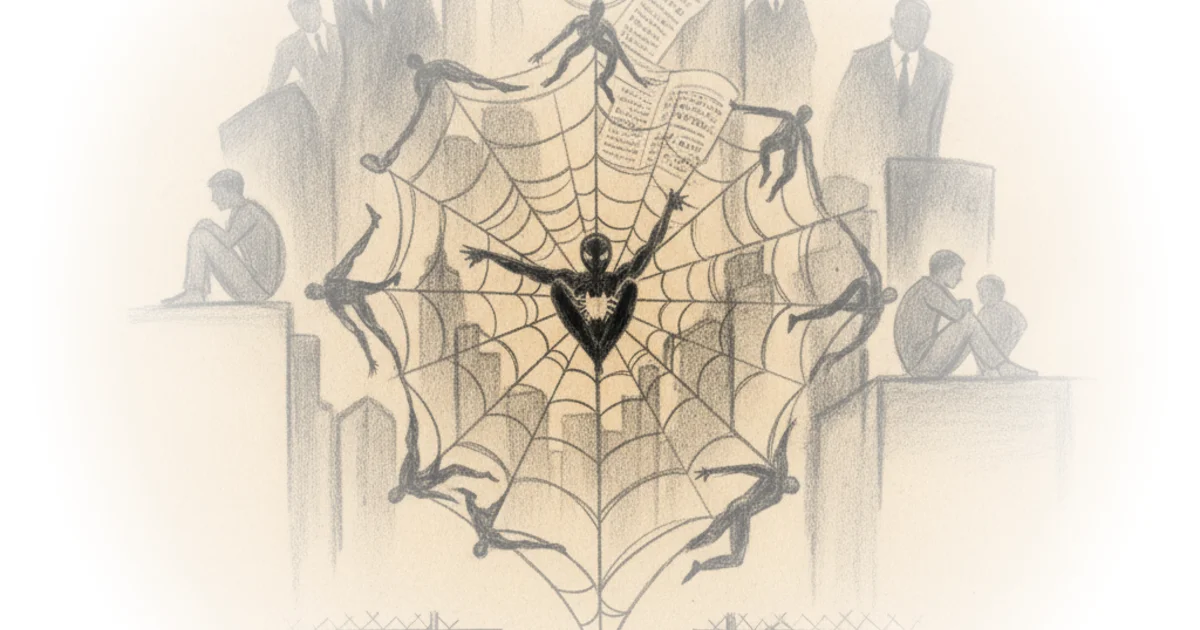
The author effectively contrasts this new reality with the establishment's reaction. In 1953, J. Edgar Hoover, director of the Federal Bureau of Investigation, published a report warning of "an appalling increase in the number of crimes" that teenagers would commit. Greene points out that the cultural response was not support, but fear. "Officials who worked with young offenders described them in terms that pointed at class as much as at crime," he notes, highlighting how the label "delinquent" was often a proxy for poverty. This framing is crucial because it establishes that Spider-Man was not just a comic book character, but a rebuttal to a specific, state-sanctioned narrative that viewed youth as inherently dangerous.
Spider-Man occupies his place in American culture because of what Stan Lee and Steve Ditko did in 1962. They made a teenager the lead in a superhero comic at a moment when American officials described teenagers as an incoming crime wave and pointed to comic books as one of the causes.
The Comics Code as Censorship
The article's most compelling evidence comes from its excavation of the Comics Code Authority. Greene details how the industry self-censored in response to the 1954 Senate hearings led by psychiatrist Fredric Wertham, whose book Seduction of the Innocent argued that comics were a leading cause of juvenile crime. Greene writes, "The code protected adults and the institutions they ran. Police officers and judges could never appear in a way that created disrespect for established authority, and good had to defeat evil in every story."
This section is particularly potent because it moves beyond the abstract idea of censorship to show its mechanical, crushing effect on creativity. Greene cites the specific metrics of the suppression: "The number of titles published fell from 650 in 1954 to 250 in 1956, and more than 800 people who made comics lost their work." The author also highlights the racial dimensions of this censorship, noting how New York City judge Charles Murphy objected to an EC story featuring a Black astronaut, demanding the artist remove the sweat from the character's face to make him more palatable. This context adds necessary depth, reminding readers that the "moral panic" of the 1950s was inextricably linked to maintaining racial and class hierarchies, a dynamic that echoes in modern debates over media representation.
Critics might argue that the Comics Code was a necessary industry survival tactic that saved the medium from total government regulation. However, Greene's evidence suggests the code was less about saving comics and more about sanitizing them to fit a conservative worldview, effectively silencing the very voices that could have challenged the status quo.
The Subversive Power of Financial Struggle
The core of Greene's argument rests on how Spider-Man broke the mold of the wealthy, adult superhero. Before 1962, heroes like Batman and Superman were defined by their resources or their invulnerability to economic hardship. Greene writes, "Until that point, American superheroes were adults, and never limited by money. Bruce Wayne inherited a fortune and paid for everything Batman used. Reed Richards built the rocket that gave the Fantastic Four their powers."
By contrast, Spider-Man was a "poor orphan who lived with his aunt and uncle in Queens," whose stories were driven by the need to pay rent and buy medicine. Greene emphasizes that "Money kept driving the stories after 1962. Peter sold photographs of himself in costume to J. Jonah Jameson... because Aunt May needed medicine and Peter had no other income." This was a radical departure. The character did not just happen to be a teenager; he was a teenager whose heroism was inextricably linked to his economic precarity. Greene argues that this resonates today because it "rejected the premise adults held about young people in 1962."
The author notes that even the Comics Code Authority eventually had to loosen its grip when Lee published a story about drug use in 1971 without the seal, proving that the public's appetite for realistic, complex stories was stronger than the code's restrictions. This historical arc serves as a powerful reminder that cultural progress often comes from the margins, from creators who refuse to accept the limits imposed by authority.
Bottom Line
Kahlil Greene's piece succeeds by reframing a pop culture icon as a historical artifact of resistance, proving that Spider-Man's greatest superpower was his ability to humanize a generation that the state was trying to criminalize. The argument's strength lies in its rigorous use of historical data to dismantle the myth of the "natural" superhero, revealing instead a character born of specific political and economic tensions. The only vulnerability is the assumption that this subversive origin story is still fully understood by modern audiences, who may consume the character's struggles as mere entertainment rather than political commentary.
Spider-Man was the first teenage superhero to carry a book instead of assisting an adult, and the first whose stories were driven by financial struggle.