Richard Hanania delivers a provocative, evolutionary-psychology-infused argument that flips the standard script on gender equity: he claims that because women are hardwired to value male status and resources, society should arguably prioritize men in hiring to boost family formation. This is not a call for traditionalism in the abstract, but a cold, utilitarian calculation suggesting that the current economic landscape is actively dismantling the mating market for average men. For busy readers tracking the collapse of marriage rates and the rise of male despair, Hanania offers a stark, if controversial, diagnosis: the problem isn't just culture, it's a mismatch between modern labor markets and ancient biological imperatives.
The Economics of Attraction
Hanania's core premise rests on a specific interpretation of evolutionary biology. He argues that while a dollar holds equal purchasing power for men and women, its social utility is vastly different. "A dollar is worth a lot more to a man than a woman," he writes, "in the same way that it matters more to a poor person than a rich person." He posits that because women have historically been the primary caregivers, their mate selection criteria remain anchored in resource acquisition, a trait that hasn't vanished despite modern economic independence. This framing forces a confrontation with the idea that "sexual equality" in the workplace might be a net negative for social stability.
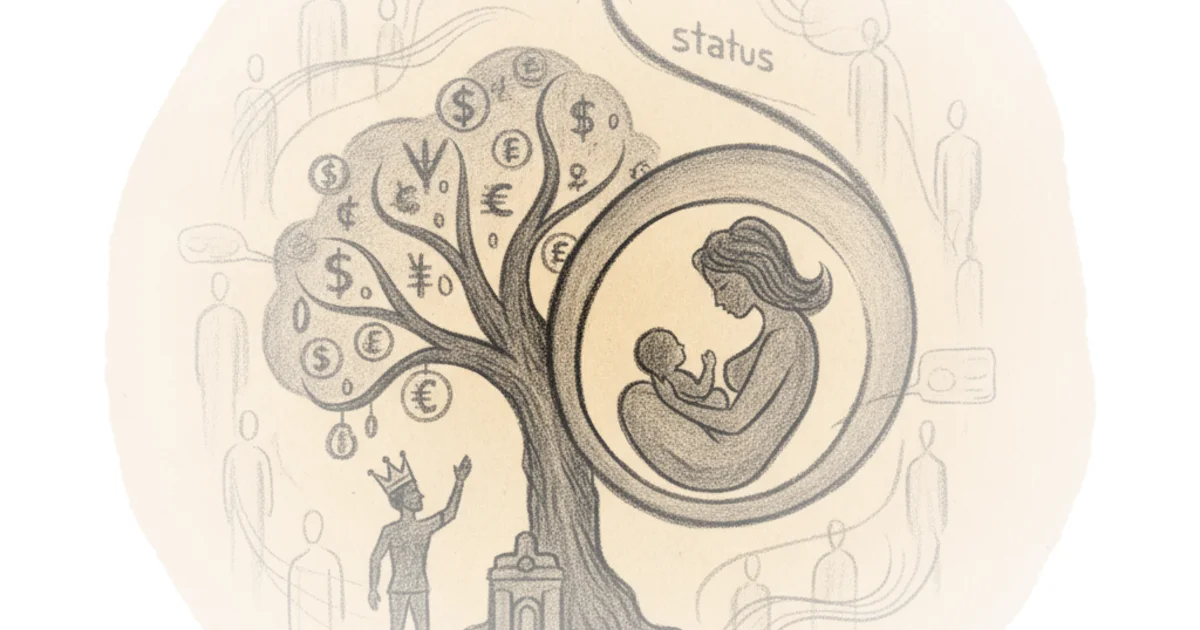
The author leans heavily on data regarding lottery winners to illustrate this point. He notes that "men who won were more likely to get married and have children, while married women who won got divorced at nearly double the baseline rate." This statistic is the engine of his argument: if a woman's sudden wealth destabilizes her marriage, then policies that elevate female earning power relative to men could be inadvertently destroying families. Critics might note that this correlation ignores the complex social dynamics of divorce or the possibility that high-earning women simply have more options, but Hanania treats the data as a direct causal link to be managed by policy.
This logic leads him to a radical conclusion regarding labor markets. "Giving the man the job is more likely to create a family, while giving the woman the job might destroy one," he asserts. He suggests that the standard economic argument against job protectionism—"Destroying jobs is how progress happens"—should be suspended in this specific domain because the goal shifts from aggregate GDP to social reproduction. He argues that prioritizing men in hiring is "basically the equivalent of waving a magic wand and making all women more physically attractive to the opposite sex, but doing it for men instead."
Giving the man the job is more likely to create a family, while giving the woman the job might destroy one.
The Trap of Modern Populism
Hanania then pivots to critique the right-wing economic populists who claim to want to restore traditional family structures. He argues that groups like American Compass and figures like JD Vance are trapped in a cognitive dissonance. They want the social outcome of a male-breadwinner society but refuse to admit that the mechanism requires suppressing female status. "Right-wing economic populism simply makes everyone poorer without doing anything for family formation," he claims, because they are trying to engineer a specific gender dynamic through bad economic policy like tariffs.
He points out the absurdity of politicians promising a return to the 1950s lifestyle on a single salary without specifying that the earner must be male. "Most women are not going to marry you if that's all you can provide," Hanania writes, dismantling the populist fantasy of a single-income household in a modern economy. He suggests that these movements are essentially "hiding their ultimate motivations"—the desire to keep men above women in the status hierarchy—which makes their economic proposals incoherent.
This section highlights a fascinating tension in the author's worldview. He acknowledges that "women caring more about a partner's income is another good reason to get rid of affirmative action and anti-discrimination laws meant to help women." Yet, he simultaneously argues that even if we remove these barriers, the market dynamics have shifted too far. The decline of physical labor and the rise of service/intellectual jobs has eroded the natural status advantage men once held. He lists four trends that have reduced male status: "the decline in religion, the decline in the value of physical labor relative to social skills and intellectual labor, birth control making pregnancy optional, and government programs and initiatives to benefit women."
The Male Status Paradox
The most biting part of Hanania's analysis is his concept of the "male status paradox." He argues that men need high status to attract partners, but the very act of demanding special treatment or protection destroys that status. "Men need higher status than women to have reproductive success, but a man arguing that case loses status," he explains. This creates a self-defeating loop where men who voice grievances about their dating prospects are viewed as "losers," which further reduces their mating value.
He draws a sharp contrast between this modern desperation and the historical role of religion. Religion, he argues, was the ultimate solution to this paradox because it outsourced the enforcement of male status to a divine authority. "Religion creates patriarchy without men directly having to argue for it," Hanania writes. "Look, honey, I'd love for you to have equal rights and responsibilities, but it's just not in God's plan." This allowed men to maintain the status required for attraction without having to explicitly state, "I need you to be less successful than me."
The author suggests that without this religious framework, and with an economy that no longer favors male physical strength, the system is broken. He notes that in a hypothetical trad movement that took power, the result would likely mirror Iran: "you would win over some of the lower classes but get massive resistance among the more educated segments of the public, particularly women." The resentment of high-status women would likely outweigh any gains in male attractiveness.
Men need higher status than women to have reproductive success, but a man arguing that case loses status.
Hanania also touches on the "hedonic treadmill" of human desire, noting that preferences don't just update to match modern conditions. He uses the example of breast size preferences to illustrate that "attraction doesn't work like that." Even if biological signals like energy reserves are less relevant in a world of abundant calories, the preference remains. Similarly, "female preferences can't just 'get with the times' because we've achieved greater sexual equality in the economic realm." This biological determinism is the bedrock of his argument, suggesting that policy cannot easily override deep-seated evolutionary drives.
Bottom Line
Hanania's strongest contribution is his unflinching link between labor market dynamics and the mating market, forcing readers to confront the possibility that gender-neutral economic policies may have unintended demographic consequences. However, his biggest vulnerability lies in his reliance on a rigid biological determinism that may underestimate the fluidity of human relationships and the potential for cultural adaptation. The reader should watch for how this "male status paradox" plays out in the coming decade as the service economy continues to expand and the traditional markers of male status further erode.