Astrology as Geopolitical Framework: Bold Claims, Familiar Patterns
Alexandra Stanko's 2026 forecast for The Cosmic Companion is an ambitious piece that weaves planetary alignments into a sweeping narrative about technology, warfare, and political upheaval. The article positions the Saturn-Neptune conjunction at zero degrees Aries as nothing less than humanity's threshold into a new era. It is, at its core, a work of mythological storytelling dressed in the language of celestial mechanics, and it deserves examination on both counts.
The most striking aspect of the piece is how confidently it maps astrological symbolism onto real-world developments that were already underway well before any planetary alignment. Stanko writes that the "talent triangle" formed by Pluto, Uranus, and Neptune will drive the AI revolution and a new space race:
Pluto in Aquarius, indicating the increasing power of future-oriented and digital corporations ('Big Tech'), aligns harmoniously with Uranus in Gemini, symbolizing a rapid 'collective learning process' or the mining, processing and use of collective digital data -- in short: the further development of artificial intelligence.
This is a reasonable description of what has been happening since at least 2022, when large language models exploded into public consciousness. The question any skeptical reader must ask is whether the astrological framework adds explanatory power, or simply provides a poetic overlay for trends that economists, technologists, and political scientists have been tracking through entirely terrestrial methods.
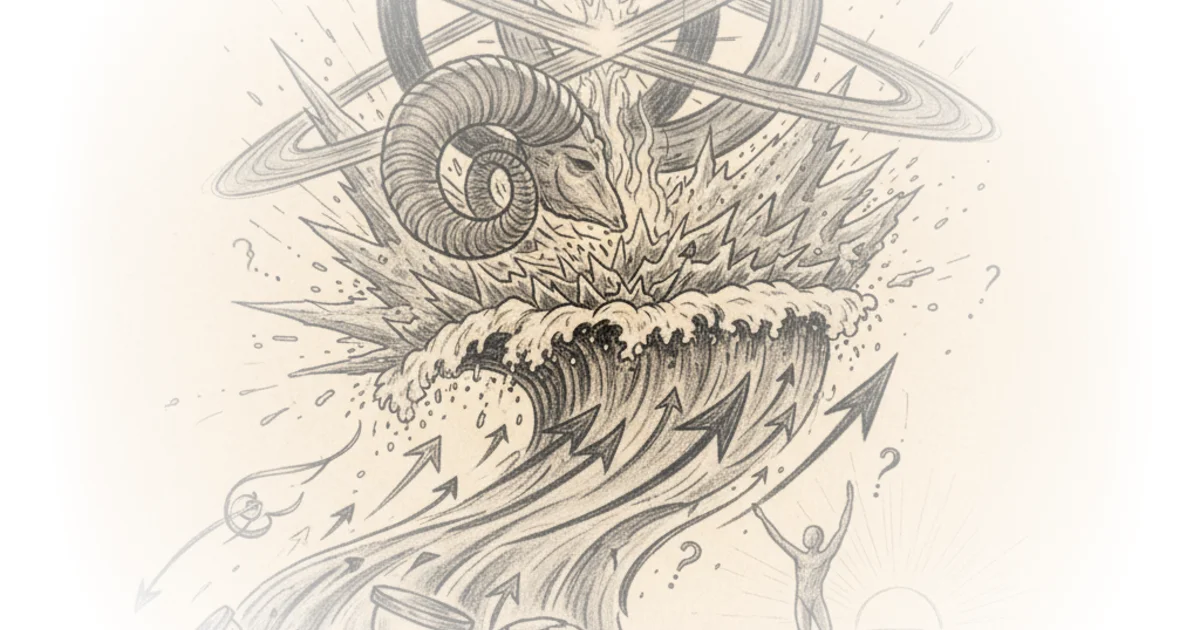
The Warrior Myth and Its Dangers
Stanko's treatment of Neptune in Aries is the most intellectually interesting section of the article. She argues that the sign Neptune occupies shapes the collective imagination for an entire generation, and that Aries will usher in an era where the warrior archetype dominates cultural narratives:
With Neptune being in the sign of Aries from 2026-2037, it's the archetype of the warrior and the story of survival, self-assertion and victory which will be "in fashion" and tend to get glorified.
To her credit, Stanko does not romanticize this. She warns that the glorification of warrior energy can be weaponized by authoritarian leaders who might "justify their aggression as being a form of 'God's wrath.'" This is a genuinely useful observation, even stripped of its astrological dressing. Societies do cycle through dominant myths, and the strongman narrative has been ascendant globally for years. Whether Neptune's position causes this or merely coincides with it is a question the article does not and cannot answer.
The counterpoint Stanko offers is that Aries also represents innocence and idealism, comparing it to spring shoots piercing through earth toward sunlight. This duality -- the warrior who destroys and the pioneer who creates -- is psychologically rich territory. But it is also a hedge. By presenting both possibilities, the forecast becomes unfalsifiable. Whatever happens in the next decade can be retroactively attributed to one face of Aries or the other.
Saturn in Aries and the Return of Conscription
The article's most concrete and testable claim concerns Saturn's transit through Aries and its connection to military preparedness. Stanko notes that European nations, particularly Germany, have been discussing compulsory military service in response to the Russian threat:
As we have already seen since last summer, when Saturn dipped into Aries for the first time, the dominant political concern has shifted from regulating the state support of the disadvantaged and needy and curbing the incoming stream of refugees (Saturn in Pisces) to military preparedness (Saturn in Aries).
This is largely accurate as a description of European political discourse. Germany's debate over conscription, Finland and Sweden's NATO membership, and broader European rearmament are well-documented trends. The causal claim -- that Saturn's ingress into Aries drove this shift -- is where mainstream analysis would part company with astrology. Defense analysts would point to Russia's invasion of Ukraine in February 2022, the subsequent degradation of European security assumptions, and the Trump administration's uncertain commitment to NATO as sufficient explanations.
Stanko also raises an intriguing point about the difficulty of distinguishing real threats from fabricated ones during the Saturn-Neptune conjunction, noting it "will probably be difficult to tell apart" whether hostile forces within a country represent genuine dangers or manufactured crises. In an era of deepfakes, information warfare, and political polarization, this observation resonates regardless of one's views on planetary influence.
The Jupiter-Pluto Opposition: Autocracy Versus Democracy
The article's discussion of Jupiter entering Leo and opposing Pluto in Aquarius is framed as a tension between autocracy and democracy. Stanko reaches for historical analogy, invoking Lyndon B. Johnson, who had Jupiter in Leo in his birth chart:
I am reminded of President Lyndon B. Johnson, who had Jupiter in Leo in his natal chart, and his vision of a "Great Society" and his pledge to redouble the war on poverty, but also his personal pride that prevented him from withdrawing from Vietnam, which resulted in a disaster.
This is an effective rhetorical move. Johnson's presidency is a case study in how grandiose vision and stubborn pride can coexist in the same leader, producing both the Civil Rights Act and the escalation in Vietnam. Whether Jupiter in Leo was the cause or merely a symbolic parallel is beside the point for most readers; the historical lesson stands on its own merits.
The broader claim about autocracy versus democracy, however, deserves scrutiny. This tension did not begin with any planetary opposition; it has been the central political story of the 2020s. From Hungary to Brazil to the United States, democratic institutions have faced sustained pressure from populist and authoritarian movements. Framing this as a Jupiter-Pluto opposition risks implying that the crisis is cosmically ordained rather than the product of human choices that can be resisted through human action.
What the Forecast Gets Right
Stripped of its astrological apparatus, the article identifies several trends that most serious analysts would endorse: the accelerating pace of AI development, the militarization of European politics, the tension between democratic norms and authoritarian impulses, and the psychological toll of increasing digital abstraction on daily life. Stanko writes perceptively about this last point:
The collective life has shifted from tangible concerns and personal interaction to abstract digital connectedness. The emphasis on the element of fire in 2026 and 2027 might be a welcome and needed vitality injection to counterbalance the increasing abstraction in our daily lives.
The desire for re-embodiment, for something visceral and immediate to counterbalance the screen-mediated flatness of modern existence, is a theme that runs through contemporary culture from the rise of cold plunges to the return of vinyl records. Whether fire signs provide this counterbalance or whether people simply need to go outside more often is a matter of interpretive preference.
Bottom Line
Stanko's 2026 forecast is a well-constructed piece of astrological writing that succeeds more as cultural commentary than as prediction. The article's strength lies in its mythological framework -- the warrior archetype, the tension between structure and dissolution, the cycle of fire and restraint -- which provides a language for discussing real anxieties about technology, conflict, and democratic decline. Its weakness is the weakness of all astrological forecasting: by covering enough possibilities, it becomes difficult to imagine any outcome that would not confirm the reading. Readers looking for a poetic lens on the year ahead will find it rewarding. Those seeking falsifiable predictions will find the hedging frustrating. The article is at its best when it asks questions rather than offers answers, and when it treats planetary symbolism as a mirror for human psychology rather than a map of predetermined events.