The Monster We Recognize
Myles Werntz has spent a career wrestling with George Saunders' central contradiction: that we are loving creatures capable of creating monstrous worlds. In his latest piece on Saunders' novel Vigil, Werntz asks whether mercy might be the only answer to a life that cannot be untangled.
The Secular Saint of Horror
Saunders has become something of a secular saint, a writer whose sense of the world's abounding horrors is balanced with a trademark humor and humanity. Werntz notes that Saunders' framework has long been class and the economy. In stories like "The Semplica-Girls Diaries," migrants make a living as front-yard ornaments for the wealthy. In "Escape from Spiderhead," experiment subjects work off their debt in pleasure research centers.
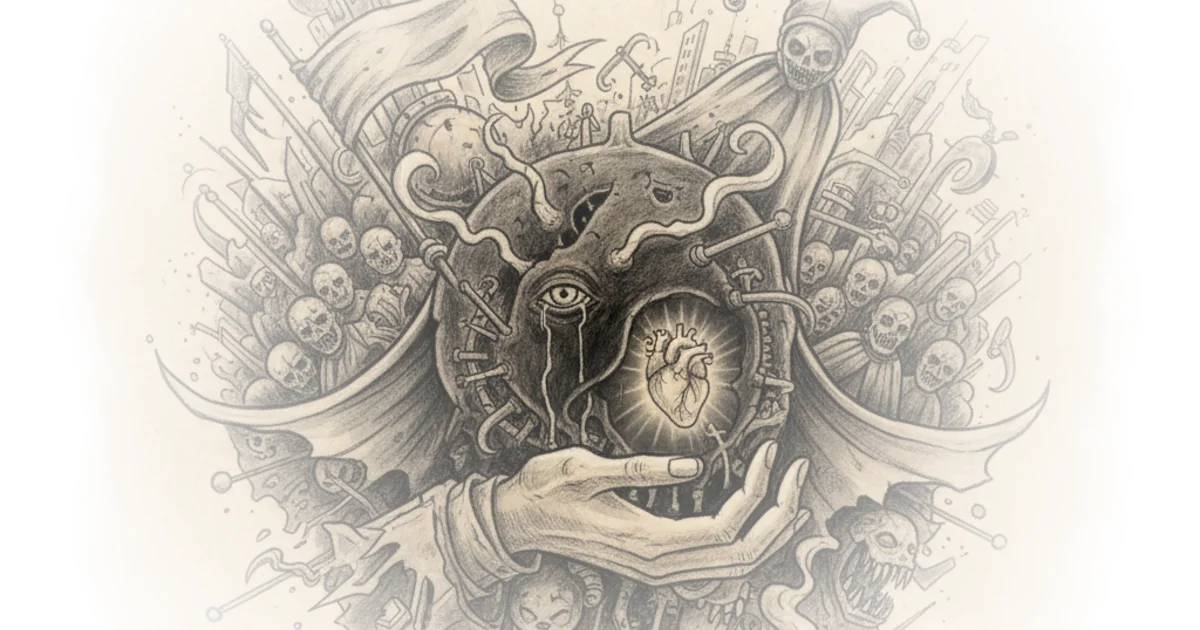
As Werntz puts it, "Saunders has spent a career unpacking one of the central contradictions of life: that we are loving creatures capable of creating monstrous worlds."
The trick Saunders pulls is refusing despair. A story about migrants selling themselves as animatronics could easily become a threadbare morality play. It would be easy to tell a story of political autocracy remorselessly. But such stories would also be incredibly boring, and arguably less true.
"Even dictators have mothers, and even monsters want to have a friend."
Werntz writes that "intertwined throughout these stories of rapacious capitalism, is an undercurrent of empathy." The protagonist of "Semplica-Girls" is a middle-class man trapped in the rat race who hires the lawn ornaments to elevate his social status. Saunders juxtaposes the girls' suffering with the love the protagonist has for his children, and his sincere desire to help them be respected in the world.
Critics might note that this empathy feels gauche in an age of government malice towards its citizens. It doesn't square with our desire for justice, much less our hope to see the powerful and unjust have their day of reckoning.
Death as Amplification, Not Relief
Saunders' vision of the afterlife differs sharply from recent literary depictions. Werntz observes that many contemporary writers treat the Great Beyond as a place of silence—a pivot from chaos. J.K. Rowling offers a quiet train station. Matt Haig presents a library of possibilities. Alice Sebold gives us an omniscient narrator in a quiet space.
Saunders draws from an older tradition. In Dickens' "Christmas Carol" or Dante's Divine Comedy, the afterlife is one in which the wildness of life is amplified. Death is not relief from the injustice of life, but a place to contend with it even more directly.
As Werntz writes, "Saunders' vision in Lincoln in the Bardo is of an afterlife teeming with real work to be done, with the dead carrying their lack of resolution around in the form of engorged genitalia and multiplying eyes instead of chains and lockboxes."
In a recent interview, Saunders notes that the three truths of facing death appear as "you're not permanent; you're not the most important thing; you're not separate." In death, every person is faced with the fact that they are—in the end—a character in a larger drama.
The Dying Oil Man
Vigil centers on K.J. Boone, a dying man in his Dallas home. Boone brings with him a long legacy of oil production, climate change denial, and wealth. Werntz writes that "it is easy to read Boone as a buffoonish cartoon, but the longer we stay with him, the more Saunders helps us to be sympathetic to a man whose career was spent making billions off of misinformation and denial."
Chief among the spirits attending to Boone is Jill Blaine, midwife to hundreds of souls. Her aim is not to change the dying, but to comfort them. Werntz notes that "Jill's approach to the contradictions of love and horror is not the resolution on offer." Alongside her are spirits aiming for retribution.
Werntz writes, "Jill helps us to see Boone for what he is: a man who has devoted his whole life, shaped his family existence, built out his most strongly held values around the proposition that the world needed oil to keep on spinning."
The other spirits assume a dying person might be compelled to see their whole life as a mistake. But Jill understands that at the end, we see our lives as knots that cannot be easily untangled. Werntz puts it sharply: "to recant a life is not just to recant one's sins, but the love that made those sins possible."
Critics might note that Boone as a villainous, self-assured antagonist feels strained at times—a Jay Gatsby for the climate era. And Saunders sometimes leans too heavily on his spirit-world conventions, with spirits who poop out smaller versions of themselves overshadowing the more subtle lead spirit Jill.
Elevation Beyond Justice
What Werntz identifies as Saunders' most powerful truth is the concept of "elevation." In the world of Vigil, the term signifies a goal for souls that exists beyond the categories of repentance and retribution. Werntz writes that "because we are capable of both great love and great devastation, the aim of our lives must not be simply to seek justice against wrongs or to atone for our wrongdoings, but to seek mercy for ourselves and others."
Both the dying and the spirits are in search of mercy—that elevation of the soul—that will help them acknowledge that both the love they had in life and the wrong they did were equally true.
As Werntz concludes, "What Saunders points us to, ultimately, is not repentance but mercy, with ourselves and others."
Bottom Line
Werntz has identified something rare in Saunders' Vigil: a theology of mercy that refuses both cheap forgiveness and pure retribution. The novel asks whether a life built on love and devastation can be reconciled without denying either truth. Werntz's answer—that elevation beyond justice is the only synthesis—may perplex readers seeking moral clarity. But it may also be the most honest response to a world where monsters love their children and oil men honor their parents.